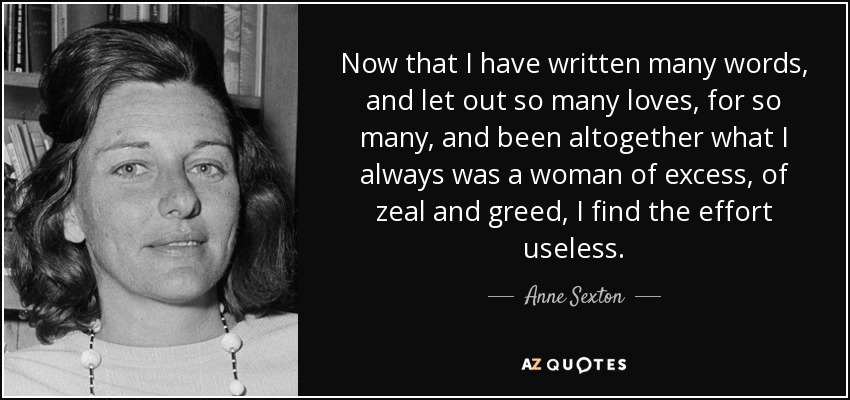
Now that I have written many words, and let out so many loves, for so many, and been altogether what I always was a woman of excess, of zeal and greed, I find the effort useless.
I am not lazy. I am on the amphetamine of the soul. I am, each day, typing out the God my typewriter believes in.
I tell it stories now and then and feed it images like honey. I will not speculate today with poems that think they're money.
I was only sitting here in my white study with the awful black words pushing me around.
I said, the poets are there I hear them singing and lying around their round table and around me still.
Poets are sitting in my kitchen. Why do these poets lie? Why do children get children and Did you hear what it said?
My business is words. Words are like labels, or coins, or better, like swarming bees.
You must be a poet, a lady of evil luck desiring to be what you are not, longing to be what you can only visit.
Walter Scott has no business to write novels, especially good ones. He has fame and profit enough as a poet, and should not be taking the bread out of other people's mouths.
Poetry is a very complex art.... It is an art of pure sound bound in through an art of arbitrary and conventional symbols.
In verse one can take any damn constant one likes, one can alliterate, or assone, or rhyme, or quant, or smack, only one MUST leave the other elements irregular.
If a poet has any obligation toward society, it is to write well. Being in the minority, he has no other choice. Failing this duty, he sinks into oblivion. Society, on the other hand, has no obligation toward the poet.
That the mere matter of a poem, for instance--its subject, its given incidents or situation; that the mere matter of a picture--the actual circumstances of an event, the actual topography of a landscape--should be nothing without the form, the spirit of the handling, that this form, this mode of handling, should become an end in itself, should penetrate every part of the matter;Mthis is what all art constantly strives after, and achieves in different degrees.
The difference between prose logic and poetic thought is simple. The logician uses words as a builder uses bricks, for the unemotional deadness of his academic prose; and is always coining newer, deader words with a natural preference for Greek formations. The poet avoids the entire vocabulary of logic unless for satiric purposes, and treats words as living creatures with a preference for those with long emotional histories dating from mediaeval times. Poetry at its purest is, indeed, a defiance of logic.
Happy you poets who can be present and so present by a simple flicker of your genius, and not, like the clumsier race, have to laya train and pile up faggots that may not after prove in the least combustible!
Multitude, solitude: equal and interchangeable terms for the active and prolific poet.
Democritus maintains that there can be no great poet without a spite of madness.
The only refuge left to us was the poet's ivory tower, which we climbed, ever higher, to isolate ourselves from the mob.
A lot of artists start out as failed poets, then move on to being failed short-story writers before they finally break through to the big time and become failed novelists.
Poets and kings are but the clerks of Time, Tiering the same dull webs of discontent, Clipping the same sad alnage of the years.
Printed prose is historically a most peculiar, almost an aberrant way of telling stories, and by far the most inherently anesthetic: It is the only medium of art I can think of which appeals directly to none of our five senses. The oral and folk tradition in narrative made use of verse or live-voice dynamics, embellished by gesture and expression--a kind of rudimentary theater--as do the best raconteurs of all times. Commonly there was musical accompaniment as well: a kind of one-man theater-of-mixed-means.
It is an evil world. The fires of hatred and violence burn fiercely. Evil is powerful, the devil covers a darkened earth with hisblack wings. And soon the end of the world is expected. But mankind does not repent, the church struggles, and the preachers and poets warn and lament in vain.
Goodbye, you who are, for me, the postmarks again of shattered towns--Xenia, Burnt Cabins, Hornell-- their loneliness given away in poems, only their solitude kept.
Look at this poet William Carlos Williams: he is primitive and native, and his roots are in raw forest and violent places; he is word-sick and place-crazy. He admires strength, but for what? Violence! This is the cult of the frontier mind.
The great charm of poetry consists in lively pictures of the sublime passions, magnanimity, courage, disdain of fortune; or thoseof the tender affections, love and friendship; which warm the heart, and diffuse over it similar sentiments and emotions.
Follow AzQuotes on Facebook, Twitter and Google+. Every day we present the best quotes! Improve yourself, find your inspiration, share with friends
or simply: