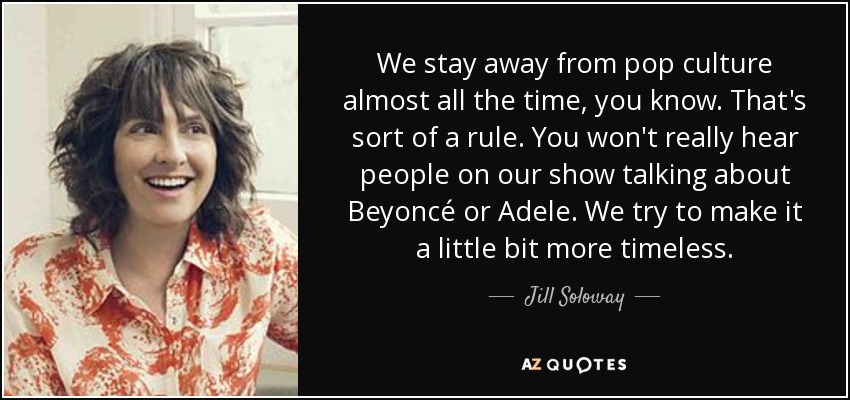
We stay away from pop culture almost all the time, you know. That's sort of a rule. You won't really hear people on our show talking about Beyoncé or Adele. We try to make it a little bit more timeless.
It's funny how film is the slowest art form to adapt to freedom. It's had freedom all along. It could've done whatever it wanted to. You know the same freedom that do-it-yourself punk and post-punk musicians had in the late 70s and ever since. That's about the time I started getting interested in film, and I assumed that film would be moving along with the other pop culture forms. Its finally done it but it's taken decades for it to catch up just to basement band level.
I'm a pop culture junkie. I'm a People magazine reader, an US Weekly subscriber; all of those celebrity magazines get my dollar.
My mom was a big Elvis fan and a general pop culture buff, and so I grew up in a house filled with what were then called "movie magazines,"Before Elvis when Rhona Barrett wrote her column about the stars. And so it seeped in.
MTV Awards are fun - it's MTV! You never know what's going to happen. It's a slice of pop culture in the moment, and you can't take it too seriously.
I allude to Back to the Future in the 1985 story to let folks know it was an inspiration and because it literally was the most time-travelly bit of pop culture we had in the mid 80's. I can talk about their tools for considering change. First, the book is metafictive in a traditional sense where I'm showing and telling the reader that the act of writing and reading is a reflexive way to push boundaries of real and literal time travel. Writers and readers are time travellers. The question is what we do with that time we traveled when we leave a book, leave a page.
Why is thinking about crime or imagining crime so goddamn central to pop culture? It doesn't matter whether it's American TV or British TV. And there's entire sections of bookstores devoted to crime.
I just see in pop culture, music, visual art, books, etc., a real hunger for the new and different, and I think that's amazing. Satisfying this hunger is part of the responsibility of a creative person.
It's a matter of resisting what something made you feel before. And resisting that as a consumer is not easy. I know it isn't for me, and not just when I consume pop culture. When I go into a book and it feels too familiar, I don't have the energy to do it. My whole reason for reading it is to be in a fictive space that is unfamiliar to me.
I take pop culture really seriously, I think it's really important, and the stuff that I make...I don't want it to be insubstantial, even if it's about something wacky, like sharpening pencils. I feel like I owe it to myself and I owe it to people who are really interested in pencils and I owe it to anybody to do my due diligence and give them something real.
I think American culture had just become so disengaged from the process of government, and we'd been so fuzzed out by our pop culture around us, that I don't think people really saw this guy for what he was.
I just remember lot of men running around in little tiny gold shorts! The format - it was kind of hard. You really have to know about pop culture and I'm not really knowledgeable about a lot of those things. I know what I like. They'd ask about Gwyneth Paltrow, and I don't know anything about her, except her mother. I know who her mother is. So you really have to be current and relevant.
Probably I'm more of a fan of the literary references than the pop-culture references. But I do go to the pop-culture well quite frequently because people, I think, are sort of inherently ready to laugh at that. It's a free laugh almost. Usually, everybody gets it.
I think there's real currency in pop culture.
People always say "pop culture." As if we have some high culture to distinguish it from.
It was life under the Soviet system - we were struggling with every big problem. Publicly, my parents had to queue up to buy food, but were able to live secret lives in their private rooms. With the TV set in the living room, we were able to see Western pop culture -a different reality from what we were living. For me, it was like two different universes existed at the same time, and we got used to being in these parallel universes.
Although, okay, in Scotland, the boys wear the skirts. But as far as pop culture, women were on the forefront of the unisex movement and I'm grateful to you.
We raise awareness and drop information about access and laws into pop culture spaces through making videos and through live events. That's like fifty percent of what we do.
There are pop-culture things on television [that I like]. Not so much in music at all.
Hip-hop has permeated pop culture for decades. For a long time, though, it seemed to permeate it in a such a way that it never really got its just due. Now, hip-hop seems to be getting that recognition and is more widely accepted, which is great.
If you're starting to lose your faith in the general intelligence of the American populous, there's nothing like them mistaking pop culture for Van Gogh as a sign that people still read their history books and care about art.
It was pop culture, entertainment, Hollywood, award shows - these are the things that really captivated me as a kid. I would watch the Oscars and every award show with my parents. I would make lists of who was going to win.
First and foremost, I'm a journalist. My business is the truth. Now, I happen to be other things, too - a pop-culture phenomenon, the most in-demand speaker on the campus lecture circuit, whatever.
You know, Mick Jagger's "Sympathy for the Devil." I think it was inspired by that [H.P.Lovecraft stories]. You don't know who's reading what, you know. It just comes out once in a while in the pop culture.
I worry about what we'll do in the future, [about the instantaneous co-opting of pop culture]. Where is our new stuff going to come from?
Follow AzQuotes on Facebook, Twitter and Google+. Every day we present the best quotes! Improve yourself, find your inspiration, share with friends
or simply: