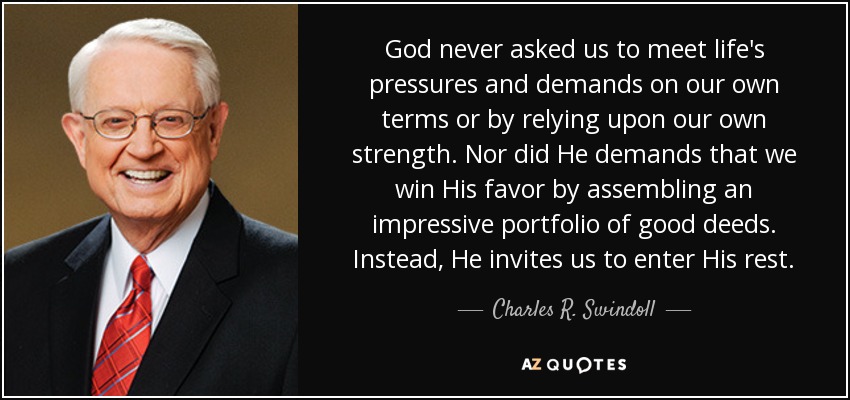
God never asked us to meet life's pressures and demands on our own terms or by relying upon our own strength. Nor did He demands that we win His favor by assembling an impressive portfolio of good deeds. Instead, He invites us to enter His rest.
The trick is to take risks and be paid for taking those risks, but to take a diversified basket of risks in a portfolio.
We know that by simply changing our allocation between stocks and bonds, we can lessen the amount of volatility in our portfolio until we reach our comfortable sleep level.
Rule No.1: Never lose money. Rule No.2: Never forget rule No.1.
Well, actually, I manage a couple of stock portfolios or funds or whatever you want to call 'em, and I think I've done relatively well with them.
Design a portfolio you are not likely to trade... akin to premarital counseling advice; try to build a portfolio that you can live with for a long, long time.
Building a portfolio around index funds isn’t really settling for the average. It’s just refusing to believe in magic.
If you own a portfolio of stocks, you must learn to sell the worst performers first and keep the best a little longer.
In choosing a portfolio, investors should seek broad diversification, Further, they should understand that equities--and corporate bonds also--involve risk; that markets inevitably fluctuate; and their portfolio should be such that they are willing to ride out the bad as well as the good times.
I'm going to do whatever interests me. Look, writing 'Rabbit Hole' came out of an interest in diversifying my portfolio, frankly.
Microsoft, Apple, Facebook all bought huge patent portfolios to further their strategic game. They're doing what I'm doing!
Zimbabwe's stock market was the best performer this decade - but your entire portfolio now buys you 3 eggs
I think it's a mistake to rely too much on any one economic factor. It's why investors try to spread their portfolio round.
The more confidence I have in each one of my stock picks, the fewer companies I need to own in my portfolio to feel comfortable.
Having the opportunity to follow the market frequently gives you the opportunity to see if you need to reevaluate your portfolio. But reevaluating your portfolio shouldn't trigger a sell signal so frequently.
The typical big winner in the Lynch portfolio generally takes three to ten years to play out.
Beta and modern portfolio theory and the like - none of it makes any sense to me.
I do know that, you know, Donald Trump has a global portfolio, and many global investors are in Russia.
Sophisticated people invest their money in stock portfolios. Rednecks invest their money in commemorative plates.
Generally a chef's book is like a calling card or a portfolio to display their personal work.
Finding a single investment that will return 20% per year for 40 years tends to happen only in dreamland. In the real world, you uncover an opportunity, and then you compare other opportunities with that. And you only invest in the most attractive opportunities. That's your opportunity cost. That's what you learn in freshman economics. The game hasn't changed at all. That's why Modern Portfolio Theory is so asinine.
I have resigned from the professional undertaking of coin flipping. I am not here to tell you where gold's going to be. I have no idea. That's my existentialism. I am a student of uncertainty, I have no idea where the stock market is going to be. So when I am creating trades in my portfolio for my clients, I am agnostic. I just want to enhance the probability that I make money come what may.
To invest successfully, you need not understand beta, efficient markets, modern portfolio theory, option pricing or emerging markets. You may, in fact, be better off knowing nothing of these. That, of course, is not the prevailing view at most business schools, whose finance curriculum tends to be dominated by such subjects. In our view, though, investment students need only two well-taught courses - How to Value a Business, and How to Think About Market Prices.
The art of banking is always to balance the risk of a run with the reward of a profit. The tantalizing factor in the equation is that riskier borrowers pay higher interest rates. Ultimate safety - a strongbox full of currency - would avail the banker nothing. Maximum risk - a portfolio of loans to prospective bankrupts at usurious interest rates - would invite disaster. A good banker safely and profitably treads the middle ground.
A powerful portfolio of physiological and behavioural evidence now exists to support the case that fish feel pain and that this feeling matters. In the face of such evidence, any argument to the contrary based on the claim that fish 'do not have the right sort of brain' can no longer be called scientific. It is just obstinate.
Follow AzQuotes on Facebook, Twitter and Google+. Every day we present the best quotes! Improve yourself, find your inspiration, share with friends
or simply: