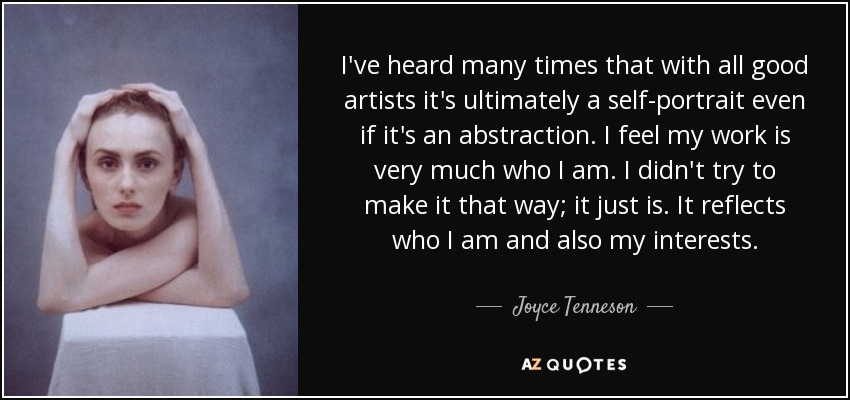
I've heard many times that with all good artists it's ultimately a self-portrait even if it's an abstraction. I feel my work is very much who I am. I didn't try to make it that way; it just is. It reflects who I am and also my interests.
In the past there were too many portraits of Chairman Mao in China. They were hung everywhere. That was not proper and it didn't really show respect for Chairman Mao.
You can describe [Portrait of the Artist as a Shadow of His Former Self] as a manifesto of sorts. I saw it as a pivotal turn, a work that really led me down the avenues that brought me to where I am. That picture was the vehicle that helped me clarify a lot of things and I began to understand that I wanted to do.
If you look at the image [ Portrait of the Artist as a Shadow of His Former Self ], it treads on a kind of popular stereotypical image of the black figure, in both its flatness and slightly comic edge. To take that image as a starting point and to render it in a proto-classical medium, like egg tempera, and then use a repertoire of classical compositional devices to make the picture was a way of setting up an engagement with art history.
[My picture A Portrait of the Artist as a Shadow of His Former Self ] was a way of demonstrating that there was a broad range of possibilities and fairly unlimited utility for a black figure that didn't have to comprise its blackness in order to preserve a place in the field of representation.
In my teens I fancied myself an artist; I hung out with the eccentric art teacher at my high school, painted still lifes and portraits and landscapes in watercolor and acrylics, took private lessons, won some blue ribbons for my earnest renderings. My lack of talent did little to dampen my enthusiasm. In college I thought I'd continue, but, like Salieri, I quickly realized that while I had the ability to appreciate art, I wasn't actually very good.
I want people to understand that this is a very calibrated image [Portrait of the Artist as a Shadow of His Former Self ], where point by point, very little is left to chance.
In a sense, every work you do is a self-portrait because your paintings always reveal more about you than about your subject. Your experience of something, not the something itself, is the true underlying subject of every work you do.
Pre-planning is essential. Research, research, research. If you are going to do a portrait, know as much as you can about the person beforehand. The web makes this very easy.
You have bits of canvas that are unpainted and you have these thick stretcher bars. So you see that a painting is an object; that it's not a window into something - you're not looking at a landscape, you're not looking at a portrait, but you're looking at a painting. It's basically: A painting is a painting is a painting. And it's what Frank Stella said famously: What you see is what you see.
Can you see the deaths, divorces, job losses or changes, disappointments, surprises, and successes on people's faces? Have they been happy, sad, disillusioned, or gratified? I have been trying the single, vertically shot portrait with my 8 x 10 since 1985 and never felt I succeeded in finding what I was looking for.
Improvisational things about picture-making... learned from working with the small camera early on have served me well in being able to think quickly when making [portraits].
Jeff [Koons] called me because he'd seen a portrait of David Bowie, at the beginning of the 80s - I've known Jeff for a long time - and he said, Greg, I want to look like a high-profile celebrity, living on the edge. I think that says it all.
I think [indications of vulnerability are] why so many portraits work when they're difficult: we believe we're presenting ourselves one way, but the camera always reveals something more vulnerable, despite our best efforts.
Portrait photography never had any charms for me, so I sought my subjects from the house-tops, and finally from the hill-tops and about the surrounding country; the taste strengthening as my successes became greater in proportion to the failures.
In making portraits, I refuse to photograph myself as do so many photographers. My style is the style of the people I photograph.
Before, the myth of photography doesn't lie was used in order to cover up tricks. If I [make a] portrait [of] you, accommodate you, illuminate you, put make up on you or use a filter, am I not manipulating reality? The only difference is that now I can do it from the computer in the postclick instead of the preclick. If I decide to photograph something instead of something else, I also manipulate reality. Of course a photograph can lie or commit abuse, but it always could.
I think if you don't love people and aren't fascinated by them, you'll never succeed as a portrait photographer, because your pictures will look cold.
I believe that photography can only reproduce the surface of things. The same applies to a portrait. I take photographs of people the same way I would take photographs of a plaster bust.
Everything in a wide sense is a kind of a self-portrait. It's just the way you see things and you're curious about certain things and just excited about them.
Between the kitchen and the destroyed chapel a door led into an oval-shaped library. The space inside seemed safe except for a large hole at portrait level in the far wall, caused by mortar-shell attack on the villa two months earlier. The rest of the room had adapted itself to this wound, accepting the habits of weather, evening stars, the sound of birds.
I do house things. I paint. I do portraits. I also paint my house.
Kenneth Hari does not paint portraits as they are but as he is. I feel he is hiding something from me. To board a train into his mind would give me a ride into dark adventure.
I've got a portrait in the Smithsonian. Who ever thought that would happen?
And I was very successful at baby photography... Strange isn't it? Because some of my portraits of babies were - I used dramatic lighting, shadow lighting, and I didn't use flash. We didn't have flash in those days, we just had floodlights, and I was photographing babies as I would an object - an inanimate object, for that matter.
Follow AzQuotes on Facebook, Twitter and Google+. Every day we present the best quotes! Improve yourself, find your inspiration, share with friends
or simply: