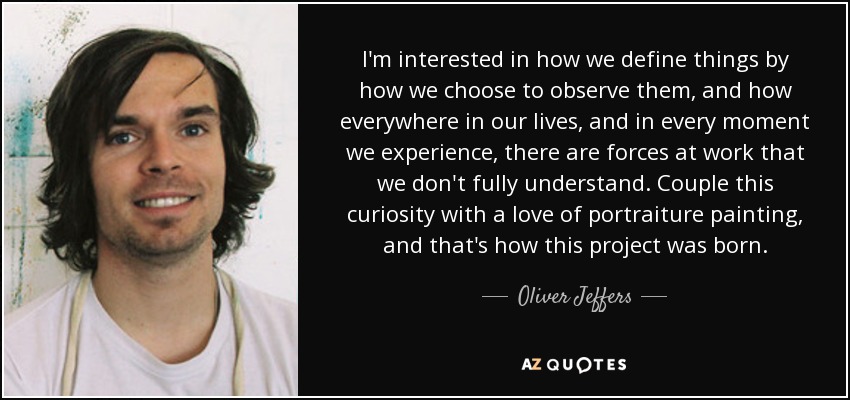
I'm interested in how we define things by how we choose to observe them, and how everywhere in our lives, and in every moment we experience, there are forces at work that we don't fully understand. Couple this curiosity with a love of portraiture painting, and that's how this project was born.
When I'm painting and drawing I only do people. Acting is obviously portraiture - and writing is as well.
All art that is not mere storytelling, or mere portraiture, is symbolic, and has the purpose of those symbolic talismans which medieval magicians made with complex colours and forms, and bade their patients ponder over daily, and guard with holy secrecy; for it entangles, in complex colours and forms, a part of the Divine Essence.
Just as the camera draws a stake through the heart of serious portraiture, television has killed the novel of social reportage.
After 20 years of painting wildlife subjects in acrylic, I felt the need for a change and began to explore portraiture and landscape in oils.
What a conception of art must those theorists have who exclude portraits from the proper province of the fine arts! It is exactly as if we denied that to be poetry in which the poet celebrates the woman he really loves. Portraiture is the basis and the touchstone of historic painting.
... into the novel goes such taste as I have for rational behaviour and social portraiture. The short story, as I see it to be, allows for what is crazy about humanity: obstinacies, inordinate heroisms, "immortal longings.
Boswell's Johnson is the word made flesh... an extemporaneous man talking himself into the thick of every occasion (in a world ofoccasions if nothing else) and therefore no monument at all but all that can be saved of a man alive in the pages of a book.
There are cells in the brain that respond to faces. This is one of the reasons that I deal with portraiture. We can learn a lot about our perception of facial expression from the behavior of these cells.
A form of art that I like is portraiture. I've been thinking about portraiture, and its relationship to writing and literature, biography and autobiography, and so that will be my next thing.
I wanted to make photographs that were immediate and revealing - different from traditional portraiture that called for formal distance between artist and subject.
My work doesn't speak about individuals (it's not portraiture in the traditional sense), it tries to speak about life in general in cities of the West - which is where I live and what I understand.
Going to the Huntington gardens and libraries was radically important for me. They have one of the best collections of 18th- and 19th-century British portraiture that you can imagine in Southern California. One doesn't think about Southern California as being the capital of great art.
We're wired to be empathetic and to care about the needs of others, but also to be curious about others. And I think that's just sort of in our DNA. And so portraiture is a very human act.
All art is self-portraiture.
What it is is a type of editorialization, you know? This is self-portraiture. This is what you think about the world we live in.
What I remember about being painted was a very severe atmosphere. I remember her intensity and sharp glance.
You start with a generic body, but I think the first wall you hit with portraiture is comprised of history and storytelling and the nature of characters - whether they are historical or coming from literature or documentation. Those are the references we have to people, besides your family, and the intimacy of portraiture is in the specifics of individuals. For me, it came out of doing things about animals.
You have no idea what portrait painters suffer from the vanity of their sitters.
Beware how in making the portraiture thou breakest the pattern: for divinity maketh the love of ourselves the pattern; the love of our neighbours but the portraiture.
And there's even a lord named Lord Dashwood [like the characters in Jane Austen's Sense and Sensibility]. It's very steeped in Austen. It's been used in many films, but not in its entirety and we shot the inside and the outside and used every nook and cranny. The inside is very gaudy. It's a little naughty inside. There's a lot of portraiture.
In the years since The Life and Extraordinary Adventures of Private Ivan Chonkin, Voinovich has sharpened his satire, and Monumental Propaganda is a novel that slashes and rips -- but not on every page. He expands his narrative to accommodate shrewd philosophy and inventive portraiture, a very amusing disquisition on Soviet latrines and a number of outlandish plot developments. In his translation, Andrew Bromfield deftly shifts his tone and tools as required, remaining true to Voinovich's Vonnegut-like playfulness and appreciation of the absurd.
A photographic close-up is perhaps the purest form of portraiture, creating a confrontation between the viewer and the subject that daily interaction makes impossible, or at least impolite.
Portraiture is something that we're all drawn to. I think primarily other forms - we prefer, by and large, to look at human beings than a bowl of fruit.
I loathe my own face, and I've done self-portraits because I've had nobody else to do.
Follow AzQuotes on Facebook, Twitter and Google+. Every day we present the best quotes! Improve yourself, find your inspiration, share with friends
or simply: