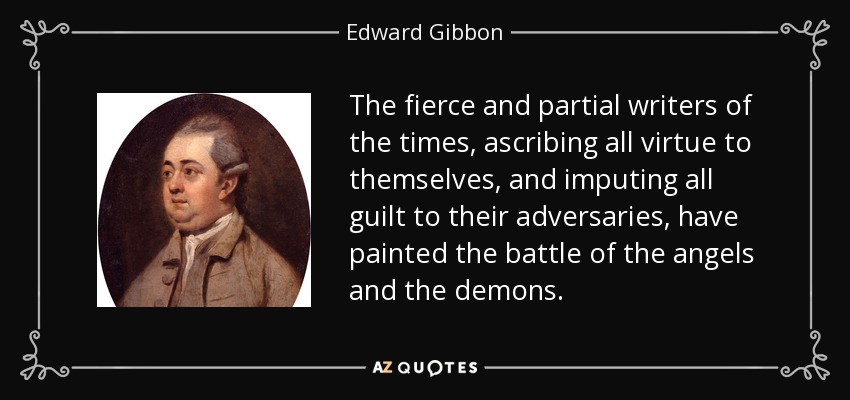
The fierce and partial writers of the times, ascribing all virtue to themselves, and imputing all guilt to their adversaries, have painted the battle of the angels and the demons.
The stony-minded orthodox were right in fearing the first movement of new knowledge and free thought. It has gone on, and will go on, irresistibly, until some day we shall have no respect for an alleged "truth" which cannot stand the full blaze of knowledge, the full force of active thought.
The soaring, imaginative minds of men, constructing lofty, shimmering piles of abstract thought, and taking as their postulate a revelation from God, gaveus relgions which coule not possible maintained without belief and obedience: ... we find them most permanent and changeless among people who make the least effort to swquare their beliefs with the laws of life.
If we once admit that our life is here for the purpose of race-improvement, then we question any religion which does not improve the race, or the main force of which evaporates, as it were, directing our best efforts toward the sky.... Improvement in the human race is not accomplished by extracting any number of souls and placing them in heaven, or elsewhere. It must be established on earth, either through achievement in social service, or through better children.
Let us inquire what glory there was in an omnipotent being torturing forever a puny little creature who could in no way defend himself? Would it be to the glory of a man to fry ants?
A normal feminine influence in recasting our religious assumptions will do more than any other one thing to improve the world.
What would have been the effect upon religion if it had come to us through the minds of women?
We grovel and "worship" and pray to God to do what we ourselves ought to have done a thousand years ago, and can do now, as soon as we choose.
There's heaven. There it is. What more do we mean? People, free to come together, and in beauty - for growth.
A celebrated north country apostle, who, after Calvin had damned ninety-nine in a hundred of mankind, had contrived a scheme for damning ninety-nine in a hundred of the followers of Calvin.
Obey; this may be right; but beware of reverence.... Government is nothing but regulated force; force is its appropriate claim upon your attention. It is the business of individuals to persuade; the tendency of concentrated strength, is only to give consistency and permanence to an influence more compendious than persuasion.
Revolution is engendered by an indignation with tyranny, yet is itself pregnant with tyranny.... An attempt to scrutinize men's thoughts and punish their opinions is of all kinds of despotism the most odious: yet this is peculiarly character of a period of revolution.... There is no period more at war with the existence of liberty.
The real or supposed rights of man are of two kinds, active and passive; the right in certain cases to do as we list; and the right we possess to the forbearance or assistance of other men. The first of these a just philosophy will probably induce us universally to explode.
By right, as the word is employed in this subject, has always been understood discretion, that is, a full and complete power of either doing a thing or omitting it, without the person's becoming liable to animadversion or censure from another, that is, in other words, without his incurring any degree of turpitude or guilt. Now in this sense I affirm that man has no rights, no discretionary power whatever.
He has no right to his life when his duty calls him to resign it. Other men are bound ... to deprive him of life or liberty, if that should appear in any case to be indispensably necessary to prevent a greater evil.
Christianity is most admirably adapted to the training of slaves, to the perpetuation of a slave society.
It is characteristic of theistic "tolerance" that no one really cares what the people believe in, just so they believe or pretend to believe.
Redemption through the Cross is worse than damnation, because of the terrible burden it imposes upon humanity, because of the effect it has on the human soul, fettering and paralyzing it with the weight of the burden exacted through the death of Christ.
Christ and his teachings are the embodiment of submission, of inertia, of the denial of life; hence responsible for the things done in their name.
A profession that we are a nation "under God" is identical, for establishment clause purposes, to a profession that we are a nation "under Jesus," a nation "under Vishnu," a nation "under Zeus," or a nation "under no god," because none of these professions can be neutral with respect to religion.
The coercive effect of this policy is particularly pronounced in the school setting given the age and impressionability of schoolchildren, and their understanding that they are required to adhere to the norms set by their school, their teacher, and their fellow students.
Hallucinations and illusions are not facts useful for scientific investigation.
Further, economic systems ... have never arranged themselves by themselves. It is men who do the ordering according to their attitudes, desires and understanding of things. Changes take place, not independent of man's will, but on account of man's wills. Civilization has progressed by man's interference with material conditions.
The language of theism which was familiar to the people, gave Gandhi the advantage of easy communication with the people, but it is atheistic in principle. It could have been the starting point for the atheistic movement in the modern age.
Satyagraha means insistence on what one knows to be the truth. The insistence implies the exercise of free will as the need of social obligation. If one is content to know the truth himself, he does not become a votary of Satyagraha. A Satyagrahi should not only know the truth but should insist upon it in social relations. So Satyagraha is activation of truthfulness.
Follow AzQuotes on Facebook, Twitter and Google+. Every day we present the best quotes! Improve yourself, find your inspiration, share with friends
or simply: