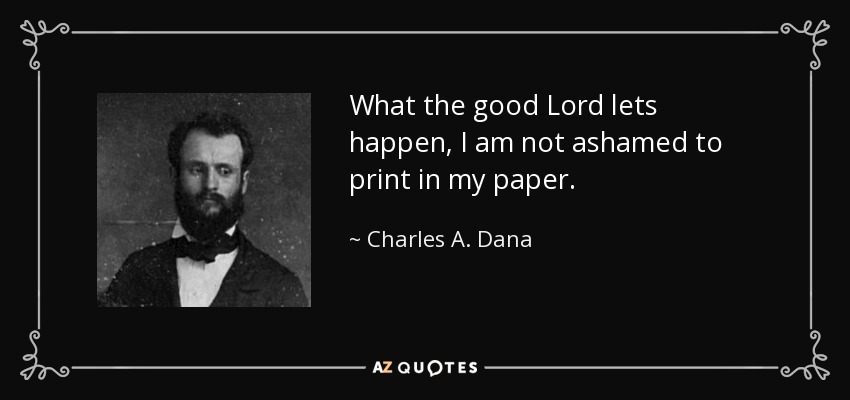
What the good Lord lets happen, I am not ashamed to print in my paper.
These days it seems like any idiot with a laptop computer can churn out a business book and make a few bucks. That's certainly what I'm hoping. It would be a real letdown if the trend changed before this masterpiece goes to print.
Avoid the unhappy ending, the harsh, the brutal, the tragic, the horrible -- if you care to see in print things you write. (In this connection don't do as I do, but do as I say.
I spent my career trying to speak to the broadest possible audience whether it's in print or whether it's in television.
Walt Whitman's "Leaves of Grass" is still in print. They're debating right now over Mark Twain. He's still available. Winslow Homer can still be seen. Our arts are - they're there. We got to go get them and understand that this is an important legacy for our country.
My wife [Tina Brown] co-founded the Daily Beast, so I have no hostility to the web or Internet. A number of print friends of mine regard it as the worst thing that's ever happened, but I don't.
Such is professional jealousy; a scientist will never show any kindness for a theory which he did not start himself. There is no feeling of brotherhood among these people. Indeed, they always resent it when I call them brother. To show how far their ungenerosity can carry them, I will state that I offered to let Prof. H--y publish my great theory as his own discovery; I even begged him to do it; I even proposed to print it myself as his theory. Instead of thanking me, he said that if I tried to fasten that theory on him he would sue me for slander.
Twiddle-twiddle away at my softly clicky keyboard for a while, making twiddly adjustments all along- and then print what I have twiddled. Glare at the printout and snarl and curse and scribble almost illegibly all over it with a ballpoint pen. Go back to the machine and enter the scribbles. Repeat this procedure until I hate the very meaning of every word I know.
If publishers and editors exert themselves to keep certain topics out of print, it is not because they are frightened of prosecution but because they are frightened of public opinion. In this country intellectual cowardice is the worst enemy a writer or journalist has to face, and that fact does not seem to me to have had the discussion it deserves.
Being a famous print journalist is like being the best-dressed woman on radio.
Television and radio are what I call sequential media; they're not simultaneous media. With simultaneous media, you can scan your eye down an electronic or print page and pick among six or seven stories you might like and want to read. With television and radio, you have to wait until the guy's finished talking about the balloon boy, which I don't have the slightest interest in, to find out that all hell's broken loose in Baghdad. Because they've chosen that day to start with the balloon boy.
The current publishing scene is extremely good for the big, popular books. They sell them brilliantly, market them and all that. It is not good for the little books. And really valuable books have been allowed to go out of print. In the old days, the publishers knew that these difficult books, the books that appeal only to a minority, were very productive in the long run. Because they're probably the books that will be read in the next generation.
A lot of my friends were mostly working in black-and-white-people like Lee Friedlander, Diane Arbus, Garry Winogrand, and others. We would exchange prints with each other, and they were always very supportive of what I was doing. What each of us was doing photographically was entirely different, but we were basically coming from the same place, sort of like a club.
I don't think that has ever changed. I don't think I see any more or any less than I did years ago. Let's say I have the print of a photo taken in the 1960s and one I took a month ago. I think it's pretty difficult to tell any difference, personally.
If you view computer designers as artists, they're really into more of an art form that can be mass-produced, like records, or like prints, than they are into fine arts. They want something where they can express themselves to a large number of people through their medium, and their medium is technology and manufacturing.
Journalism has not only its social stimulations but its aesthetic virtues. An invitation into print, from however suspect a source, is an opportunity to make something beautiful, to discover within oneself a treasure that would otherwise have remained buried.
I have this reputation of not wanting to talk to the media, which isn't true. What I don't like-what a lot of us don't understand-is how we can say one thing and it turns up in print as something else.
I read a lot of Socrates in the off-season. Don't print that, or it'll ruin my rep.
Counting lines is probably a good idea if you want to print it out and are short on paper, but I fail to see the purpose otherwise.
The outfit is inspired by Alice in Wonderland. It's kind of about a surprise, because when Alice goes down the rabbit hole, she finds all these things that are so surprising. This outfit is about having a surprise in a tennis dress, and showing some skin and then just having a print. Prints don't happen that often in tennis. So it's called the Wonderland dress.
And dazzling memory revive.Refresh the faded tints, Recut the aged prints, And write my old adventures, with the pen Which, on the first day, drew Upon the tablets blue The dancing Pleiads, and the eternal men.
Poetry is a fossil rock-print of a fin and a wing, with an illegible oath between.
Poetry is any page from a sketchbook of outlines of a doorknob with thumb-prints of dust, blood, dreams.
I don't know why, but I always feel a kind of necessity to write things that are beyond acceptance, that are too offensive or something. For people to read them and say, Ha-ha-ha, very funny. No, we can't print that.
The founding American generations did something that almost no others have ever done. They read the fine print! They taught their children to read bills, laws, court cases, legislative debates, executive decrees, and bureaucratic policies. They read them in schoolrooms and at home....They said they would consider their children uneducated if they didn't read such things.
Follow AzQuotes on Facebook, Twitter and Google+. Every day we present the best quotes! Improve yourself, find your inspiration, share with friends
or simply: