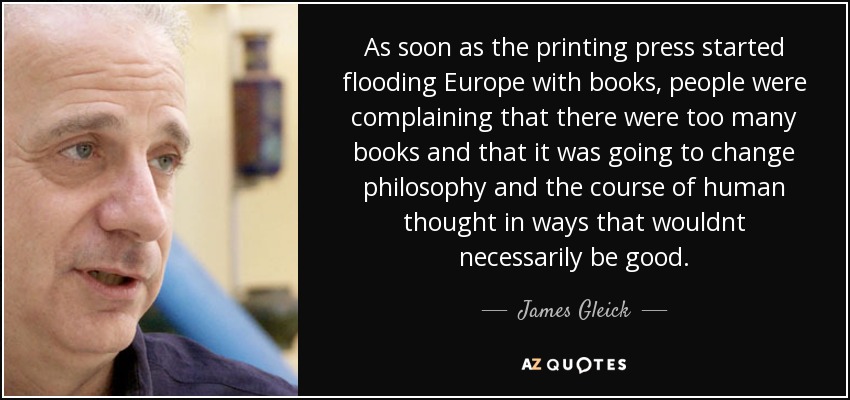
As soon as the printing press started flooding Europe with books, people were complaining that there were too many books and that it was going to change philosophy and the course of human thought in ways that wouldnt necessarily be good.
Technological civilizations don't last long. You're all right until you get a printing press. Then a race starts between technology and common sense. And maybe technology always wins.
Over the last few millennia we've invented a series of technologies - from the alphabet to the scroll to the codex, the printing press, photography, the computer, the smartphone - that have made it progressively easier and easier for us to externalize our memories, for us to essentially outsource this fundamental human capacity.
I'm called an oral historian, which is something of a joke. Oral history was here long before the pen, long before Gutenberg and the printing press. The difference is I have a tape recorder in my hand.
Communication media enabled collective action on new scales, at new rates, among new groups of people, multiplied the power available to civilizations and enabled new forms of social interaction. The alphabet enabled empire and monotheism, the printing press enabled science and revolution, the telephone enabled bureaucracy and globalization, the internet enabled virtual communities and electronic markets, the mobile telephone enabled smart mobs and tribes of info-nomads.
Let's say I am a chocoholic and I eat tons of chocolate a day. A hundred thousands of tons a day. I have this craving, but I can't afford it, so I get a printing press, and I start printing money, and I print billions and billions to buy chocolate. So I create this boom in the chocolate industry, so stores are running out of chocolate. So they have demand, so chocolate makers expand. Cocoa growers expand. You create this great boom. But now the feds arrest me and shut me down. And now there is a depression in the chocolate industry. That's what happens with the monetary policy.
A global society is coming into being, a global society that is made out of information that was not intended to be ours, but is ours, by the mistaken invention of computers and the printing press, information is power, and information has spilled by the clumsy hands of the dominator culture so that the information is everywhere, never before has the situation been so fluid, we might be able to finally have a crack at this
Paper money is made of cotton, and I'm long cotton, by the way. One reason I'm long cotton is because Dr. Bernanke is out there running the printing presses as fast as he can.
If another Messiah was born he could hardly do so much good as the printing-press.
By 1833 the largest publisher in America, Harper and Company, boasted one horse-powered printing press and seven hand presses while the American Bible Society owned 16 new state-of-the-art, steam-driven presses and 20 hand presses.
Like gold, U.S. dollars have value only to the extent that they are strictly limited in supply. But the U.S. government has a technology, called a printing press (or, today, its electronic equivalent), that allows it to produce as many U.S. dollars as it wishes at essentially no cost. By increasing the number of U.S. dollars in circulation, or even by credibly threatening to do so, the U.S. government can also reduce the value of a dollar in terms of goods and services, which is equivalent to raising the prices in dollars of those goods and services.
There isn't a single government agency that can't function. There's more money in this federal government, there's more money allocated than these people can possibly spend. They have to concoct asinine ways to spend it, like advertising for new food stamp users. I've gotten to the point, I'm just so righteously indignant and offended at the very idea that our government could ever run out of money when we've got a printing press, for crying out loud. Printed three and a half trillion dollars over seven years and flooded Wall Street with it.
The coming of the printing press must have seemed as if it would turn the world upside down in the way it spread and, above all, democratized knowledge.
Television was the most revolutionary event of the century. Its importance was in a class with the discovery of gunpowder and the invention of the printing press, which changed the human condition for centuries afterward.
The coming of the printing press must have seemed as if it would turn the world upside down in the way it spread and, above all, democratized knowledge. Provide you could pay and read, what was on the shelves in the new bookshops was yours for the taking. The speed with which printing presses and their operators fanned out across Europe is extraordinary. From the single Mainz press of 1457, it took only twenty-three years to establish presses in 110 towns: 50 in Italy, 30 in Germany, 9 in France, 8 in Spain, 8 in Holland, 4 in England, and so on.
The government can't create jobs; they'll destroy jobs trying to do it. The government doesn't have any money; all they have is a printing press. We need to free markets to create jobs; if the government wants to help, they should reduce their burden on the economy.
In the North, neither greenbacks, taxes, nor war bonds were enough to finance the war. So a national banking system was created to convert government bonds into fiat money, and the people lost over half of their monetary assets to the hidden tax of inflation. In the South, printing presses accomplished the same effect, and the monetary loss was total.
People's social networks do not consist only of people they see face to face. In fact, social networks have been extending because of artificial media since the printing press and the telephone.
At Facebook, we're inspired by technologies that have revolutionized how people spread and consume information. We often talk about inventions like the printing press and the television - by simply making communication more efficient, they led to a complete transformation of many important parts of society. They gave more people a voice. They encouraged progress. They changed the way society was organized. They brought us closer together.
The printing presses of the state treasuries cranked out reams of paper currency- showing wise kinds and blissful martyrs- while bankers wept and peasants starved.
Our enthusiasm for digital technology about which we have little understanding and over which we have little control leads us not toward greater agency, but toward less...We have surrendered the unfolding of a new technological age to a small elite who have seized the capability on offer. But while Renaissance kings maintained their monopoly over the printing press by force, today's elite is depending on little more than our own disinterest.
First book was handwritten, then the printing press, now we've got our Kindles. To be able to push a button and a dictionary comes up. And then, at my age, that I can make the letters any size I want, and that I can carry all of William Shakespeare, all of Gogol, all of Franz Kafka in my handbag? You've got to love it.
There are no checks and balances if the gov is wrong. If a private entrepreneur makes a mistake, he goes bankrupt, the losses are cut; if he bets wrong, he loses; if the gov bets wrong, they just get bigger, they just appropriate more money. It's a bottomless pit, because they either get it from the tax payers or run it off a printing press.
University printing presses exist, and are subsidised by the Government for the purpose of producing books which no one can read; and they are true to their high calling.
Architecture is the printing-press of all ages, and gives a history of the state of the society in which it was erected, from the cromlech of the Druids to those toy-shops of royal bad taste
Follow AzQuotes on Facebook, Twitter and Google+. Every day we present the best quotes! Improve yourself, find your inspiration, share with friends
or simply: