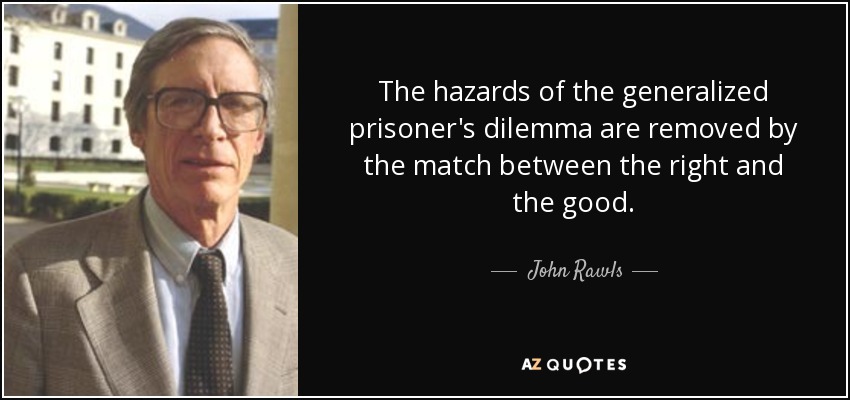
The hazards of the generalized prisoner's dilemma are removed by the match between the right and the good.
This is the woman who stopped the Stanford Prison Study. When I said it got out of control, I was the prison superintendent. I didn't know it was out of control. I was totally indifferent. She came down, saw that madhouse and said, "You know what, it's terrible what you're doing to those boys. They're not prisoners, they're not guards, they're boys, and you are responsible." And I ended the study the next day. The good news is I married her the next year.
Whether we consider Nazi Germany or Abu Ghraib prison, there were many people who observed what was happening and said nothing. At Abu Ghraib, one photo shows two soldiers smiling before a pyramid of naked prisoners while a dozen other soldiers stand around watching passively. If you observe such abuses and don't say, "This is wrong! Stop it!" you give tacit approval to continue. You are part of the silent majority that makes evil deeds more acceptable.
When I look back on it, I think, "Why didn't you stop the cruelty earlier?" To stand back was contrary to my upbringing and nature. When I stood back as a noninterfering experimental scientist, I was, in a sense, as drawn into the power of the situation as any prisoners and guards.
Structures of which we are unaware hold us prisoner.
Man, full of emptiness and torn apart with homesickness for the desert has had to create from within himself an adventure, a torture-chamber, an unsafe and hazardous wilderness- this fool, this prisoner consumed with longing and despair, became the inventor of 'bad conscience'.
The moment the first American soldier sets foot on the Japanese mainland, all prisoners of war will be shot.
The sacrifices of our people were very great. Out of a population of one million, 28,000 were killed, 12,600 wounded, 10,000 were made political prisoners in Italy and Germany, and 35,000 made to do forced labour, of ground; all the communications, all the ports, mines and electric power installations were destroyed, our agriculture and livestock were plundered, and our entire national economy was wrecked.
I have always had plenty of friends, and now at age sixty, I face four walls as a common prisoner.
I cherish my own freedom dearly, but I care even more for your freedom. Too many have died since I went to prison. Too many have suffered for the love of freedom. I owe it to their widows, to their orphans, to their mothers and their fathers, who have grieved and wept for them ..... Not only have I suffered during these long lonely wasted years. I am no less life-loving than you are. But I cannot sell the birthright of the people to be free ....... Only free men can negotiate. Prisoners cannot enter into contracts. Your freedom and mine cannot be separated.
When I wrote my eighth thriller, Inside Out, in 2009, the villains were a group of CIA and other government officials who colluded to destroy a series of tapes depicting Americans torturing war-on-terror prisoners.
I'm not a movie star like other actors in the way that I need to walk around with a bodyguard. My goal is just to get some interesting parts and make enough money to live free. Otherwise, to be a movie star, it's a lot of compromise and also a lot of headaches. You can't do what you want. You become a prisoner of your fame. This happened to me in France and I don't want it. I want to go to the terrace of a café, have a coffee. I have no problems with the fact that people recognize me, I'm very glad about it, but to be a movie star is kind of unreal for me.
This is really the common mentality of prisoners: they read with great attention all the articles that deal with illnesses and send away for treatises and "be your own doctor" or "emergency treatments" and end up by discovering that they have at least 300 or 400 illnesses, whose symptoms they are experiencing.
As so often happens in marriage, roles that had begun almost playfully, to give line and shape to our lives, had hardened like suits of armor and taken us prisoner.
I wonder about prisoners. They're told, "You are free, you are innocent, you can go anywhere." I'm sure they usually feel nothing. They don't burst into tears or hysterics or joy or "I told you so." It's nothing. To be on the straight path isn't a bloody thing. It's just ordinary.
Tis base to plead the unhappy prisoner's cause, With eloquence that's bought.
Besides writing, I have been teaching myself to 'develop' my own photographic plates, and I haven't a stick of clothing or an exposed finger that isn't stained. I sit for hours in a dark-room feeling as if I were a very elderly Faust at some dreadful incantation, and come out of it, blinding at the light, like a Bastille prisoner. And yet I am not successful!
My arrest was on every bloody TV set. The other prisoners all knew who I was and asked me to sing.
Always late: thus I make you the prisoner of my freedom.
We've seen the reality of Saddam's regime: his thugs prepared to kill their own people, the parading of prisoners of war and now the release of those pictures of executed British soldiers.
It was spine tingling, actually, when you saw how people kept saying, "Release Nelson Mandela," and meaning really, "Release all of our political prisoners."
There's been a lot of comparisons to "The Prisoner," and sometimes people take a negative tact on that, but to be really honest, I count that as a compliment, in the sense that what I felt "The Prisoner" was for the '60's, in how the individual triumphs over the state and authority, our show is really about how complacent we have become in our lives, which are scrutinized.
Unfortunately, the United States and a few other governments have used the war on terrorism as a way of violating human rights. I am referring to the case of the Guantánamo Bay prisoners. This violation of the rights of prisoners has been so unbelievable that the United Nations has reminded the United States repeatedly that the treatment of prisoners should take place according to the preestablished conventions of the United Nations.
I'm no longer a prisoner of my fears. Which really just means I'm using real butter.
I saw a man walk into my camera viewfinder from the left. He took a pistol out of his holster and raised it. I had no idea he would shoot. It was common to hold a pistol to the head of prisoners during questioning. So I prepared to make that picture - the threat, the interrogation. But it didn't happen. The man just pulled a pistol out of his holster, raised it to the VC's head and shot him in the temple. I made a picture at the same time. (On his 1968 photograph of the summary street corner execution of prisoner Nguyen Van Lem by South Vietnam's police chief, Lt. Col. Nguyen Ngoc Loan.)
Follow AzQuotes on Facebook, Twitter and Google+. Every day we present the best quotes! Improve yourself, find your inspiration, share with friends
or simply: