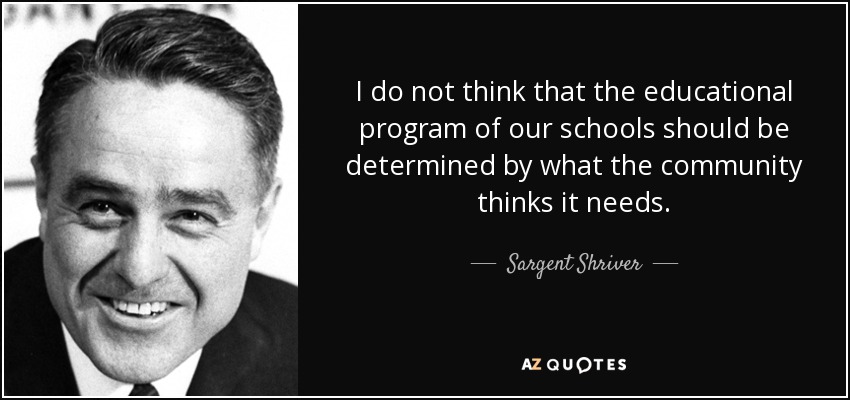
I do not think that the educational program of our schools should be determined by what the community thinks it needs.
What could become a danger to world peace is Iran's nuclear program and the country's open threat to annihilate Israel.
It's cool when people ask me about my gold medal and they say it will last forever. I will try to promote skiing and show everyone it's not just about competition. It's about having fun with your friends in the snow. I want to bring people with less opportunities to the snow, try to use my gold medal to support programs to bring more people to the snow.
Much to the surprise of the builders of the first digital computers, programs written for them usually did not work.
While spay neuter is important, our goal has never been no more births, even though reducing birth rates might help. Our goal has been and is, and has always been no more killing. And when you focus on the no more killing part, spay neuter actually takes a backseat to all those other programs like foster care, and adoptions, and helping people overcome the challenges they face that cause them to surrender their animals.
If every animal shelter in the United States embraced the No Kill philosophy and the programs and services that make it possible, we would save nearly four million dogs and cats who are scheduled to die in shelters this year, and the year after that. It is not an impossible dream.
We have also obtained a glimpse of another crucial idea about languages and program design. This is the approach of statified design, the notion that a complex system should be structured as a sequence of levels that are described using a sequence of languages. Each level is constructed by combining parts that are regarded as primitive at that level, and the parts constructed at each level are used as primitives at the next level. The language used at each level of a stratified design has primitives, means of combination, and means of abstraction appropriate to that level of detail.
The hardest part of the software task is arriving at a complete and consistent specification, and much of the essence of building a program is in fact the debugging of the specification.
Our intellectual powers are rather geared to master static relations and that our powers to visualize processes evolving in time are relatively poorly developed. For that reason we should do (as wise programmers aware of our limitations) our utmost to shorten the conceptual gap between the static program and the dynamic process, to make the correspondence between the program (spread out in text space) and the process (spread out in time) as trivial as possible.
Yes, I share your concern: how to program well -though a teachable topic- is hardly taught. The situation is similar to that in mathematics, where the explicit curriculum is confined to mathematical results; how to do mathematics is something the student must absorb by osmosis, so to speak. One reason for preferring symbol-manipulating, calculating arguments is that their design is much better teachable than the design of verbal/pictorial arguments. Large-scale introduction of courses on such calculational methodology, however, would encounter unsurmoutable political problems.
The first step in fixing a broken program is getting it to fail repeatably [on the simplest example possible].
In those days [batch processing] programmers never even documented their programs, because it was assumed that nobody else would ever use them. Now, however, time-sharing had made exchanging software trivial: you just stored one copy in the public repository and therby effectively gave it to the world. Immediately people began to document their programs and to think of them as being usable by others. They started to build on each other's work.
Object-oriented programming as it emerged in Simula 67 allows software structure to be based on real-world structures, and gives programmers a powerful way to simplify the design and construction of complex programs.
What is the central core of the subject [computer science]? What is it that distinguishes it from the separate subjects with which it is related? What is the linking thread which gathers these disparate branches into a single discipline. My answer to these questions is simple -it is the art of programming a computer. It is the art of designing efficient and elegant methods of getting a computer to solve problems, theoretical or practical, small or large, simple or complex. It is the art of translating this design into an effective and accurate computer program.
To treat programming scientifically, it must be possible to specify the required properties of programs precisely. Formality is certainly not an end in itself. The importance of formal specifications must ultimately rest in their utility -in whether or not they are used to improve the quality of software or to reduce the cost of producing and maintaining software.
...One of the most important lessons, perhaps, is the fact that SOFTWARE IS HARD. From now on I shall have significantly greater respect for every successful software tool that I encounter. During the past decade I was surprised to learn that the writing of programs for TeX and Metafont proved to be much more difficult than all the other things I had done (like proving theorems or writing books). The creation of good software demand a significiantly higher standard of accuracy than those other things do, and it requires a longer attention span than other intellectual tasks.
Composing computer programs to solve scientific problems is like writing poetry. You must choose every word with care and link it with the other words in perfect syntax. There is no place for verbosity or carelessness. To become fluent in a computer lnaguage demands almost the antithesis of modern loose thinking. It requires many interactive sessions, the hands-on use of the device. You do not learn a foreign language from a book, rather you have to live in the country for year to let the langauge become an automatic part of you, and the same is true for computer languages.
The only way for errors to occur in a program is by being put there by the author. No other mechanisms are known. Programs can't acquire bugs by sitting around with other buggy programs. Right practice aims at preventing insertion of errors and, failing that, removing them before testing or any other running of the program.
The discipline of programming is most like sorcery. Both use precise language to instruct inanimate objects to do our bidding. Small mistakes in programs or spells can lead to completely unforseen behavior: e.g., see the story, "The Sorcerer's Apprentice". Neither study is easy: "...her [Galinda's] early appetite for sorcery had waned once she'd heard what a grind it was to learn spells and, worse, to understand them." from the book "Wicked" by G. Maguire.
To understand a program, you must become both the machine and the program.
You think you KNOW when you learn, are more sure when you can write, even more when you can teach, but certain when you can program.
There is one very good reason to learn programming, but it has nothing to do with preparing for high-tech careers or with making sure one is computer literate in order to avoid being cynically manipulated by the computers of the future. The real value of learning to program can only be understood if we look at learning to program as an exercise of the intellect, as a kind of modern-day Latin that we learn to sharpen our minds.
Once you succeed in writing the programs for [these] complicated algorithms, they usually run extremely fast. The computer doesn't need to understand the algorithm, its task is only to run the programs.
Every program has (at least) two purposes: the one for which it was written and another for which it wasn't.
If you stay up late and you have another hour of work to do, you can just stay up another hour later without running into a wall and having to stop. Whereas it might take three or four hours if you start over, you might finish if you just work that extra hour. If you're a morning person, the day always intrudes a fixed amount of time in the future. So it's much less efficient. Which is why I think computer people tend to be night people - because a machine doesn't get sleepy.
Follow AzQuotes on Facebook, Twitter and Google+. Every day we present the best quotes! Improve yourself, find your inspiration, share with friends
or simply: