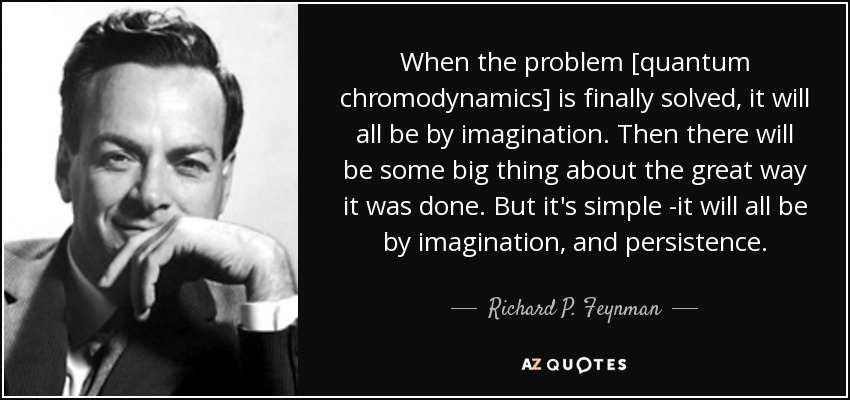
When the problem [quantum chromodynamics] is finally solved, it will all be by imagination. Then there will be some big thing about the great way it was done. But it's simple -it will all be by imagination, and persistence.
In engineering, as in other creative arts, we must learn to do analysis to support our efforts in synthesis. One cannot build a beautiful and functional bridge without a knowledge of steel and dirt, and a considerable mathematical technique for using this knowledge to compute the properties of structures. Similarly, one cannot build a beautiful computer system without a deep understanding of how to "previsualize" the process generated by the code one writes.
Gates has always understood Moore's Law better than anyone else in the industry. If you can make something run at all, get it out there -it may be slow and clunky, but hardware improvements will bail you out. If you wait until it's running perfectly on the hardware already in the field, it will be obsolete before it's released. This philosophy built Microsoft and is the main reason Microsoft won the war IBM declared back in the OS/2 days.
We are all shaped by the tools we use, in particular: the formalisms we use shape our thinking habits, for better or for worse, and that means that we have to be very careful in the choice of what we learn and teach, for unlearning is not really possible.
Yes, I share your concern: how to program well -though a teachable topic- is hardly taught. The situation is similar to that in mathematics, where the explicit curriculum is confined to mathematical results; how to do mathematics is something the student must absorb by osmosis, so to speak. One reason for preferring symbol-manipulating, calculating arguments is that their design is much better teachable than the design of verbal/pictorial arguments. Large-scale introduction of courses on such calculational methodology, however, would encounter unsurmoutable political problems.
When a Caltech student asked the eminent cosmologist Michael Turner what his "bias" was in favoring one or another particle as a likely candidate to compromise dark matter in the universe, Feynmann snapped, "Why do you want to know his bias? Form your own bias!"
...methods are more important than facts. The educational value of a problem given to a student depends mostly on how often the thought processes that are invoked to solve it will be helpful in later situations. It has little to do with how useful the answer to the problem may be. On the other hand, a good problem must also motivate the students; they should be interested in seeing the answer. Since students differ so greatly, I cannot expect everyone to like the problems that please me.
Microsoft knows that reliable software is not cost effective. According to studies, 90% to 95% of all bugs are harmless. They're never discovered by users, and they don't affect performance. It's much cheaper to release buggy software and fix the 5% to 10% of bugs people find and complain about.
There is this thing called the GPL (Gnu Public Licence), which we disagree with... nobody can ever improve the software.
...One of the most important lessons, perhaps, is the fact that SOFTWARE IS HARD. From now on I shall have significantly greater respect for every successful software tool that I encounter. During the past decade I was surprised to learn that the writing of programs for TeX and Metafont proved to be much more difficult than all the other things I had done (like proving theorems or writing books). The creation of good software demand a significiantly higher standard of accuracy than those other things do, and it requires a longer attention span than other intellectual tasks.
The most common human act that writing a novel resembles is lying. The working novelist lies daily, very complexly, and at great length.
Don't ask what it means, but rather how it is used.
Bandwidth grows at least three times faster than computer power.
Questions are the important thing, answers are less important. Learning to ask a good question is the heart of intelligence. Learning the answer-well, answers are for students. Questions are for thinkers.
And simple truth miscalled simplicity
In the Java world, security is not viewed as an add-on a feature. It is a pervasive way of thinking. Those who forget to think in a secure mindset end up in trouble. But just because the facilities are there doesn't mean that security is assured automatically. A set of standard practices has evolved over the years. The Secure Coding Standard for Java is a compendium of these practices. These are not theoretical research papers or product marketing blurbs. This is all serious, mission-critical, battle-tested, enterprise-scale stuff.
Don't worry about how things are. Watch where they are headed.
Stupidity is the only natural capital offense.
Given the incredible power of these new technologies, shouldn't we be asking how we can best coexist with them? And if our own extinction is a likely, or even possible, outcome of our technological development, shouldn't we proceed with great caution?
There is one very good reason to learn programming, but it has nothing to do with preparing for high-tech careers or with making sure one is computer literate in order to avoid being cynically manipulated by the computers of the future. The real value of learning to program can only be understood if we look at learning to program as an exercise of the intellect, as a kind of modern-day Latin that we learn to sharpen our minds.
The best way to do research is to make a radical assumption and then assume it's true. For me, I use the assumption that object oriented programming is the way to go.
The real problem in speech is not precise language. The problem is clear language.
John von Neumann draws attention to what seemed to him a contrast. He remarked that for simple mechanisms, it is often easier to describe how they work than what they do, while for more complicated mechanisms, it is usually the other way around.
Our intellectual powers are rather geared to master static relations and that our powers to visualize processes evolving in time are relatively poorly developed. For that reason we should do (as wise programmers aware of our limitations) our utmost to shorten the conceptual gap between the static program and the dynamic process, to make the correspondence between the program (spread out in text space) and the process (spread out in time) as trivial as possible.
If you have a large number of unrelated ideas, you have to get quite a distance away from them to get a view of all of them, and this is the role of abstraction. If you look at each too closely you see too many details. If you get far away things may appear simpler because you can only see the large, broad outlines; you do not get lost in petty details.
Follow AzQuotes on Facebook, Twitter and Google+. Every day we present the best quotes! Improve yourself, find your inspiration, share with friends
or simply: