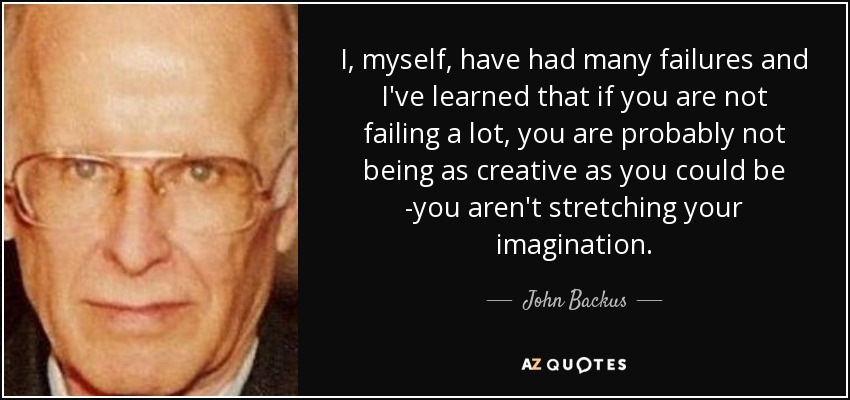
I, myself, have had many failures and I've learned that if you are not failing a lot, you are probably not being as creative as you could be -you aren't stretching your imagination.
The best way to predict the future is to invent it.
I don't have any focus groups on talent and programming. If I need five people in a mall to be paid $40 to tell me how to do my job, I shouldn't do my job.
I have been an unabashed fan of NPR for many years, and have stolen untold excellent ideas from its programming.
Increasingly, people seem to misinterpret complexity as sophistication, which is baffling -- the incomprehensible should cause suspicion rather than admiration.
Every parent in America has the total power to control all television programming that is dispatched to their home today.
The unavoidable price of reliability is simplicity.
The programmer, like the poet, works only slightly removed from pure thought-stuff. He builds his castles in the air, from air, creating by exertion of the imagination. Few media of creation are so flexible, so easy to polish and rework, so readily capable of realizing grand conceptual structures.
Adjusting to the requirement for perfection is, I think, the most difficult part of learning to program.
Data isn't information; information isn't knowledge; knowledge isn't wisdom.
After graduating in 1973 I went into the programming field.
Microsoft has a new version out, Windows XP, which according to everybody is the 'most reliable Windows ever.' To me, this is like saying that asparagus is 'the most articulate vegetable ever.'
It's OK to figure out murder mysteries, but you shouldn't need to figure out code. You should be able to read it.
A computer is like a violin. You can imagine a novice trying first a phonograph and then a violin. The latter, he says, sounds terrible. That is the argument we have heard from our humanists and most of our computer scientists. Computer programs are good, they say, for particular purposes, but they aren’t flexible. Neither is a violin, or a typewriter, until you learn how to use it.
There's an old story about the person who wished his computer were as easy to use as his telephone. That wish has come true, since I no longer know how to use my telephone.
Clearly, programming courses should teach methods of design and construction, and the selected examples should be such that a gradual development can be nicely demonstrated.
That's what's cool about working with computers. They don't argue, they remember everything, and they don't drink all your beer.
The only people who have anything to fear from free software are those whose products are worth even less.
Any fool can use a computer. Many do.
Computer language design is just like a stroll in the park. Jurassic Park, that is.
It is not about bits, bytes and protocols, but profits, losses and margins.
It's ridiculous to live 100 years and only be able to remember 30 million bytes. You know, less than a compact disc. The human condition is really becoming more obsolete every minute.
Software suppliers are trying to make their software packages more 'user-friendly'... Their best approach so far has been to take all the old brochures and stamp the words 'user-friendly' on the cover.
The bulk of all patents are crap. Spending time reading them is stupid. It's up to the patent owner to do so, and to enforce them.
We have also obtained a glimpse of another crucial idea about languages and program design. This is the approach of statified design, the notion that a complex system should be structured as a sequence of levels that are described using a sequence of languages. Each level is constructed by combining parts that are regarded as primitive at that level, and the parts constructed at each level are used as primitives at the next level. The language used at each level of a stratified design has primitives, means of combination, and means of abstraction appropriate to that level of detail.
Follow AzQuotes on Facebook, Twitter and Google+. Every day we present the best quotes! Improve yourself, find your inspiration, share with friends
or simply: