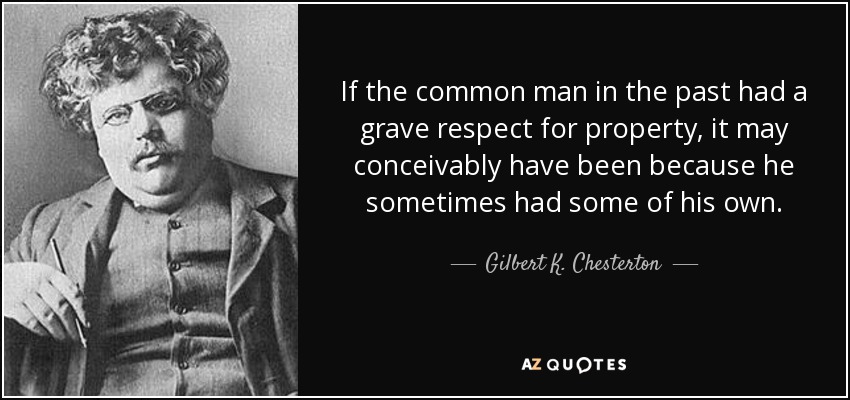
If the common man in the past had a grave respect for property, it may conceivably have been because he sometimes had some of his own.
You may twist the word freedom as long as you please, but at last it comes to quiet enjoyment of your own property, or it comes to nothing. Why do men want any of those things that are called political rights and privileges? Why do they, for instance, want to vote at elections for members of parliament? Oh! Because they shall then have an influence over the conduct of those members. And of what use is that? Oh! Then they will prevent the members from doing wrong.
The right to work, I had assumed, was the most precious liberty that man possesses. Man has indeed as much right to work as he has to live, to be free, to own property.
It is also true that the less possible it becomes for a man to acquire a new fortune, the more must the existing fortunes appear as privileges for which there is no justification. Policy is then certain to aim at taking these fortunes out of private hands, either by the slow process of heavy taxation of inheritance or by the quicker one of outright confiscation. A system based on private property and control of the means of production presupposes that such property and control can be acquired by any successful man.
Only now are increasing numbers of political and social scientists beginning to realize that Kelso's theories provide a private-property-based alternative to the imminent passage of a government-distributed "guaranteed income" or "negative income tax."
A community of small farmers... land property owners, will be the only assurance that the freedom our republic offers will be guaranteed to each and every citizen.
I am conscious that an equal division of property is impracticable, but the consequences of this enormous inequality producing so much misery to the bulk of mankind, legislators cannot invent too many devices for subdividing property.
Property in everyday life, is the right of control.
Equality of economic opportunity, in the context of private property, means equality of opportunity for the millions of capital-less households of today to buy, pay for, and employ in their lives the non-human factor of production, capital.
Take Milton Friedman, he sits at his desk pontificating about such bunk as the monetary system being the answer to our problems. The monetary system is a legal contrivance. Property, not money, is real wealth. It's physical, not legal.
When incentive to acquire and obtain property is gone, people no longer make efforts to acquire any... Those who infringe upon property rights commit an injustice... If this occurs repeatedly, all incentives to cultural enterprise are destroyed and they cease utterly to make an effort. This leads to destruction and ruin of civilization.
Every man has by nature the right to possess property as his own. This is one of the chief points of distinction between man and the animal creation.
It is clear that the main tenet of socialism, community of goods, must be utterly rejected, since it only injures those whom it would seem meant to benefit, is directly contrary to the natural rights of mankind, and would introduce confusion and disorder into the commonweal. The first and most fundamental principle, therefore, if one would undertake to alleviate the condition of the masses, must be the inviolability of private property.
It has been the fashion to speak of the conflict between human rights and property rights, and from this it has come to be widely believed that the use of private property is tainted with evil and should not be espoused by rational and civilized men... the only dependable foundation of personal liberty is the personal economic security of private property. The Good Society.
If history could prove and teach us anything, it would be the private ownership of the means of production as a necessary requisite of civilization and material well-being. All civilizations have up to now been based on private property. Only nations committed to the principle of private property have risen above penury and produced science, art, and literature. There is no experience to show that any other social system could provide mankind with any of the achievements of civilization.
A critical knowledge of the evolution of the idea of property would embody, in some respects, the most remarkable portion of the mental history of mankind.
The dissolution of society bids fair to become the termination of a career of which property is the end and aim, because such a career contains the elements of self-destruction. Democracy in government, brotherhood in society, equality in rights and privileges, and universal education, foreshadow the next higher plane of society to which experience, intelligence and knowledge are steadily tending.
The growth of property and the desire for its transmission to children was, in reality, the moving power which brought in monogamy to insure legitimate heirs, and to limit their number to the actual progeny of the married pair.
So many of the new nations which were established as democracies after the second world war, during the decolonizing process, have now changed their system to state-socialism. Small elites run them, and they aren't sharing societies. They aren't even socialist. The power of the state has been merged with business property and you have the greatest concentration of power that's possible.
Marxism was the social creed and the social cry of those classes who knew by their miseries that the creed of the liberal optimists was s snare and a delusion... Liberalism and Marxism share a common illusion of the "children of light." Neither understands property as a form of power which can be used in either its individual or its social form as an instrument of particular interest against the general interest.
It's long been common practice among many to draw a distinction between "human rights" and "property rights," suggesting that the two are separate and unequal - with "property rights" second to "human rights."
We must adopt reforms which will expand the range of opportunities for all Americans. We can fulfill the American dream only when each person has a fair chance to fulfill his own dreams. This means equal voting rights, equal employment opportunity and new opportunities for expanded ownership, because in order to be secure in their human rights, people need access to property rights.
Therefore the dignity of the human person normally demands the right to the use of earthly goods as the natural foundation for a livelihood; and to that right corresponds the fundamental obligation to grant private property, as far as possible, to all.
We hold that the ownership of private property is the right and privilege of every American citizen and is one of the foundation stones upon which this nation and its free enterprise system has been built and has prospered. We feel that private property rights and human rights are inseparable and indivisible. Only in those nations that guarantee the right of ownership of private property as basic and sacred under their law is there any recognition of human rights.
I've long believed one of the mainsprings of our own liberty has been the widespread ownership of property among our people and the expectation that anyone's child, even from the humblest of families, could grow up to own a business or corporation.
Follow AzQuotes on Facebook, Twitter and Google+. Every day we present the best quotes! Improve yourself, find your inspiration, share with friends
or simply: