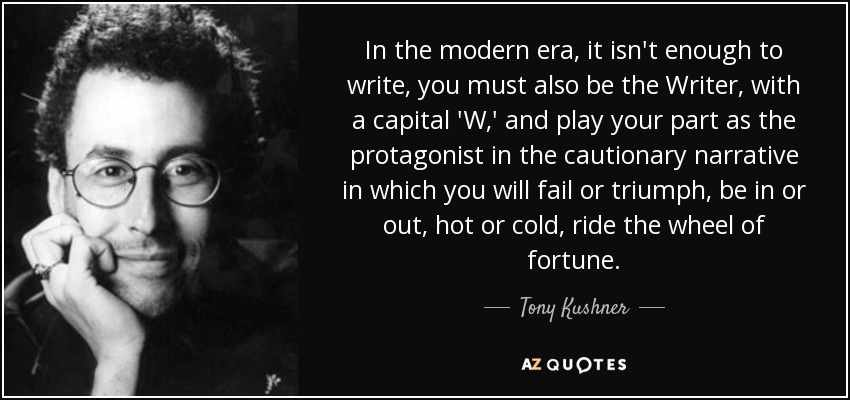
In the modern era, it isn't enough to write, you must also be the Writer, with a capital 'W,' and play your part as the protagonist in the cautionary narrative in which you will fail or triumph, be in or out, hot or cold, ride the wheel of fortune.
Since so many romantic comedies vary little in their storyline, the success or failure of such movies depends largely on whether we believe in the relationship of the protagonists.
Can Protagonist think of a single film that interests him as much as the three-hundredth best book he ever read?
Treefingers is important, it's the point in which our protagonist crosses the icy tundra that is how to disappear completely to reach the island of Optimistic. But seriously, kill yourself.
To me there's no difference between writing YA and adult except that in YA I make the book a little shorter and the protagonists are teens. The difference is in the readers.
In the history of enterprise, most of the protagonists of major new products and companies began their education - not in the classroom, where the old ways are taught, but in the factories and labs where new ways are wrought ... nothing has been so rare in recent years as an Ivy League graduate who has made a significant innovation in American enterprise.
The Greeks were the first intellectualists. In a world where the irrational had played the chief role, they came forward as the protagonists of the mind.
It seems to me that most good protagonists are both clever and resourceful. They are intelligent and can fix things, both little and big. They can come up with inventive solutions others would never think of.
I hate the whole übermensch, superman temptation that pervades science fiction. I believe no protagonist should be so competent, so awe-inspiring, that a committee of 20 really hard-working, intelligent people couldn't do the same thing.
Once you have a situation that is fresh, then you sort of believe in it and it becomes normal. So you do end up with protagonists that haven't been in other movies before.
The adolescent protagonist is one of the hallmarks of American literature.
Think 'Game of Thrones.' In the old days, this sort of show might be considered bad writing. It doesn't really seem to be moving toward a crisis or climax, it has no true protagonist, and it's structured less like a TV show or a movie than a soap opera.
Because the writer must be a participant in the scene, while he's writing it — or at least taping it, or even sketching it. Or all three. Probably the closest analogy to the ideal would be a film director/producer who writes his own scripts, does his own camera work and somehow manages to film himself in action, as the protagonist or at least a main character.
The novel form is about the protagonist's struggle to transform his arbitrary, fragmented, given experience into a narrative as meaningful as his favorite books.
When I first began writing In the Country of Men all I had was the voice of the protagonist. He intrigued me and my desire to want to know him and his world became almost compulsive.
When does a session of The Theatre of the Oppressed end? Never - since the objective is not to close a cycle, to generate a catharsis, or to end a development. On the contrary, its objective is to encourage autonomous activity, to set a process in motion, to stimulate transformative creativity, to change spectators into protagonists. And it is precisely for these reasons that the Theatre of the Oppressed should be the initiator of changes the culmination of which is not the aesthetic phenomenon but real life.
You don't need to like your protagonists.
The protagonist of folktale is always, and intensely, a young person moving through ordeals into adult life. . . . and this is why there are no wicked stepchildren in the tales.
Most literary critics agree that fiction cannot be reduced to mere falsehood. Well-crafted protagonists come to life, pornography causes orgasms, and the pretense that life is what we want it to be may conceivably bring about the desired condition. Hence religious parables, socialist realism, Nazi propaganda. And if this story likewise crawls with reactionary supernaturalism, that might be because its author longs to see letters scuttling across ceilings, cautiously beginning to reify themselves into angels. For if they could only do that, then why not us?
In fact, some reviewers have said that as they got into the story they forgot that the protagonist is a black woman. They were moved by the story - by the people as a whole - and not by the little things.
Just as women supplement men in private life, so they will supplement men in public life by concentrating their organized efforts on those objects which men are likely to ignore. There is a tremendous field for women as active protagonists of new ideas and new methods of political and social housekeeping. When organized and conscious of their power to influence their surroundings, women can use their newly acquired freedom in a great many ways to mold the world into a better place to live in.
Terry Farish seems to breathe the reader into the emotional spaces of war, exile, and refugee life. The Good Braider is a delicate stunning exploration of its young protagonist's life and heart.
Black music has always known, and not been afraid to acknowledge just how high the stakes of Black thought are. To summarize the final soliloquy of Clay, the protagonist in LeRoi Jones’ (aka Amiri Baraka’s) play Dutchman. You’d better be glad Charlie Parker could play him some horn and Bessie Smith could sing, because if they didn’t make music they might murder you. One would be hard pressed to find another group of people on this planet whose music is a surrogate for murder. One would be hard pressed to another group of people on this planet whose life is a proxy for death.
Open Secret boasts a nifty plot and, in Coroner Fortin, a fascinating protagonist who will likely be around for a long time. Deryn Collier is a talent to watch.
Dreams have consequences. There is no turning back. A revolution is not a painless march to the gates of freedom and justice. It is a struggle between rage and hope, between the temptation to destroy and the desire to build. Its temperament is desperate. It is a tormented response to the past, to all that has happened, the recalled and unrecalled injustices - for the memory of a revolution reaches much further back than the memory of its protagonists.
Follow AzQuotes on Facebook, Twitter and Google+. Every day we present the best quotes! Improve yourself, find your inspiration, share with friends
or simply: