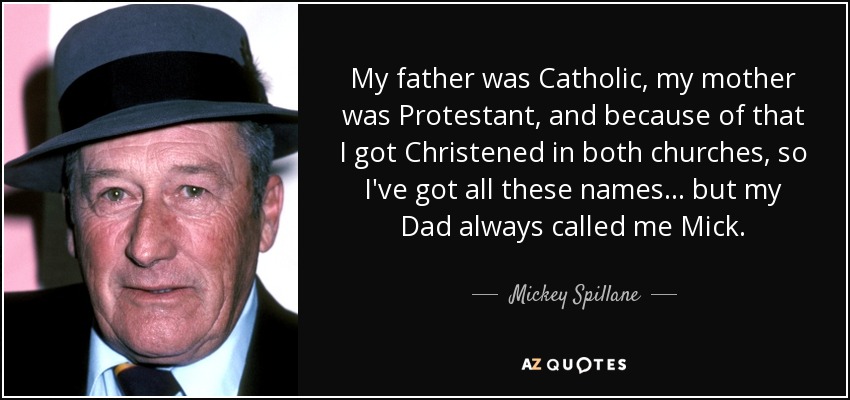
My father was Catholic, my mother was Protestant, and because of that I got Christened in both churches, so I've got all these names... but my Dad always called me Mick.
This regard for the liberties of Europe, this care at one time for the protestant interest, this excessive love for the balance of power, is neither more nor less than a gigantic system of outdoor relief for the aristocracy of Great Britain.
The irony is that in our decades, the combination of rationalism, asceticism, and individualism (the so-called Protestant Ethic) has produced precisely the system of boondoggling, luxury-consumption, and status.
The Church is our Mother, which means it is an internal voice. It is not a set of external rules. That's what isn't understood about Catholicism in this Protestant culture. It means that your conscience is formed by the Church, but in the end you're responsible for your own activities.
I work within the framework of a very concerted, purely driven Protestant Christian mindset. I had dark early circumstances. I went inward. I have a sturdy will. I have a big heart. I'm a decent guy. And I have a great gift. It's blunted me to the world in many ways.
The persecution of the innovator and protestant has always been inspired by fear on the part of constituted authority of having its infallibility questioned and its power undermined.
Hence from all we have hitherto said, it is clear beloved Catholics that we cannot approve the opinions which some [Protestants, Jews, and other heretics] comprise under the head of Americanism [freedom].
Protestants, from the first, have been distinguished from their opponents by what they do not believe; to throw over one more dogma is, therefore, merely to carry the movement one stage further. Moral fervor is the essence of the matter.
I think that we live in a remarkably networked world. The problem with that, of course, is that tensions can travel in nanoseconds across the Internet, and so the tensions between Shiites and Sunnis in Baghdad, or between Protestants and Catholics in Belfast - those show up in different parts of the world.
If you read Calvin, for example, he says, How do we know that we are godlike, in the image of God? Well, look at how brilliant we are. Look how we can solve problems even dreaming, which I think is true, which I've done myself. So instead of having an externalized model of reality with an objective structure, it has a model of reality that is basically continuously renegotiated in human perception. I think that view of things is pretty pervasively influential in Protestant thought.
My background is Protestant so I benefited from the great Bible teaching that was provided there... I did love the more culturally classical things, like Irish music, which I think is some of the most congregational-style music when you think of... 'St. Patrick's Breastplate' (and) 'Danny Boy.' These are traditional Irish melodies. I think being brought up there (Ireland) gave me a sense of melody that is very attuned to congregational singing.
I have met many Roman Catholic theologians who will emphasize as much as any good Protestant preacher that everything comes from the love and grace of God.
We have to separate here the church in its broad sense. We have Catholics, Protestants, Eastern Orthodox churches. The Catholic church is a corporation like a chief executive. A fairly homogenous operation. Today its attitude toward anti-Semitism is much more severe than it's ever been. The Catholic Church today is much less the problem than the other groups.
Protestants are the more segmented group. Mainline churches - you have problems in the U.S., Europe, the Scottish Church, the Dutch Protestant Church, the state church in Norway. The evangelicals have been pro Israel, but a major effort is to bring them in on the Palestinian side. A huge problem and the problems are rising.
I grew up Presbyterian, just a basic Protestant upbringing. There were years in my life when I would go to church every Sunday and to Sunday school. Then I just phased out of it.
It was not necessarily the best of times in America when Catholics and Protestants were suspicious of and hated one another; but at least they were taking their beliefs seriously, and the more or less satisfactory accommodations they worked out were not simply the result of apathy about the state of their souls.
Though I was a Catholic, I recognized that Protestant churches had something.
A long memory is the most subversive idea in America. A tautology is a thing which is tautological. A witty saying proves nothing, but saying something pointless gets people's attention. If your kids look like you, it's hereditory. If they look like the neighbor, it's the environment. Although golf was originally restricted to wealthy, overweight Protestants, today it's open to anybody who owns hideous clothing.
The cultural contrast I saw between religions... Catholics have a lot of mediators, going through saints and Mary or whatever. Protestants in general say things to God directly.
I do not believe in the creed professed by the Jewish church, by the Roman church, by the Greek church, by the Turkish church, by the Protestant church, nor by any church that I know of. My own mind is my own church.
The point is to strip down, get protestant, then even more naked. Walk over scorched bricks to find your own soul. Your heart a searching dog in the rubble.
Forget what you might have heard. There are no separate corps of angels for agnostics, atheists, Catholics, Protestants, Jews, Muslims, Mormons, Buddhists, Unitarians, Hindus, Druids, Shintoists, Wiccans, and so on. To put a spin on the old saying, it's okay if you don't believe in angels. We believe in you.
Because modern Protestants have not only forgotten what Rome was, what she is, and what she will for ever be; the most irreconcilable and powerful enemy of the Gospel of Christ; but they consider her almost as a branch of the church whose corner stone is Christ.
[Pope Francis] most recent trip was to Sweden, where he commemorated the 500th anniversary of the Protestant Reformation. That had triggered one of the biggest splits in Christianity and decades of religious wars. He went so far as to praise Luther, who was once considered a heretic in the church, as a great reformer. So what he's been doing with other Christian churches is trying to heal past wounds and work together toward a shared view of their history.
Now the ordinary Protestant, Jew or Secularist has a stereotype about Catholicism. It consists of Spanish Catholicism, Latin-American Catholicism and, let us say, a Catholicism of O'Connor's "Great Hurrah." Now there are types of Catholicism like that but this doesn't - this doesn't do justice to the genuine relation that Catholicism has had to Democratic Society.
Follow AzQuotes on Facebook, Twitter and Google+. Every day we present the best quotes! Improve yourself, find your inspiration, share with friends
or simply: