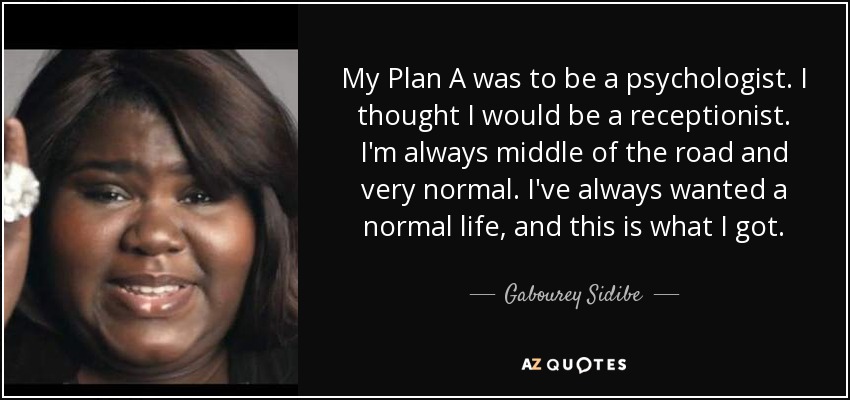
My Plan A was to be a psychologist. I thought I would be a receptionist. I'm always middle of the road and very normal. I've always wanted a normal life, and this is what I got.
Wherever possible, home is by far the best nest until at least eight, ten or twelve. Psychologists and psychiatrists who understand child development would prefer an even later age. In a reasonably warm home, parent-child responses, the true ABC's of sound education, are likely to be a hundred times more frequent than the average teacher-child responses in a classroom.
The psychologists are valiantly trying to provide us with answers, the religious people are trying to provide us with answers. I think it properly falls on the cultural workers to investigate this predicament with a little less concern for the marketplace and a little more concern for their higher calling.
Psychologists tested the story of the Good Samaritan. What they learned gives us reason to pause. The greatest determinant of who stopped to help the stranger in need was not compassion, morality, or religious creed. It was those who had the time. Makes me wonder if I have time to do good.
I think of myself as a social scientist. In order to get hired and to get promoted, we're forced to declare a disciplinary and sub-disciplinary specialty, so I am a psychologist and I am a social psychologist within that. But I think the exciting thing is to think about the social sciences in general and the nature of society. It's one of the hardest things to think about, because our brains aren't designed to think about these emergent entities. We're not good at it.
Philosophers and psychologists have long puzzled over the question of how we know as much as we do despite our limited experiences. One way is to see how children learn. Another example is consciousness. The concept is usually explored by armchair academics. Looking at kids expands our conceptions of consciousness.
I don't think anybody should go through life without a team of psychologists. I have been through times when I'm literally squatting in the living room, having one of those open-throated cries, where you're crying all the way to your butthole. I always believed I would come out of it, though.
After my husband, Dave, died, I called my friend Adam, a psychologist who studies how people find meaning in our lives, and I asked him what, if anything, I could do to help myself and my kids get through this. We started talking about resilience, then reading about it, then talking to other people who had gotten through grief and other huge challenges. In time, those conversations and that research helped me heal.
I have always trusted writers, books, thinkers, psychologists in figuring things out. Maybe because they don't know me, so they are always honest, if that makes sense. Their wisdom and counsel are always unconditional.
I was a man who played basketball and after I played basketball and before I played basketball I was going to be a psychologist, whereas most people who play their occupation is their definition - and then when they stop doing who they are, they become nothing.
For one thing, studying language is by itself a part of a study of human intelligence that is, perhaps, the central aspect of human nature. And second, I think, it is a good model for studying other human properties, which ought to be studied by psychologists in the same way.
We've learned a lot from the great psychologists. Wilhelm Reich wrote about the relationship between fascism and sexual repression. Freud rediscovered the underworld of consciousness that European rationalism had denied. But when you have a nation of people in therapy and counselling, "support" groups for every kind of human condition, where, in the clichés of that milieu, people "share" and "heal," the question, "What for?", "What now?" is no longer asked.
The most important thing you can do individually and organizationally is to pay attention to your own creativity. Sports psychologists call this muscle memory or paying attention to your perfect performance. In your own life you can notice when you do something that works right for you and celebrate it. The more you do this, the greater the probability that you will act creatively in future situations.
It is culturally constructed, but not unnecessary. A crisis is a period in a person's life that lasts at least a year during which there is an unusual level of emotional instability, negativity, and crucially, major changes. This is important because right now, when you diagnose mental health problems, where you are in life doesn't really come into it. Psychologists are saying that it should.
There seems to be something in the zeitgeist, and maybe it's a function of - I'm no analyst, nor am I a psychologist - when you look at things and say, What if I could go back and change things? I think we live in a world right now where people are asking those questions a lot. What if we could go back and change what we did? How would we change the way we handled things in the Middle East, and how would we change things with the banking industry, and how would we change economic and educational issues?
I grew up thinking the best job in the world would be a Jedi and being a psychologist is the closest thing I could get, so I wanted to be a Jedi and I don't want to be a Sith, so that is what keeps me on the straight and narrow.
I try to come to my reporting as a real, whole person, not an automaton. And it's always one of the strange discomforts of the job, that you're in this very intense moment in someone's life - you're engaging with them nonstop - and then suddenly your piece is out and that's done. It always reminds me that the journalist's job isn't to be someone's friend, or their psychologist, or anything other than what we actually are. And at the end of the day, that can definitely seem like such a strange, extractive relationship.
The physical basis for sociopathy is approximately 50 percent inheritable, which sounds more dramatic than it probably is, because most personality characteristics that psychologists test for and study the genetics of are about 50 percent inheritable. Introversion, extroversion, it turns out that they're about 50 percent inheritable, which means that somehow sociopathy is physical, it's organic.
Psychologists would say that the only two important forms of social learning are imitation and teaching, and they will spend time trying to figure out if animals imitate or teach. Sometimes they find they do; sometimes they find they don't. And so that's kind of the level of controversy there. Biologists would include imitation and teaching and a range of other kinds of social learning. So we would call that culture, whereas the psychologist wouldn't.
When we take out school psychologists, truant officers, counselors, art, music, and athletics, and bring in the police, the school gets turned into a feeder system for the penal system.
Psychologists, like other scientists, pride themselves on being extremely modern, and therefore much better than any group of people that ever were before.
Right now, America doesn't ask us to do anything besides pay taxes. We don't even have to vote. But as psychologists will tell you, when you have to sacrifice for something, you value it more. What about national service for young people? Everybody between 18 and 24 could spend a year or two working for this country in some capacity. It'd be an amazing thing. And it would mix this country racially, culturally, economically.
You have to be a psychiatrist too, especially in fashion. A psychologist and a psychiatrist together.
Can a controlled experiment explain why people like Kewpie dolls in one year, Beanie Babies in another, and American Girl dolls this year? Yet social scientists are asked to answer analogous questions. We economists and perhaps psychologists shouldn't overreact to the derision. That is, we shouldn't try to overlay a false sense of precision on our admittedly squooshy work.
My clinical psychologist wife of 40 years has always had a close intellectual influence on me. When I was beginning to talk openly in the economics profession about irrationality in decision-making, I received a lot of criticism. Ginny would support my views and remind me that a whole other profession - psychology - studies people's irrational sides.
Follow AzQuotes on Facebook, Twitter and Google+. Every day we present the best quotes! Improve yourself, find your inspiration, share with friends
or simply: