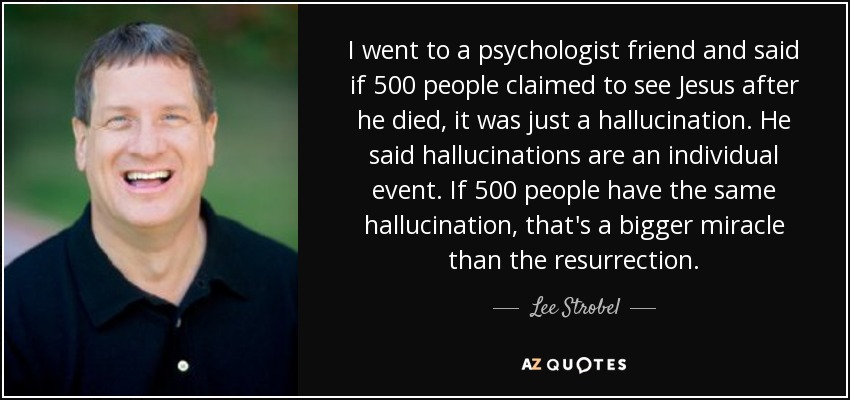
I went to a psychologist friend and said if 500 people claimed to see Jesus after he died, it was just a hallucination. He said hallucinations are an individual event. If 500 people have the same hallucination, that's a bigger miracle than the resurrection.
So far as love or affection is concerned, psychologists have failed in their mission. The little we know about love does not transcend simple observation, and the little we write about it has been written better by poets and novelists.
By instructing students how to learn, unlearn and relearn, a powerful new dimension can be added to education. Psychologist Herbert Gerjuoy of the Human Resources Research Organization phrases it simply: 'The new education must teach the individual how to classify and reclassify information, how to evaluate its veracity, how to change categories when necessary, how to move from the concrete to the abstract and back, how to look at problems from a new direction — how to teach himself. Tomorrow's illiterate will not be the man who can't read; he will be the man who has not learned how to learn.'
I think I'm becoming a psychologist in explaining the Republican Party. It's the only way you can explain 'em. It's psychological.
I was a loner as a child and happiest at home, launching toy rockets and aeroplanes. When I started causing trouble in my third year at grammar school, Mum was really surprised. My parents sent me to a child psychologist, who suggested I might have Asperger's syndrome.
One of the perks of being a psychologist is access to tools that allow you to carry out the injunction to know thyself.
Beautiful people are always with us, as evolutionary psychologists and a trip to the news-stand confirm.
In the high school classroom you are a drill sergent, a rabbi, a shoulder to cry on, a disciplinarian, a singer, a low-level scholar, a clerk, a referee, a clown, a counselor, a dress-code enforcer, a conductor, an apologist, a philosopher, a collaborator, a tap dancer, a politician, a therapist, a fool, a traffic cop, a priest, a mother-father-brother-sister-uncle-aunt, a bookeeper, a critic, a psychologist, the last straw.
How do we regulate our emotions? The answer is surprisingly simple: by thinking about them. The prefrontal cortex allows each of us to contemplate his or her own mind, a talent psychologists call metacognition. We know when we are angry; every emotional state comes with self-awareness attached, so that an individual can try to figure out why he's feeling what he's feeling. If the particular feeling makes no sense—if the amygdala is simply responding to a loss frame, for example—then it can be discounted. The prefrontal cortex can deliberately choose to ignore the emotional brain.
From my perspective as a depth psychologist, I see that those who have a connection with story are in better shape and have better prognosis than those to whom story must be introduced.
Follow AzQuotes on Facebook, Twitter and Google+. Every day we present the best quotes! Improve yourself, find your inspiration, share with friends
or simply: