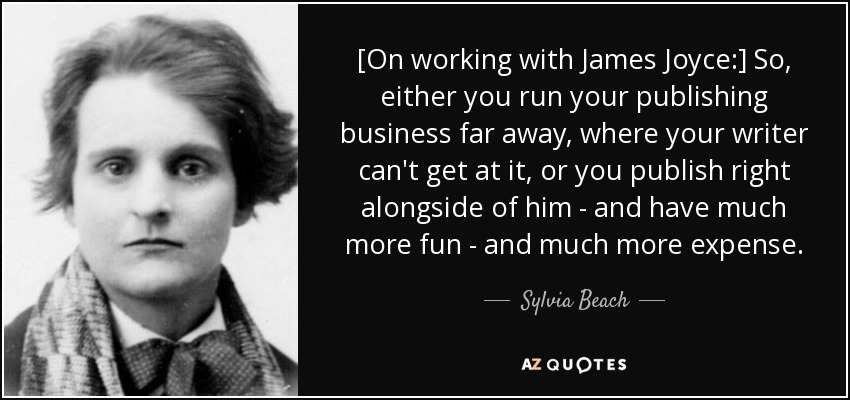
[On working with James Joyce:] So, either you run your publishing business far away, where your writer can't get at it, or you publish right alongside of him - and have much more fun - and much more expense.
I have a lot of novels that I haven't finished. I usually get 150 pages in and I realize it's not going anywhere. I don't publish everything I write. I must have six unfinished novels at least.
Mathematics and art are quite different. We could not publish so many papers that used, repeatedly, the same idea and still command the respect of our colleagues.
Most publishers seem very reluctant to publish short story collections at all; they bring them out in paperback, often disguised as novels.
No man divulges his revenue, or at least which way it comes in: but every one publishes his acquisitions.
Publicity is the only thing some people fear. An aroused public opinion has been the cause of most reforms. Telling the truth is perhaps the pacifist's only weapon. Over and over again, even the suggestion that one may publish the facts has changed a scornful, bullying opponent into an almost subservient helper. But how dangerous it is!
The attitude of, I will never self-publish, coming from any author, indicates that they have never been in a position where it is their only option.
It will be practicable to blot written words which you do not publish; but the spoken word it is not possible to recall. [Lat., Delere licebit Quod non edideris; nescit vox missa reverti.]
What an age do we live in, when 'tis a miracle if in ten couples that are married, two of them live so as not to publish to the world that they cannot agree.
Each of my books has taken me a different length of time to write - eight months for Seesaw Girl, eight months for Shard, three years for When My Name Was Keoko! The publisher takes another year and a half to work on the book, so altogether each book can take up to three or four years to publish.
My writing is of a very different kind from anything I've heard about. All this mythological material is out there, a big gathering of stuff, and I have been reading it for some forty- or fifty-odd years. There are various ways of handling that. The most common is to put the material together and publish a scholarly book about it. But when I'm writing, I try to get a sense of an experiential relationship to the material. In fact, I can't write unless that happens ... I don't write unless the stuff is really working on me, and my selection of material depends on what works.
As a journalist, I would talk to writers, directors, creative people, and discover that for an awful lot of them, the moment they became successful, that was all they were allowed to do. So you end up talking to the bestselling science-fiction author who wrote a historical-fiction novel that everybody loved, but no one would publish.
We publish only to satisfy out craving for fame; there's no other motive except the even baser one of making money.
I began writing seriously in my mid-20s and didnt publish my first book until I was 41.
I certainly have opportunities many can only dream of - but in most ways Im a typical girl in her 20s trying to forge a career and represent herself in what can sometimes seem rather strange circumstances. One of the most attractive has been the chance to publish Celebrate.
There are many people who say, I write for myself. I think that if you write and publish, then you write for your readers, not just for yourself. Many writers say that they write to be loved. I place myself among those writers.
Brahms believed that there was no need to publish absolutely everything that Schubert ever wrote.
We believe we're moving out of the Ice Age, the Iron Age, the Industrial Age, the Information Age, to the participation age. You get on the Net and you do stuff. You IM (instant message), you blog, you take pictures, you publish, you podcast, you transact, you distance learn, you telemedicine. You are participating on the Internet, not just viewing stuff. We build the infrastructure that goes in the data center that facilitates the participation age. We build that big friggin' Webtone switch. It has security, directory, identity, privacy, storage, compute, the whole Web services stack.
It's become something of a ritual - every year, Google publishes its year-end summary of what the world wants, and every year I complain about how shallow it is, given what Google really knows about what the world is up to.
By this point, it was clear she wasn't interested in continuing the relationship. What publication on earth would continue a relationship with a writer who would refuse to discuss her work with her editors? What publication would continue to publish a writer who attacked it on TV? What publication would continue to publish a writer who lied about it - on TV and to a Washington Post reporter? ... It's true: Ann is fearless, in person and in her writing. But fearlessness isn't an excuse for crappy writing or crappier behavior.
By academic freedom I understand the right to search for truth and to publish and teach what one holds to be true. This right implies also a duty: one must not conceal any part of what on has recognized to be true. It is evident that any restriction on academic freedom acts in such a way as to hamper the dissemination of knowledge among the people and thereby impedes national judgment and action.
Bolkenstein, a Minister, was speaking on the Dutch programme from London, and he said that they ought to make a collection of diaries and letters after the war. Of course, they all made a rush at my diary immediately. Just imagine how interesting it would be if I were to publish a romance of the "Secret Annexe." The title alone would be enough to make people think it was a detective story.
It reveals to me the causes of many natural phenomena that are entirely incomprehensible in the light of the generally accepted hypotheses. To refute the latter I collected many proofs, but I do not publish them ... I would dare to publish my speculations if there were people men like you.
Just imagine how interesting it would be if I were to publish a romance of the "Secret Annexe." The title alone would be enough to make people think it was a detective story.
It was the ponderous battering ram of his novels that opened the way through the genteel reticences of American nineteenth-century fiction. . . Without [Theodore] Dreiser's treading out a path for naturalism none of us would have had a chance to publish.
Follow AzQuotes on Facebook, Twitter and Google+. Every day we present the best quotes! Improve yourself, find your inspiration, share with friends
or simply: