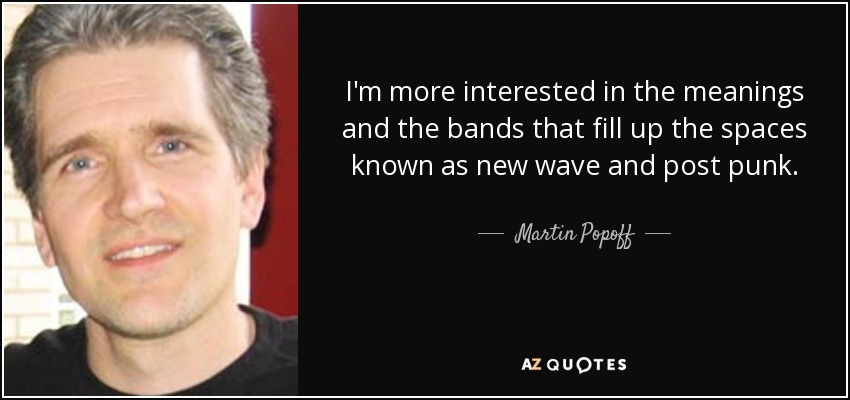
I'm more interested in the meanings and the bands that fill up the spaces known as new wave and post punk.
When I was young I wanted to make films and then I got into folk music when I was about 12, and started going to this folk club in Auckland. My dad [Barry Andrews] was in punk and post-punk bands, so I guess it was a side of music I hadn't really listened to before - the really narrative form of songwriting.
So if the punks come here, they’re going to dance with the devil and get the short end of the horn. (Zarek) No one better than my Zarek to rip someone’s head off. You two should get along famously. (Astrid)
A young woman is dead. I don’t care. You probably don’t care. The police don’t care. The papers don’t care. The punks for the most part don’t care. The only people that care are (I suppose) her parents and (I’m almost certain) the boy accused of murdering her.
I liked a lot of alternative and I like punk stuff.
The iconoclastic mode, that specific mode of language, there is an element of it that it is punk - that is confrontational. That's just a part of the language of jazz - at a certain point.
I was once a student in a punk T-Shirt hooked on screwed-up scenarios. Thats how I became the esteemed cultural figure that I am today.
My haters are laughable punks, my supporters the greatest people that ever lived.
I liked seventeen-year-old me, I was happy when I was seventeen. I was this troubled goth kid that wore eyeliner and make-up to school and listened to punk-rock music and I loved my friends and I started to make music - I like seventeen-year-old me.
I think punk, pop-punk, and rock music is all meshed together and I think good music is good music.
The only punk that I really care about and am an expert on is the original punk of 1976 to 1979.
In high school I was in a band called Goodfight, but it was more me running around on stage. It was very punk inspired. Then I started to get into indie-rock and older music and decided I wanted to write my own stuff. I quit the band. Around 16 or 17, I started recording myself at home on keyboard and piano.
When I was 13, I kind of got into the punk scene. I realized it was easier to wear a pair of combat boots and jeans and a beat-up T-shirt. I think of it as a uniform: Ya know, if you're a Maytag man, you put on your bow tie. I still have T-shirts from when I was that age.
People will tell me, "You're such a punk rebel," this or that, but I was not that growing up. I was actually a super-sheltered, conservative girl. Now, there was probably a bit of me that was like, "Why do I have to be like that?"
I was an angry young man, as you say. I was a punk rocker, blaming the government, corporations, and anything external, like my family, for my anger. I was pretty miserable, festering in my own mind. I began to think, there has to be a different way, there has to be another way out.
If post-punk enterprise suggested that pop music could establish a fierce skittishness, an aggressive self-irony, that would enable it to transcend its manufactured state, video narcissism announces that pop has found an easy way to steal more cash from young people and damage their natural desires.
I watch a sort of primitive form of the recommodification machine around my friends and myself in sixties, and it took about two years for this clumsy mechanism to get and try to sell us The Monkees. In 1977, it took about eight months for a slightly faster more refined mechanism to put punk in the window of Holt Renfrew. It's gotten faster ever since. The scene in Seattle that Nirvana came from: as soon as it had a label, it was on the runways of Paris.There's no grace period, so that's a way in which I see us losing the interstitial.
It meant a kind of real liberation of expression. It embraced amateurism in a way that I still am inspired by. It was not about trying to get, you know, stadium gigs or even commercial radio play or even record deals for that matter. It was about saying something 'cause you meant it, and expressing something that you felt. And that was primary for that - whatever the scene, whatever punk rock means, it was very, very important to me, very formative.
The filmmaker Amos Poe was a huge inspiration for me by making guerrilla-style punk films on the streets of New York and - well, it's just a lot of painters and artists and filmmakers all within that scene, and it's very, very important to me.
Punk's really cool because it's very inclusive of all types, which I like. And I would submit that even though people talk about punk as being thuggish, I think it can be more creative than other types of music.
One thing that really attracted me to punk was the DIY aspect. And the fact that, since I was a nerd, I was like 'you mean nerds can belong to this little society? So all of these things went into my attraction to it.
I still think punk's around. It's been pushed into the mainstream and it gets harder to draw that line between what's pop and what's punk.
As long as bands are still out there slaving away in the garage and putting out their own records and just pushing the envelope for how songs should be written or how they should be played, punk will never die.
We like to be punks. We like to still be kind of edgy and if being edgy means you might teeter on that line of being inappropriate, I'm still willing to teeter on that line, even at my age. But some of them go over that line and you've gotta draw that line somewhere.
The older I get, the more of an anarchist I become, and I don't mean in a punk rock way.
Follow AzQuotes on Facebook, Twitter and Google+. Every day we present the best quotes! Improve yourself, find your inspiration, share with friends
or simply: