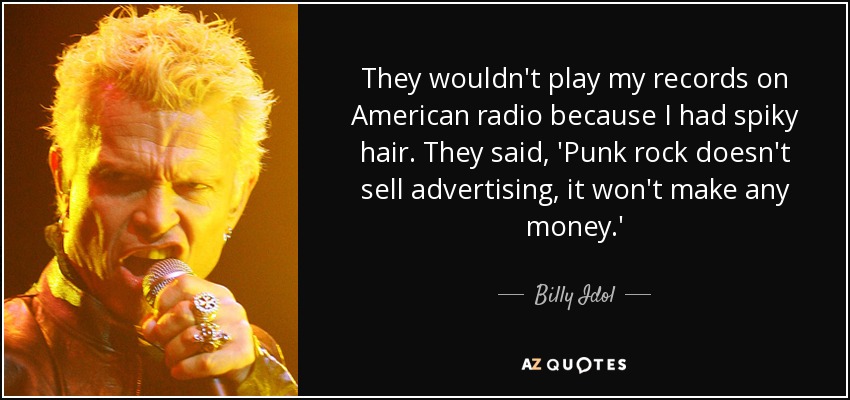
They wouldn't play my records on American radio because I had spiky hair. They said, 'Punk rock doesn't sell advertising, it won't make any money.'
My hair used to be real long, and my parents were encouraged when I cut it. They thought I was going 'straight,' but I was just getting weirder - at least in their eyes. I was getting into the punk thing.
I was trained as an actress. But I wasn't a very convincing actress, so I started doing punk poetry and then fell into doing stand-up.
I've always thought that gaming and YouTube and the web is a very post-punk extravaganza.
I can't find anything wrong with Ashton Kutcher. I think he's great. It's odd that in America there's a very mixed reaction to him. I think those that have only seen him on 'Punk'd' or 'That 70s Show' get him wrong. There's much more to him than those characters or that persona he plays in those shows.
Where there is young people and vitality, you're going to find punk rock.
Punk can be a mental ghetto. People get into it and make all these rules and pretty soon they're worse than born again Christians and have stupid three hour conversation about things like, which band is a sellout and is straight edge cool or un-cool and it's just completely idiotic. So punk has taught me the aesthetic of the outsider, which is great, but it's also taught me not to get involved in petty little cults.
If something is visceral and unsettling for me, my job is to not look away, not to punk out. Sometimes the dark things come from places inside me, experiences Ive had, that need to be transformed.
I sometimes feel a bit embarrassed to play guitar. There's something - I don't want to sound ungrateful - but there's something very old-fashioned and traditional about it. You meet kids today whose grandparents were in punk bands, really. It's very old and traditional, But then, you know, so is an orchestra and so is the string section.
I just think that playing bass, like punk rock bass with a pick, wasn't meant to be done for 25 years.
I grew up in the '80s and '90s listening to Public Enemy and Mobb Deep and the Smashing Pumpkins. I don't even know what it was like in the '60s - I wasn't alive then - so the Mayer Hawthorne sound is taking what I can learn from the classics, and blending it with my hip-hop DJ and producer background and punk-rock bands that I played in as a kid.
Punk was a protest against work and against boredom. It was a sign of life, a rant, a scream, a rejection of bourgeois morals. But have things improved since then? Arguably, they've got worse.
Part of the punk attitude was that you should project your music through your whole body... show your personality as much as possible.
Grunge is a hippied romantic version of punk.
I was originally like a punker, know what I mean, like the punks are today, I'd spit in a minute.
I love country music, blues, and punk, and one day I might make those kinds of records.
When I was growing up I never babysat. I was considered to 'punk rock' to be trusted with kids.
I think I began getting really influenced by that whole punk scene around the age of 13 or 14-I went through that whole thing like the shaved head. I was always interested in what people called "the darker side," whatever that was, and the kind of look that you would see in the old horror films. So I let that become more of my persona.
So if the punks come here, they’re going to dance with the devil and get the short end of the horn. (Zarek) No one better than my Zarek to rip someone’s head off. You two should get along famously. (Astrid)
If there is a new fascism, it won't come from skinheads and punks; it will come from people who eat granola and think they know how the world should be.
I am genuinely into soul, R&B and hip hop - all these genres that get slapped under the 'soul' genre. That spoke to me more than it did to my punk-rock friends. And punk spoke more to me than it did to my soul friends. I basically didn't fit comfortably in either world.
I was always interested in music, I felt it was time to do it, coming out of the punk scene [1979]. I thought it was ideal that anyone could just put together a group and make it work. Then, of course, it became a little more detailed after starting it and realizing that it was something serious, not just a one-off situation. I had to put a lot more into it. Also I did it to get a lot of things out of my system, things that had been put there while I was growing up in my family. A sort of exorcizing of demons.
Crisis and my experience of Punk Rock in Britain/Europe was anything and everything but "fun" and this sort of idea comes from people who were either not there at the time, or were and have an axe of some kind or another to grind about their own experiences with Crisis. The years between 1977 and 1980 were some of the hardest of my Life and they certainly contributed to Tony and I wanting to destroy the group in 1980 and head for sunnier pastures artistically, culturally, and whatever else we could find.
Daft Punk and I belong to the Generation 75. We were born in 1975, so we are somewhat in the middle of the rebellion and freedom of the 70s and the consumer culture of the 80s.
When I want something, I want it now, and Daft Punk taught me to be more patient.
Follow AzQuotes on Facebook, Twitter and Google+. Every day we present the best quotes! Improve yourself, find your inspiration, share with friends
or simply: