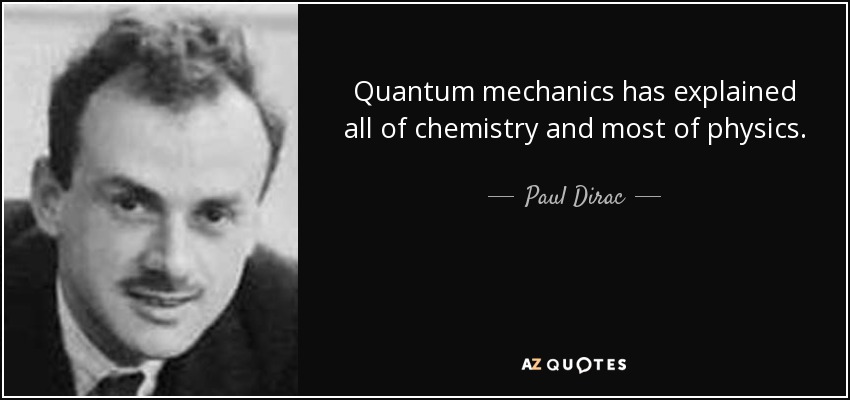
Quantum mechanics has explained all of chemistry and most of physics.
When you think about the complexity of our natural world - plants using quantum mechanics for photosynthesis, for example - a smartphone begins to look like a pretty dumb object.
A. Douglas Stone, a physicist who has spent his life using quantum mechanics to explore striking new phenomena, has turned his considerable writing skills to thinking about Einstein and the quantum. What he finds and makes broadly understandable are the riches of Einstein's thinking not about relativity, not about his arguments with Bohr, but about Einstein's deep insights into the quantum world, insights that Stone shows speak to us now with all the vividness and depth they had a century ago. This is a fascinating book, lively, engaging, and strong in physical intuition.
It is not intuitive ease I am after, but rather a point of view which is sufficiently definite to clear up some difficulties, and to be criticized in rational terms. (Bohr's complementarity cannot be so criticized, I fear; it can only be accepted or denounced - perhaps as being ad hoc, or as being irrational, or as being hopelessly vague.)
Quantum mechanics is confusing and consciousness is confusing, so maybe they're the same.
I liked quantum mechanics very much. The subject was hard to understand but easy to apply to a large number of interesting problems.
People get a lot of confusion, because they keep trying to think of quantum mechanics as classical mechanics.
Einstein's theory of relativity does a fantastic job for explaining big things. Quantum mechanics is fantastic for the other end of the spectrum - for small things.
For the record: Quantum mechanics does not deny the existence of objective reality. Nor does it imply that mere thoughts can change external events. Effects still require causes, so if you want to change the universe, you need to act on it.
Physics is really figuring out how to discover new things that are counterintuitive, like quantum mechanics. It's really counterintuitive.
Most of what Einstein said and did has no direct impact on what anybody reads in the Bible. Special relativity, his work in quantum mechanics, nobody even knows or cares. Where Einstein really affects the Bible is the fact that general relativity is the organizing principle for the Big Bang.
Quantum mechanics brought an unexpected fuzziness into physics because of quantum uncertainty, the Heisenberg uncertainty principle. String theory does so again because a point particle is replaced by a string, which is more spread out.
Scientists, therefore, are responsible for their research, not only intellectually but also morally. This responsibility has become an important issue in many of today's sciences, but especially so in physics, in which the results of quantum mechanics and relativity theory have opened up two very different paths for physicists to pursue. They may lead us - to put it in extreme terms - to the Buddha or to the Bomb, and it is up to each of us to decide which path to take.
What're quantum mechanics?" "I don't know. People who repair quantums, I suppose.
The role of gender in society is the most complicated thing I’ve ever spent a lot of time learning about, and I’ve spent a lot of time learning about quantum mechanics.
But, as we have seen, movement does not require a mover, and modern quantum mechanics has shown that not all effects require a cause. And even if they did, why would the Prime Mover need to be a supernatural anthropomorphic deity such as the Judeo - Christian God? Why could it not just as well be the material universe itself?
Just because quantum mechanics is weird does not mean that everything that is weird is quantum mechanics.
If you aren't confused by quantum mechanics, you haven't really understood it.
Nature allows only experimental situations to occur which can be described within the framework of the formalism of quantum mechanics
Bertrand Russell had given a talk on the then new quantum mechanics, of whose wonders he was most appreciative. He spoke hard and earnestly in the New Lecture Hall. And when he was done, Professor Whitehead, who presided, thanked him for his efforts, and not least for 'leaving the vast darkness of the subject unobscured'.
The difference between science and religion is that the former wishes to get rid of mysteries whereas the latter worships them.
According to inflation, the more than 100 billion galaxies, sparkling throughout space like heavenly diamonds, are nothing but quantum mechanics writ large across the sky. To me, this realization is one of the greatest wonders of the modern scientific age.
But I don't actually adopt the point of view that our subjective impression of free will, which is a kind of indeterminacy behavior, comes from quantum mechanical indeterminacy.
Niels Bohr brainwashed a whole generation of theorists into thinking that the job (interpreting quantum theory) was done 50 years ago.
You have to say now that space is something. Space can vibrate, space can fluctuate, space can be quantum mechanical, but what the devil is it?
Follow AzQuotes on Facebook, Twitter and Google+. Every day we present the best quotes! Improve yourself, find your inspiration, share with friends
or simply: