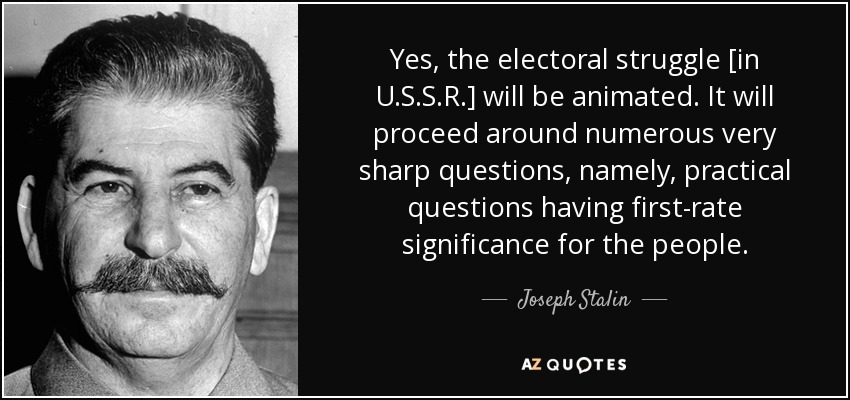
Yes, the electoral struggle [in U.S.S.R.] will be animated. It will proceed around numerous very sharp questions, namely, practical questions having first-rate significance for the people.
Right now we're concerned about budget. Right now we're concerned about the prospect of interest rate rise. We're concerned about government corruption, government handing out deals to specific groups. Coolidge fixed a problem like that. He came into a rough time and he, and Harding before him, fixed that by budgeting.
You can't have 23 million people struggling to get a job. You can't have an economy that over the last three years keeps slowing down its growth rate. You can't have kids coming out of college, half of them can't find a job today, or a job that's commensurate with their college degree. We have to get our economy going.
Once you have an equalization instrument in place, as you have in Canada, there arise tremendous bureaucratic values - bureaucratic rent so to speak - in maintaining the system that you have. To shift to a system that paid the transfers directly to individuals, by having differential rates of federal income tax levied to adjust to provincial fiscal capacities, which would be my preference, you would have huge bureaucratic opposition. People would try to protect the rents they have in the current system of institutions.
We want to limit the exploitation of the fiscal capacity of the richer regions by keeping down the rate of immigration to a level that would be meaningful and efficient. One way to do that is to have a scheme of equalization which essential bribes people to stay in the poorer regions.
When you say that after World War I there was a pandemic that killed more people than the war itself, most will say: "Wait, are you kidding? I know World War I, but there was no World War 1.5, was there?" But people were traveling around after the war, and that meant the force of infection was much higher. And the problem is that the rate of travel back then was dramatically less than what we have nowadays.
In community after community, there are unemployment rates among young African-Americans of 30 to 40 percent. Thirty to 40 percent! Kids have no jobs, they have no future. That is an issue that has got to be dealt with simultaneously as we deal with police brutality, voter suppression and the other attacks that are taking place on the African-American community.
There are systemic, painful problems of globalization and de-industrialization that cannot be solved with a phone call or a tweet or an angry speech or trying to isolate the press and the first amendment. Sooner or later, the Donald Trump show, which is a projection of strength and authority, will have to deliver to his voters. And if he doesn't, in very real terms, if he can't supersede a situation where a president cut the unemployment rate in half, if he can't do better, if he can't open factories and all the rest that he's promised, then I think he's in trouble.
Many decry rising inequality because it makes those who've fallen behind feel impoverished. But it's done much more than cause hurt feelings. It has also raised the real cost to middle-income families of achieving many basic goals. The process begins with the completely unremarkable fact that top earners have been spending at a substantially higher rate than before. They've been building bigger mansions, staging more elaborate weddings and coming-of-age parties for their kids, buying more and better of everything.
On the flat tax, the more you compress the tax rates, the more you untax where the income is really made, at the top of the pyramid.
Men's gender problems cause them a lot of suffering. There is a massive spiking suicide rate in middle age for men and a cultural attitude to male friendship that is destructive.
If we can make sure that that young boys starting at the age of three or four already knows their colors and their letters and are getting good preschool, and by the time they get into school they've got a good teacher and are getting the support that they need and are able to keep up with their classwork, that is going to do more to reduce the incarceration rate at the same time, obviously, as it increases the college enrollment rate.
You have to see the stories [The New York Times] have written, it's one after another, after another, and facts mean nothing, third-rate journalism. The great editors of the past from the New York Times and others, ladies and gentlemen, are spinning in their grave.
In most industries, technological change is happening at a rapid rate.
Global central banks are working hard to lift their economies through an aggressively easy monetary policy. The ECB [European Central Bank] and BOJ [Bank of Japan] are buying tens of billions of bonds and other financial securities each month in an effort to stimulate their economies, which is pushing down rates everywhere, including in the U.S.
For reasons that have stunningly little to do with crime or crime rates, we, as a nation, have chosen to lock up more than two million people behind bars. Millions more are on probation or parole, or branded felons for life and thus locked into a permanent second-class status.
Most criminologists today will acknowledge that crime rates and incarceration rates in the United States have had relatively little to do with each other.
Incarceration rates - especially black incarceration rates - have soared regardless of whether crime has been going up or down in any given community or the nation as a whole.
Millions of people are unable to vote due to felony convictions with the highest rates among black men. People in prison are denied the right to vote in 48 states, and while we accept that as normal in the United States, in other western democracies people in prison do have the right to vote.
When I walk, I try to set a fairly brisk rate. I love walking outside. I hate machines like treadmills. The path that I have chosen to walk is just city streets, but you see pretty houses, trees... my routes have some hills in them; it's not just straight walking. You have to exercise your heart and lungs.
From the Million Man March to this day, the crime and murder rates have significantly decreased in the major cities of America, according to police reports. I believe that the Million Man March was a significant part of the reason for the decrease.
I am a child of the digital revolution. So what I love about digital content is the quick turnover rate.
We live in a global market and money's fungible and hedge fund private equity is looking for momentum plays, and there ain't no momentum plays in bonds, right? When the interest rates were spiking up or down, well they never really spike down they do spike up though. Something's got to happen, there's got to be motion, the dice has to be rolling on the board, and if it's not then they're not going to play because they're not going to get the adrenaline rush from looking at... you know, money markets fund interest rates or bond interests or whatever. It's got to be sexy.
The Fed has a lot of power in the economy because it has a big impact on the supply and cost of credit, that is, interest rates. It also plays a key role in supervising banks and historically has seemed to take it easy on the banks when it shouldn't have, such as in the lead up to the financial crisis.
Raising interest rates might lead to some initial reductions in wealth by lowering asset prices, but it could also take a bite out of your paycheck and dampen your prospects of finding a job. It's a bit of damned if you do and damned if you don't.
Follow AzQuotes on Facebook, Twitter and Google+. Every day we present the best quotes! Improve yourself, find your inspiration, share with friends
or simply: