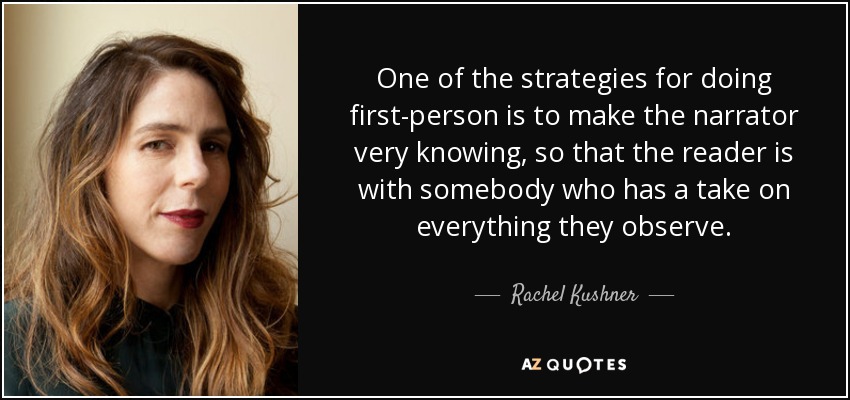
One of the strategies for doing first-person is to make the narrator very knowing, so that the reader is with somebody who has a take on everything they observe.
I've had to work hard all my life, and I will never, ever ask a fan or reader to pay for something I've rushed. It's not fair to them, and I will never give them anything except my absolute best.
By definition, memoir demands a certain degree of introspection and self-disclosure: In order to fully engage a reader, the narrator has to make herself known, has to allow her own self-awareness to inform the events she describes.
All prizes have a role, if they are run with integrity and with a clear focus on reading and quality writing. I don't think any of them is necessary, but they all play an incredibly important role in building a body of literature, in introducing new authors to new readers, and extending reading.
I'm proud of what I write and feel endorsed by my readers.
Writing is something that I've always loved. That stems from my love of being a reader.
My relationship with my readers is somewhat theatrical. One of the main things I try to do in my work is delight my readers.
What really grabs me is when a reader writes to express her personal story and how a book helped her situation, or her acceptance of a situation she can't change. I read some sad cases in my snail and electronic mail. I respond to all I can, affirming that they are the true heroes of life because they are fighting through adversity and surviving.
I feel like reading really defined me as a writer because I lived my life outside of my own body for so much of my life and I loved it. I've always been a reader. I think living all those stories served me to naturally take that next step to creating.
I majored in journalism at Arizona State University, where I began writing the columns I write now, but I cannot, in good conscience, refer to myself as a writer. I'm a columnist, maybe a journalist, I guess I'm an author, but writer... no. That's not up to me to call myself, that's rather lofty. It's for the reader to decide.
The only pressure I feel is to write good books. And to not replicate the previous book. Whether you have a thousand readers or a million readers it doesn't change the pressure. I never feel tempted to give the reader what I think the reader wants.
But it seemed to me that as soon as you have computer storage you could put every point you wanted in - make the ones that are less relevant to your central topic, further away or allow the central topic to move as the reader proceeded.
I'm not the best actor I can be, so I'm just working on it. I'm not the quickest reader in the world but when I get an acting book I can read it in two days.
Poetry and prose are of equal importance to me as a reader, and there doesn't seem to be much difference in my own writing.
Write a nonfiction book, and be prepared for the legion of readers who are going to doubt your fact. But write a novel, and get ready for the world to assume every word is true.
Writers think in metaphors. Editors work in metaphors. A great reader reads in metaphors.
I think there's no excuse for the American poetry reader not knowing a good deal about what is going on in the rest of the world.
I think there is a great difference, in that when the poet is reading you get the whole personality of the person, especially if he's a good reader. Whereas a person just sitting gets what he puts into it.
Before 'Wings' came out, I told a few people that at the end of book one, readers should think Laurel made the right choice. Then, at the end of 'Spells,' they should understand why Laurel made the choice she did.
I was just as voracious a writer as I was a reader.
I do have to earn a living, so I'm conscious of probable reactions from readers, but the most important one is still the awareness that if I'm not enjoying a story, the reader won't either.
I'm interested in Scotland now and then, how it's changed. I want to get the reader to think about that by thinking about something from the past. How has society changed, how has policing changed, have we changed philosophically, psychologically, culturally, spiritually?
I've mis-signed many a book Rollins or Clemens. My readers quickly become aware. Booksellers will often promote me under both names, and I do plug both at signings. Generally, the fantasy reader has no problem going into the suspense genre. It's harder for the typical suspense reader to go the other direction.
I'm not a masochistic reader. If something is just too dense or not enjoyable, even though I'm told it should be good for me, I'll put it down. That said, most of what I read would be considered high-end or good for you, I suppose. But, I also think that reading should be enjoyable.
One of my goals is to allow readers to see my characters and the world they inhabit as vividly as possible.
Follow AzQuotes on Facebook, Twitter and Google+. Every day we present the best quotes! Improve yourself, find your inspiration, share with friends
or simply: