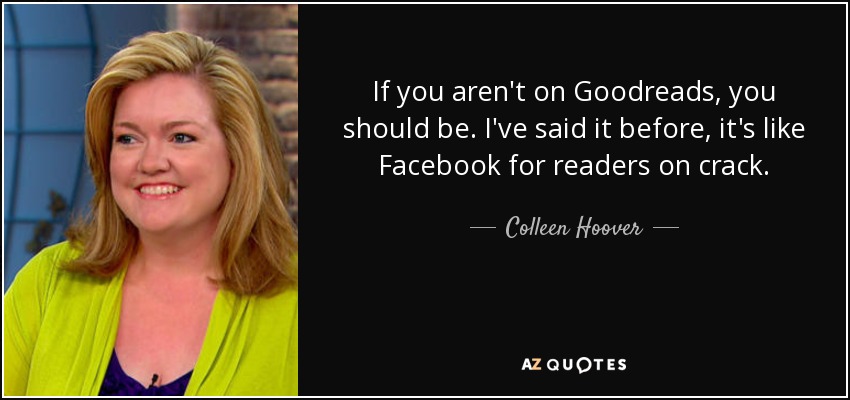
If you aren't on Goodreads, you should be. I've said it before, it's like Facebook for readers on crack.
The Transformation of the World is lavishly reinforced with critical apparatus (that, too, must have been a labor of Hercules to translate--I honestly never expected to see this book in English), but by far its greatest attraction is the intelligence and more important the wisdom of its author. It's a towering achievement no serious reader should miss.
Writing for young readers is almost like dipping into a fountain of youth; for hours a day, I am a child again.
And a more foolish notion can scarcely be imagined, it being obvious that the reader is only informed of what the writer wishes him to know, and is thus seduced into believing almost anything.
Great literature should do some good to the reader: must quicken his perception though dull, and sharpen his discrimination though blunt, and mellow the rawness of his personal opinions.
The readers who commited suicide after reading 'Werther' were not ideal but merely sentimental readers.
We can roam the bloated stacks of the Library of Alexandria, where all imagination and knowledge are assembled; we can recognize in its destruction the warning that all we gather will be lost, but also that much of it can be collected again; we can learn from its splendid ambition that what was one man's experience can become, through the alchemy of words, the experience of all, and how that experience, distilled once again into words, can serve each singular reader for some secret, singular purpose.
I quickly learned that reading is cumulative and proceeds by geometrical progression: each new reading builds upon whatever the reader has read before.
Sylvia Day delivers readers to a fantasy world as unique as it is erotic! Ms. Day is an up-and-coming talent in the world of erotic fiction. [on Pleasures of the Night ]
I think a good writer is a mix of confidence (sure that what they're writing is going to appeal to their readers) and uncertainty (what if all these words are crap?). If you're too confident, you get an attitude that seeps through into your writing, affecting the characters and the story. If you're too uncertain, you'll never finish anything.
Labels don't mean much to me one way or another -- except when they close the minds of potential readers. I'd much rather we do away with genres and simply file everything under fiction. I know it can work -- one of my favourite record stores (Waterloo Music in Austin) simply files everything alphabetically and no one seems to have much problem finding what they're looking for.
To me there's no difference between writing YA and adult except that in YA I make the book a little shorter and the protagonists are teens. The difference is in the readers.
The only real reason for self-referencing is the fun factor. It's fun for the writer, getting little peeks at what old characters might be up to. And it's fun for readers to spot a familiar face, or pick up on a made-up book title or something from an earlier story. I don't know that it does -- or even should -- contribute to the story in hand being any better than it would have been without it.
It is a fallacy to think that carping is the strongest form of criticism: the important work begins after the artist's mistakes have been pointed out, and the reviewer can't put it off indefinitely with sneers, although some neophytes might be tempted to try: "When in doubt, stick out your tongue" is a safe rule that never cost one any readers. But there's nothing strong about it, and it has nothing to do with the real business of criticism, which is to do justice to the best work of one's time, so that nothing gets lost.
Your reader is at least as bright as you are
His hypothesis goes to this - to make the common run of his readers fancy they can do all that can be done by genius, and to make the man of genius believe he can only do what is to be done by mechanical rules and systematic industry. This is not a very feasible scheme; nor is Sir Joshua sufficiently clear and explicit in his reasoning in support of it.
The modern reader (or viewer, or listener: let's include everybody) is perilously overloaded. His attention is, to use the latest lingo,'targeted' by powerful forces? Our consciousness is a staging area, a field of operations for all kinds of enterprises, which make free use of it.
But metre itself implies a passion , i.e. a state of excitement, both in the Poet's mind, & is expected in that of the Reader.
The private reader of listener can become an executant of felt meaning when he learns the poem or the musical passage by heart. To learn by heart is to afford the text or music an indwelling clarity and life-force.
If the reader enters a kind of immersive experience reading a book, then I have to enter a kind of immersive state to do my best work.
I beg the reader not to go in search of messages. It is a term that I detest because it distresses me greatly, for it forces on me clothes that are not mine, which in fact belong to a human type that I distrust; the prophet, the soothsayer, the seer. I am none of these; I'm a normal man with a good memory who fell into a maelstrom and got out of it more by luck than by virtue, and who from that time on has preserved a certain curiosity about maelstroms large and small, metaphorical and actual.
Nature is my religion. And my desire...my ambition...the great goal I wish to achieve is to take my readers with me into the heart of this Nature. I love it, and I feel that they must love it......if I can only get the two acquainted.
The secret of good writing is to strip every sentence to its cleanest components. Every word that serves no function, every long word that could be a short word, every adverb that carries the same meaning that’s already in the verb, every passive construction that leaves the reader unsure of who is doing what—these are the thousand and one adulterants that weaken the strength of a sentence. And they usually occur in proportion to the education and rank.
Most readers will be shocked by the clear record of history linking Adolf Hitler and the Roman Catholic Church in a conspiracy to exterminate the Jews
It is apparent at first glance that in The Double there is more creative talent and depth of thought than in Poor Folk. But meanwhile the consensus of St. Petersburg readers is that this novel is intolerably long-winded and therefore terribly boring.
Follow AzQuotes on Facebook, Twitter and Google+. Every day we present the best quotes! Improve yourself, find your inspiration, share with friends
or simply: