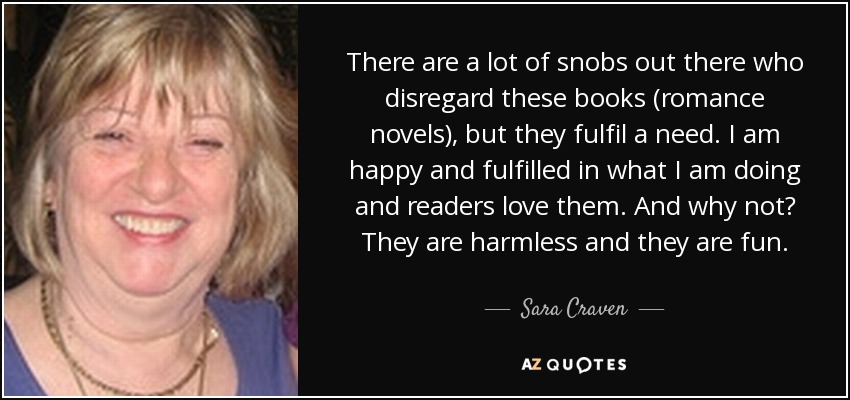
There are a lot of snobs out there who disregard these books (romance novels), but they fulfil a need. I am happy and fulfilled in what I am doing and readers love them. And why not? They are harmless and they are fun.
The reader reads aloud, with a sing-song up … then down … then down again cadence. My mood shifts from merely reluctant to derisive. It’s a tired reading style. I’m sick of it. It attaches more importance to the words than the words themselves—as they’ve been arranged—could possibly sustain, and it gives poets and poetry a bad name.
Once a poet calls his myth a myth, he prevents the reader from treating it as a reality; we use the word "myth" only for stories we ourselves cannot believe.
Some critics of my work took the view that a satirist should defer to the finer feelings of his readers and respect widely held beliefs.
Works of art are not so much finished as abandoned. Perhaps poems can be perfect. A short-short story might even be perfectible, as effective and enjoyable for one reader as the next. But novels and other book-length narratives are great rambling things that always contain some flaws. For works of any length, there comes a point when your continued tinkering won't improve the whole, but will just trade one set of problems for another.
Terry Farish seems to breathe the reader into the emotional spaces of war, exile, and refugee life. The Good Braider is a delicate stunning exploration of its young protagonist's life and heart.
As a reader I feel included a lot in Julie Carr’s hard and beautiful book. I can pretty much hear its author speak—a whispering that enables us into its world . . . a masterfully sutured journey, painfully useful. Sarah—Of Fragments and Lines is a book I know I will return to. And urge it on my friends who have lives too and write in them.
Writing is a way of living. It doesn't quite matter that there are too many books for the number of readers in the world to read them. It's a way of being alive, for the writer.
If you remember the shape of your spoon at lunch, it has to be the wrong shape. The spoon and the letter are tools; one to take food from the bowl, the other to take information off the page... When it is a good design, the reader has to feel comfortable because the letter is both banal and beautiful.
The clever reader who is capable or reading between these lines what does not stand written in them but is nevertheless implied will be able to form some conception.
If he can give his readers no reason why they should read his book, except that the events happened to him, it is not a valid book.
Sometimes the reader will decide something else than the author's intent; this is certainly true of attempts to empirically decipher reality.
Readers usually ignore the typographic interface, gliding comfortably along literacy's habitual groove. Sometimes, however, the interface should be allowed to fail. By making itself evident, typography can illuminate the construction and identity of a page, screen, place or product.
Libraries made me - as a reader, as a writer, and as a human being.
Take the time you need to learn the craft. Then sit down and write. When you hand over your completed manuscript to a trusted reader, keep an open mind. Edit, edit, and edit again. After you have written a great query letter, go to AgentQuery.com. This site is an invaluable resource that lists agents in your genre. Submit, accept rejection as part of the process, and submit again. And, of course, never give up.
Reality is not always probable, or likely. But if you're writing a story, you have to make it as plausible as you can, because if not, the reader's imagination will reject it.
I try, and I think I succeed, in making my readers feel sorry for my psychopaths, because I do.
I was quite a reader before I became a writer.
I do not allow fan-fiction. The characters are copyrighted. It upsets me terribly to even think about fan-fiction with my characters. I advise my readers to write your own original stories with your own characters. It is absolutely essential that you respect my wishes.
Many photographers feel their client is the subject. My client is a woman in Kansas who reads Vogue. I'm trying to intrigue, stimulate, feed her. My responsibility is to the reader. The severe portrait that is not the greatest joy in the world to the subject may be enormously interesting to the reader.
When you go to the mind reader, do you get half price?
The reader, the booklover, must meet his own needs without paying too much attention to what his neighbors say those needs should be.
I wish I could have a little tape-and-loudspeaker arrangement sewn into the binding of this magazine, to be triggered off by the light reflected from the reader's eyes on to this part of the page, and set to bawl out at several bels: MORE WILL MEAN WORSE.
[from a reader] Whenever I feel myself resenting someone, I reach out. I have made good friends that way.
When I was a teenager, I was a voracious reader of crime fiction, but only contemporary books.
Follow AzQuotes on Facebook, Twitter and Google+. Every day we present the best quotes! Improve yourself, find your inspiration, share with friends
or simply: