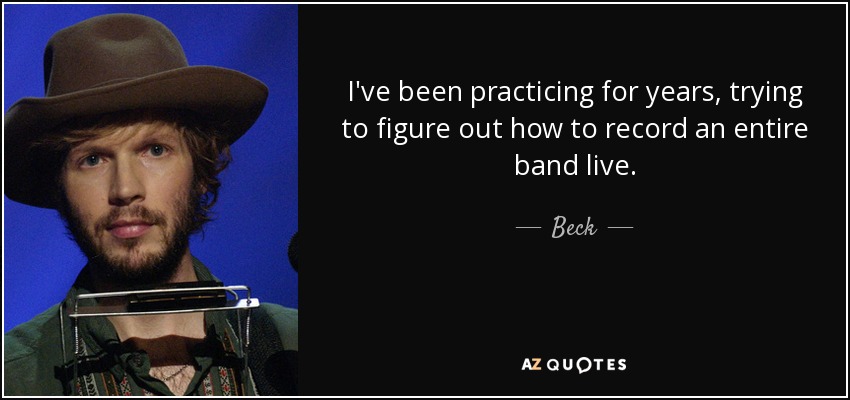
I've been practicing for years, trying to figure out how to record an entire band live.
When people want me to sign records they usually always have Vivadixie[submarinetransmissions], and I think that's a lot of people's favorite record. And that was sort of when I was just learning what I was doing.
Of course, before the internet people found records, too. You can still do it. It's just that people like to make the least amount of effort as possible.
I've always been against recreating or re-recording samples, but I managed to re-record one or two that were just too expensive and it was just ridiculous.
I record to my heart's content whatever I feel like.
In making a record there are so fewer people involved - at least in our case. There were no more than three or four people in the studio at once. So I really feel like I can stand by everything on the record and say this is something that I personally endorse.
I feel like making music because - and this has much to do with the way I was able to make this record - there's more of myself in it.
I think subconsciously or selfishly I knew that I was supposed to do something. It was like a thumping or a throbbing saying, "Yes, this what you've been waiting for." But you're a little dim to those spiritual thoughts when you're dumb like me. So I did have to get a little bit of a kick. I played it for a bunch of people and I think their reactions were warm and deep enough that they gave me the courage to get [the record] out there.
I just understand... I mean this may sound kind of bigheaded, bullheaded, or cumbersome, but when people say they've had a really deep experience with the record, like it caused a divorce or it like...I've gotten all these stories.
I love touring, I love making records, but eventually all I want...I want to score. I want people to ask me to score their film or use my songs in cinematic ways. I think the ultimate media is a story that you can watch and feel and have a musical moment to. I think it's my favorite. I love watching something when music is creating motion within the motion.
If it wasn't for this person's privacy, I'd be able to talk pretty freely about this subject on a personal level. The record's about not her. It's about my struggles through years of dealing with the aftermath of lost love and longing and just mediocrity and just bad news, like life stuff. And in the [record], where the title comes from, the lyrics are actually a conversation between me and another girl, not this Emma character.
I'll keep making records until I don't have more ideas for records.
You have to really swallow your pride and admit that you want to make a comeback. And that means that you weren't at your best and I feel like I stopped being who I needed to be. When I started making this record "Born Villain", I didn't want to be what I used to be but I certainly didn't want to be what I was at the time. I knew that I was supposed to be something better then what I was. I feel that I am close to being what I'm supposed to be and am enjoying what I'm doing here.
Everything is starting to make a little more sense to me now. I love the idea that, first of all when I made the record I don't look at the music by classifying it. People have a problem classifying me as pop, or rock, or folk, or alt. The beauty for me is that a thirteen year old girl can fall in love with the record and so can her mom. I tend to gravitate towards artists that are timeless and don't sound dated.
Mainly horror movies and exploitation movies and a lot of stuff comes from those press books from those old movies. Lines out of old movies, comic books that we collect, all the old horror comics of the 50s, probably about the only comics that we collect are obscure horror comics, the real sick ones from the 50s. Some stuff comes from there but mainly just old records, old rockabilly records and that stuff, singles mainly, 45s.
They wanted to 'radiofy' what I was doing. I was also in a position where I was compromised. I was much younger and maybe it is because I am Irish but there was a guilt factor when the record company pays you a lot of money, you feel obliged.
I don't really think of these as projects. I think of them as bands. I have tried to not just convene a group of musicians and make one record or make one gig and just drop it. Each of them develop over time. I have been really fortunate to keep a band like the Sextet together over three very different albums. Each time, the goal got more deep for me in terms of how I wanted to write for those people. So it is really about trying to develop ideas and trying to have a consistent focus on a way to come up with new ideas in music that I want to do.
As a matter of fact it wasn't until after BIG passed and stupid rumors went around that I had something to do with it, and it's like I'm not a killer man , I'm a musician, I'm a DJ we got like a different heart. Ya know back then when rappin' was fun, and we could immolate being gangstas; ya know Dr. Dre made the hardest gangsta rap records in the world, that didn't necessarily make him a gangsta. It was all like ya know : character, we were all in character.
We have signed with Artemis Records. Originally they were our distributor for 'Group Therapy'. My former manager (Chip Quigley) started a record label (Recon Records) and had Artemis Records as their distributor. Unfortunately, the way the label was run meant that it didn't turn out the way that we thought it was going to be. We simply got into something that was different to what we initially thought
When Adam's House Cat broke up in 1991, which was Cooley and my band for six years, I put my entire life, heart, and soul into that thing. I mean everything. I ended up getting divorced over it, and then the band broke up and I was left with nothing. I had nothing to show for six years of my life except for a finished record that still hasn't come out. And I went through a pretty deep, dark, two-year depression after that, [which] probably resulted in some of the earlier songs that became Drive-By Trucker songs, for that matter.
There's always only been three of us [drummer Joey Shuffield, vocalist, bassist and keyboardist Tony Scalzo and myself], but when we first started we didn't have anybody augmenting the band, so everything had to be kinda to the point anyway. We did that record and toured a while on that, but I just got sick of playing it every night. It felt like doing push-ups to me.
Before I joined Kraftwerk in 1971, I played guitar in a band called Spirits of Sound, whose members included (at times) amongst others singer Wolfgang Riechmann (Sky Records released his only solo album Wunderbar shortly after his death in 1978) and drummer Wolfgang Flür (later on Kraftwerk, now solo). The music of S.o.S. in the mid 60's first was the English pop and rock music of the times (Beatles, Kinks, Rolling Stones ).
I record at the same place [Toe Rag or FatSounds Studios in London], with the same people [Liam Watson at Toe Rag and Ed Deegan at Fatsounds], every time. It makes it effortless, and another reason for the vast output when I do go in and record stuff.
Since I left Chicago, I'm a lone wolf. I put on the record player and sit and try to play on the guitar. I've got five guitars here and can't play them, but I'm always whompin' around.
[Brion calls his working relationship with West a natural fit.] His knowledge and understanding of records across the board is great, ... That's the reason why we got along: We don't see music as something that happens in one genre.
Follow AzQuotes on Facebook, Twitter and Google+. Every day we present the best quotes! Improve yourself, find your inspiration, share with friends
or simply: