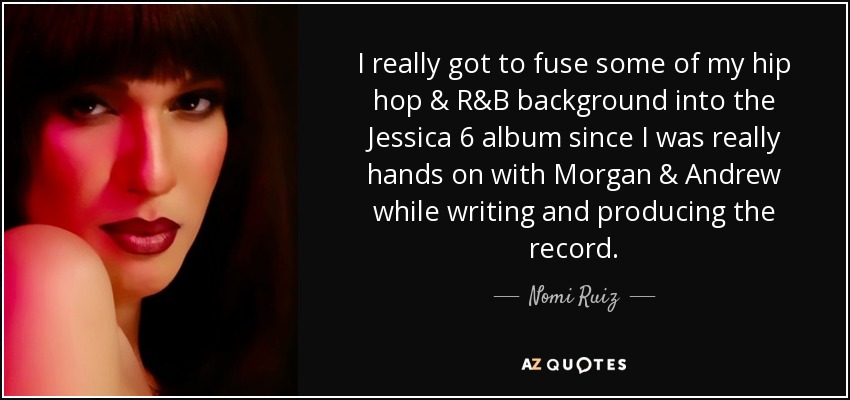
I really got to fuse some of my hip hop & R&B background into the Jessica 6 album since I was really hands on with Morgan & Andrew while writing and producing the record.
People expect us to be a straight up dance band but there are many more elements to our sound that you really get to see during our live show and hear on our record 'See The Light.'
I guess my biggest influence was actually my Grandfather. He used to play old records on vinyl, and would play old jazz and soul music like Ella Fitzgerald, Billie Holiday and The Rat Pack and swing music.
They understand what their market is and who they should be selling records to, and most importantly, they know the kind of artist that they want to be, but they have to do it themselves. You don't want a 13-year-old singing some awful song from a musical.
I was a sound engineer, and all of these gurus and shamans would come, and I would record the workshops they were teaching. And I took part in a shamanic journeying workshop, and this woman leading the workshop had brought Ayahuasca, which is a Peruvian hallucinogen and contains DMT.
The idea was that the record itself ['The Bones Of What You Believe' ] is a kind of labour of love for us - all our energy and all our passion and all the stuff we believed in is in that record, so you're kind of handing that off to other people, if that makes sense.
I feel connected to every song on this record [ 'Modern Vampires Of The City' ], but yeah I think there's something special about 'Young Lion'. It's pretty different from any song that we've had before because the vocals are kind of between two different very simple instrumental piano melodies and it's almost like something that we call a vignette, it's sort of like a miniature.
The Replacements definitely changed my life, I think they're just amazing. The thing that blew me away [a band like that] is that you'll get into a band from hearing one interesting song and then you'll realise that you've got seven or eight albums to listen to afterwards and every single one of them is a great record. The Replacements definitely changed my life.
Having solidarity is important and having conviction and sticking with it and also consistency. You can't just have one good record, or a couple of good singles, you have to continue making good music to be considered to be a great band. Having some degree of integrity, that's it in one word.
So, it just seemed like it happened naturally. We nailed our live show to some extent in a year or about a year and a half, maybe just a year of playing songs pretty much around L.A. then we went and scheduled a mini-tour up-state on the West Coast and that's when the whole Rough Trade [Records] thing started happening and from there, things just happened so quick. It changed really quickly.
I definitely didn't have a lot of money. I had been fired from a record store. I was just trying to get by. I was on unemployment. I didn't have anything going full-time.
If a record label will sign you in order for you to be moulded into something that can make more money for them, then you should get out of there if you're that artist.
I still make music. I still write music and I record music, I just don't trust music promotion [and] distribution right now enough to record a new set of diligently worked-upon compositions. I do trust the audience and the audiences very much.
When you're listening to a recording, you're supposedly listening to some aspect of the past in the present as you travel slowly into the future, but you also know there's a very strong likelihood that the future of that recording, whether you made it or whether you're listening to a Led Zeppelin record, is going to continue probably far beyond where you are.
If we were making a record in Kentucky, there might be some more elements that recall a time, a place, or a relationship. Recording for the BBC you enter into this strange and wonderful, but kind of sterile, place with which you have no personal history, and that's the Maida Vale Studios at BBC in London.
Well, this is shortly after the idea was put to me because it wasn't my idea to do a Christmas record. We can talk about that a little bit, if you like, later on. But I wrote that song actually about two days after the idea was put to me.
"I Wish It Could Be Christmas Every Day," which I actually recorded on "Quality Street" because I don't think anyone has ever covered it before. You hear it every single Christmas, and it is a great record. That's by Wizzard. It is a really great record, but I don't think anyone's ever covered it before, so I had to go it doing it differently. It's quite different from how the original goes.
I love to play music, and this is fun, and let's record this stuff in a way that we both like. That was exciting enough, so we just recorded it. There was no business in it until the very last minute, really. It was really as much of an extension of me writing the songs in my bedroom as it could possibly be.
It's great, because we've had some really great people playing with us who really have studied the record and been able to recreate a lot of what was done. But I would need a choir of eight, probably, to do all of the backup vocals.
You know, that was the first time [with Any Winehouse] that I probably ever used a baritone sax. And it's certainly the texture that, you know - it's all over the record 'cause it's a nice compliment to her tone.
And I remember that about three years before that, her first record had come out. And I just remember really liking this one song off it called "In My Bed" and being a little bit enamored. This, you know, this young kind of Jewish girl from North London, you know, I have the same thing - from a Jewish family from North London - with this incredible voice.
I guess the best thing about having a successful record like this is, like, I know I'm at least good for another five years, like, before everyone starts to like - all the haters start to come out again. And that's really what it is.
It's like every time you have one of these, you're sort of - your lease is renewed another five years. And that's kind of great for me 'cause that's all I really want to be doing still at this point, like just making records and getting to work with, like, artists that I think are exciting.
Where do you draw the line as a human being? Written record is only, what, a couple thousand years? And this scientific revolution is less than a hundred years. And computers only a few decades! We've changed so much. It's amazing, the speed of changes.
I have an artist background and I got into the field because I heard things in my own head that weren't happening and I wanted to have the control. So I learned to record and mix and do all those things. I found it as a means to an end, and I was fascinated by sound and creating sound. I very quickly became addicted to understanding everything there was to know.
Follow AzQuotes on Facebook, Twitter and Google+. Every day we present the best quotes! Improve yourself, find your inspiration, share with friends
or simply: