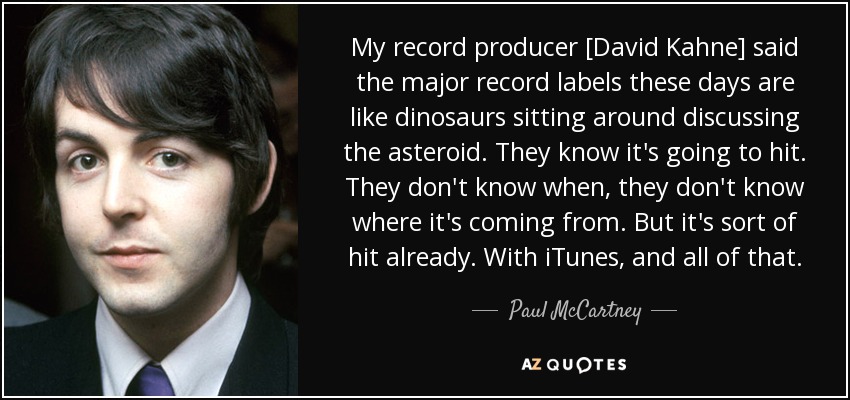
My record producer [David Kahne] said the major record labels these days are like dinosaurs sitting around discussing the asteroid. They know it's going to hit. They don't know when, they don't know where it's coming from. But it's sort of hit already. With iTunes, and all of that.
Bankrupsy stays on your record for 7-10yrs. That gives you an idea how long it takes to rebuild trust.
Senator Obama is a gifted and eloquent young man who can do great things for our country in the years ahead. But my friends, eloquence is no substitute for a record - not in these tough times for America. In the Senate he has not reached across party lines to get anything significant done, nor has he been willing to take on powerful interest groups in the Democratic Party.
'Mediocre' tends to mean 'undistinguished', while snobs enjoy their distinguishing hallmarks of style - how they wear clothes, use words, where they go and gather and gossip. ...Whatever the circumstances the genius has put you into, the fact of individuality defends the soul against all class-action claims. No soul is mediocre, whatever your personal taste for conventionality, whatever your personal record of middling achievements.
I don't know how you make a record on liberal and conservative these days. We've had a conservative Republican Congress, so to speak, and a conservative president, and we've run up one of the most astounding deficits in the history of our nation.
I read the script [ of 'Steve Jobs' movie ], and it was very, very good. I wasn't sure they would want me to be in the movie, but I auditioned for it. Which I hadn't done in a few years. But I had auditioned in the previous few years for another movie that I did not get the part. And so my track record wasn't good. But I really wanted to audition because I was worried that I was going to blow it, and I wanted it to be on them for choosing me.
I always think I'm going to record a lot on tour but it's always hard to fit it in the schedule, and there's a whole lotta' other extra curricular activities that happen on the road.
The lyrics are usually the last take. So after like five times, saying it over and over again, your voice starts to relax and you get into the groove of the record. Personally I don't raise my voice; my voice is usually lower, more casual.
Every single record I make is an act of faith in a sense, and somewhere I also have faith that the people who need to hear my music somehow will.
So often, the singer is the sound of the record. People think they can cover anything, but the whole voice is the thing that's unrepeatable.
What was great about the 80s was that you still had record companies who would get behind developing you as an artist. You had these bonkers heads of department and A&R people who, even after a flop album, would let you make another one.
I think that every record has its own life and a different sound.
I love the idea that the person that signs you makes the record, because you get that sense of guidance, of being there at that close point.
I have no perspective as regards my work. One reason I put out records and books is people respond to it, and it enables you to actually see the work more clearly. It's a form of therapy for me. Sometimes abusive therapy.
The demise of the monolithic record industry has been, for a lot of people, really liberating and emancipating.
I feel like people might be slightly less inclined to hate me as much as they did in the past, and I think part of that is selling fewer records.
There are so many musicians, friends of mine, who play shows for ten people a night, or always desperately wanted a record contract. So even if every person on the planet loathes me, I have nothing to complain about. My job is not a bad job, so I can't complain.
The eighties turned the whole system upside down. They would sign three groups and give them five or ten million dollars each to make three records. Out of those three records maybe one would be a hit. The economy changed, and that's why the music changed.
Every time I meet the CEO of a record label I tell them how they did it in the seventies because they want to know. I tell them, "Sign a hundred people! Throw it against the wall and see which ones stick!" And they frown and say, "Oh, we can't do that!" and they start mumbling about demographics and this and that.
I think the whole obsession with old gear is completely overblown. You don't need old-fashioned gear to make a great-sounding record. You don't even need [analog] tape.
Everybody was in tears. You turned on the radio or the television, and it was nothing but Gainsbourg. With typical British music journalist disdain, I just figured it was a testament to how poor French pop was if there was this much fuss about a guy who had one hit record, 'Je T'Aime (Moi Non Plus)'.
Three years between records is longer than average. Double albums are much more of a statement. I really wanted to put myself out there as much as I possibly could.
I'm glad that, despite everything, I was able to get work done and finish something. I never finish anything. So just being able to finish record and to make music is a great gift.
Every time I make a record, it's a gem with different facets, and every time I like to explore a different side. The core is the same, it never changes, but I try to create a different shape.
I always felt that's why people buy records anyhow is because they get that vicarious excitement and thrill that they don't get unless they buy your record.
Follow AzQuotes on Facebook, Twitter and Google+. Every day we present the best quotes! Improve yourself, find your inspiration, share with friends
or simply: