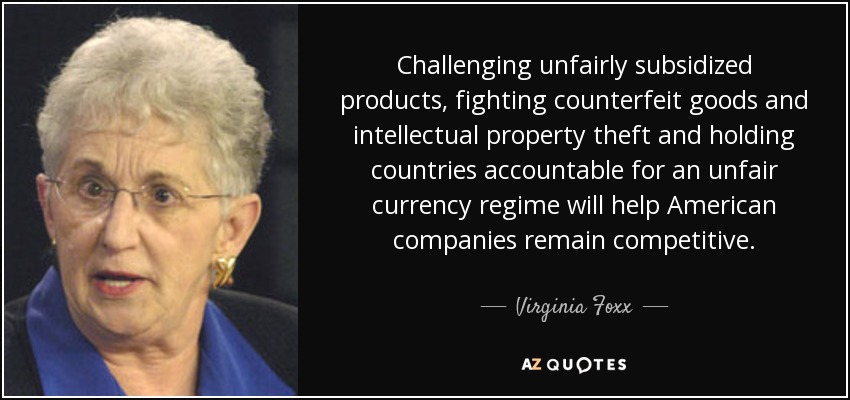
Challenging unfairly subsidized products, fighting counterfeit goods and intellectual property theft and holding countries accountable for an unfair currency regime will help American companies remain competitive.
And, in the future, while the dumb show of bohemianism plays itself out in the cookie cutter shape of the politically correct martyr/victim, aesthetic terrorists will not involve themselves in the dubious rewards of celebrity. The best of them will work alone, already a part of the enemy camp, and in chameleon-like style master the fifth-column algorithms to subvert the ancient regime. We won't know them by their name but their compensation will be to affect the outcome of the planet. Until then, there's a lot of work to be done.
Brian Myers takes a fresh approach. He largely ignores what the regime tells the outside world about itself, but concentrates instead on what North Koreans themselves are supposed to believe, paying special attention to the North Korean narratives and mass culture, including movies and television shows. (...) There are few books that can give the world a peek into the Hermit Kingdom. The Cleanest Race provides a reason to care about how those in North Korea see themselves and the West. It is possibly the best addition to that small library.
True Socialism, in which everyone is truly equal, does not just resemble a prison - it is a prison. It can not exist unless it is surrounded by high walls, by watchtowers and by guard-dogs, for people always want to escape from any socialist regime, just as they do from a prison. If you continue your attempts to establish a model society you will need to build walls around it. You will be forced to do so sooner or later by the flood of refugees.
I know something quite sure. We'll never have peace with this Syrian regime. They'll never give us relief, and we'll never forget that.
We live in a regime built on force and lies. In essence, it's the same here as in Uzbekistan, except the government here is better at presenting itself to the outside world.
But it is important to observe that when Europe or the United Nations impose sanctions that are supposed to be aimed against a certain regime, usually generally millions of people end up being directly punished.
We cannot blame other people for our troubles. We are not victims of the influx of foreign people into South Africa. We must remember that it was mainly due to the aggressive and hostile policies of the apartheid regime that the economic development of our neighbours was undermined.
Any test that turns on what is offensive to the community's standards is too loose, too capricious, too destructive of freedom of expression to be squared with the First Amendment. Under that test, juries can censor, suppress, and punish what they don't like, provided the matter relates to "sexual impurity" or has a tendency "to excite lustful thoughts." This is community censorship in one of its worst forms. It creates a regime where, in the battle between the literati and the Philistines, the Philistines are certain to win.
Man is about to be an automaton; he is identifiable only in the computer. As a person of worth and creativity, as a being with an infinite potential, he retreats and battles the forces that make him inhuman. The dissent we witness is a reaffirmation of faith in man; it is protest against living under rules and prejudices and attitudes that produce the extremes of wealth and poverty and that make us dedicated to the destruction of people through arms, bombs, and gases, and that prepare us to think alike and be submissive objects for the regime of the computer.
So that in 1974, when I graduated as a lawyer, I figured I'm not going to be a lawyer under a military regime.
Iran's continued drive to develop nuclear capabilities, including troubling enrichment activities and past work on weaponization documented by the IAEA, and its continued support to groups like Hezbollah, Hamas and other terrorist organizations make clear that the regime in Tehran is a very grave threat to all of us.
Everywhere in the world the industrial regime tends to make the unorganized or unorganizable individual, the pauper, into the victim of a kind of human sacrifice offered to the gods of civilization.
The regime of globalization promotes an unfettered marketplace as the dynamic instrument organizing international relations.
The fundamental difference between Islamic government, on the one hand, and constitutional monarchy and republics, on the other, is this: whereas the representatives of the people or the monarch in such regimes engage in legislation, in Islam the legislative power and competence to establish laws belong exclusively to God Almighty.
No democracy is born perfect, and none ever gets to be perfect. Yet democracy is superior to authoritarian and totalitarian regimes because, unlike them, democracy is perfectible.
There has never been a humane communist regime. Marxism is inherently totalitarian. It recognizes no moral limits on the state. It’s the most convenient ideology for aspiring tyrants; it also retains its appeal for intellectuals, who have proved equally skillful at rationalizing abuses of power and at exculpating themselves.
Regimes collapse when people are no longer afraid and think they're no longer alone.
Just as the 99% of Soviet citizens who supported the Soviet regime in 1985 was no indication of what the people inside the USSR really thought, the army of true believers that we think we see in the Arab world is an illusion.
The animal testing regime... is utterly futile
. . . the example given by the Nazi regime as to the ability of a modern state to destroy human lives with the same techniques used by modern industry, employing the bureaucratic apparatus readily available to any modern state, is one that can hardly be ignored. Because although history may not repeat itself, it is rare that anything introduced to human history is not used again. Whether the Holocaust was unique or not in terms of its precedents is one question; whether it will remain so is quite another.
No one can compare us to the apartheid regime. It's not like in South Africa between the blacks and the whites who belong to the same nation, or in Berlin where you find parents living on the eastern side and their children in the western side.
Stalin’s postwar goals were security for himself, his regime, his country, and his ideology, in precisely that order.
It was very depressing to realize that, when looking around for regimes that have systematically corrupted science within the past century or so, three stood out quite distinctly, head and shoulders above the rest of the herd: Hitler’s Germany, Stalin’s Russia, and Bush’s America. At times when working on the three relevant chapters, I had to remind myself which chapter was the one in front of me: the parallels between the three regimes, in terms of their vigorous attempts to trample honest science underfoot, are as horrifically close as that.
We're stuck. We're stuck between the East and the West. Between the past and the future. On the one hand there are the secular modernists, so proud of the regime they constructed, you cannot breathe a critical word. They've got the army and half of the state on their side. On the other hand there are the conventional traditionalist, so infatuated with the Ottoman past, you cannot breathe a critical word. They've got the general public and the remaining half of the state on their side.
Follow AzQuotes on Facebook, Twitter and Google+. Every day we present the best quotes! Improve yourself, find your inspiration, share with friends
or simply: