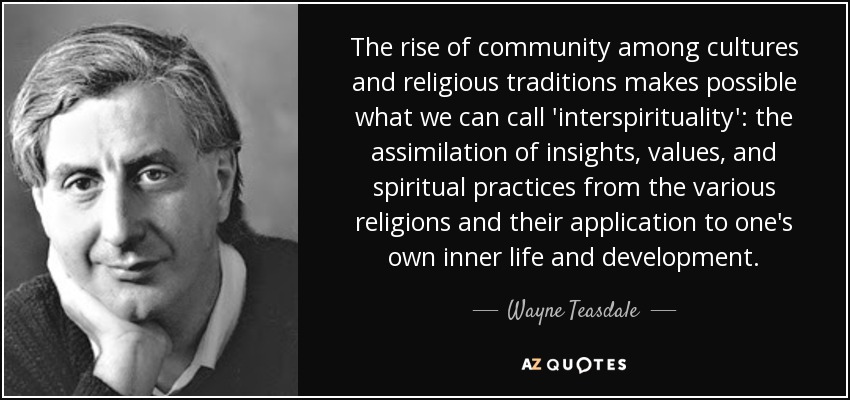
The rise of community among cultures and religious traditions makes possible what we can call 'interspirituality': the assimilation of insights, values, and spiritual practices from the various religions and their application to one's own inner life and development.
Every religious tradition on which we draw has a reverence for life. We are a part of an intricate web of life. Every tradition on which we draw teaches that the ultimate expression of our spirituality is our action. Deep spirituality leads to action in the world. A deep reverence for life, love of nature's complex beauty and sense of intimate connection with the cosmos leads inevitably to a commitment to work for environmental and social justice.
Tantra is non-dogmatic, in the sense that we don't care about the sensual world; we don't care about other religious traditions. To not care doesn't mean that we don't learn.
Remarkable is the greater openness of the Catholic Church towards people of other religious traditions and persuasions. The development has not been without problems, since some people have resisted it and others have pushed openness beyond the desirable point.
If you look throughout human history ... the central epiphany of every religious tradition always occurs in the wilderness.
Religious traditions hold enormous value, extraordinary wisdom, breathtaking insights into the human experience, but they are limited to the degree that there has not been a new theological idea expressed by any of the major religions for thousands of years.
Every time that a man has, with a pure heart, called upon Osiris, Dionysus, Buddha, the Tao, etc., the Son of God has answered him by sending the Holy Spirit. And the Holy Spirit has acted upon his soul, not by inciting him to abandon his religious tradition, but by bestowing upon him light. It is, therefore, useless to send out missions to prevail upon the peoples of Asia, Africa or Oceania to enter the Church.
Those who like myself, consider themselves to be followers of Buddha, should practice as much as we can. To followers of other religious traditions, I would like to say, 'Please practice your own religion seriously and sincerely.' And to non-believers, I request you to try to be warm-hearted. I ask this of you because these mental attitudes actually bring us happiness.
We can't really waste our time; we have to see that we are all in the same boat and that different religious traditions point in the same direction, and now let's get moving together, doing something for peace.
There is a fundamental spiritual quality to gratitude that transcends religious traditions. Gratitude is a universal human experience that can seem to be either a random occurrence of grace or a chosen attitude to create a better experience of life; in many ways it contains elements of both. Grateful people sense that they are not separated from others or from God; this recognition of unity with all things brings a deep sense of gratefulness, whether we are religious or not.
To the extent that I come from a deeply religious tradition and have been contending with those beginnings all of my life - that constitutes the subject of much of my early fiction.
I'm more often confronted by women who come from religious traditions and don't feel that they have a place in the feminist movement. I've felt pressure when reporters asked me, "Do you believe in God?" I do say, "No. I believe in people."
The critical question is how a religious tradition is interpreted. Is it interpreted in ways that are pro-human rights or in ways that are a throwback to the Dark Ages?
We Christians bring peace and grace as a treasure to be offered to the world, but these gifts can bear fruit only when Christians live and work together in harmony. This makes it easier to contribute to building relations of respect and peaceful coexistence with those who belong to other religious traditions, and with non-believers.
Like most people of my generation, I fell in love with the philosophy of existentialism. There is no particular religious tradition in my work. There is only one psychological assertion that I would insist upon. That is: the SELF takes precedence.
It's hard to rest knowing that millions of people merely carry on religious traditions but don't actually reach God.
Religion is important for humanity, but it should evolve with humanity. The first priority is to establish and develop the principle of pluralism in all religious traditions. If we, the religious leaders, cultivate a sincere pluralistic attitude, then everything will be more simple. It is good that most religious leaders are at least beginning to recognize other traditions, even though they may not approve of them. The next step is to accept that the idea of propagating religion is outdated. It no longer suits the times.
A religion made up solely of heightened religious experiences would not be a religion at all. ...The major religious traditions address the mysteries (with or without entheogens), but they have other business to do: widen understanding, give meaning, provide solace, promote loving-kindness, and connect human being to human being.
While it may be impossible to 'disprove' the existence of some 'Higher Power' or abstract Creator, it is entirely possible — through analysis and research — to find discrepancies within the ancient, organized religious traditions that support the idea of a specific God.
I don’t claim to know an over-arching ‘Meaning of Life,’ but I do operate under the understanding that life should not be lived under the pretense that it is simply a test propagated by an invisible, intangible, Creator-God. And it should not be spent identifying with religious traditions and organized groups that, historically, have been at the root of a tremendous amount of oppression and violence.
My belief is that the various religious traditions have great potential to increase compassion, the sense of caring for one another, and the spirit of reconciliation. However, I believe that a human being, without religious faith, can be a very good person - sincere, a good heart, having a sense of concern for others - without belief in a particular religious faith.
They recite their sacred books, although the fact informs me that these are a fiction from first to last. O Reason, thou (alone) speakest the truth. Then perish the fools who forged the (religious) traditions or interpreted them!
The history of our nation is intertwined with a certain religious tradition, and that the First Amendment was not intended to result in the complete exclusion of religious beliefs from our public classrooms.
A great deal of what is being published by writers in the religious tradition is a scandal and is actually turning people away from the church. The liberal writers who are continually accommodating and whittling down the truth of the Gospel are responsible.
It's always been you know, religion that has been the primary impediment to actual relationship with God, because it creates a mythology about performance -- that you can perform your way into the appeasement of the deity. And you know, when you're born inside the cultural framework that I was, and you're born inside the religious traditions that I was, that becomes your understanding of spirituality: That it's about trying to please God. So, it's really not about God at all; it's about our ability to perform according to whatever the expectations are.
Follow AzQuotes on Facebook, Twitter and Google+. Every day we present the best quotes! Improve yourself, find your inspiration, share with friends
or simply: