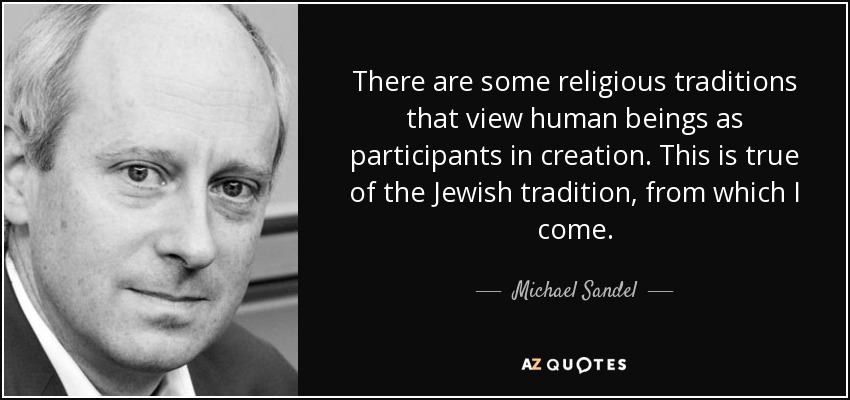
There are some religious traditions that view human beings as participants in creation. This is true of the Jewish tradition, from which I come.
It's true that to speak of an ethic of giftedness, which is very much the ethic that I deploy in raising questions about designer children and genetic engineering - an appreciation of the giftedness of the child or the giftedness of life does have religious resonance, because a great many religious traditions emphasize the sense in which the good things in life are not all our own doing; they are gifts from God.
A very enjoyable meditation on the curious thing called 'Zen' -not the Japanese religious tradition but rather the Western clich of Zen that is embraced in advertising, self-help books, and much more. . . . Yamada, who is both a scholar of Buddhism and a student of archery, offers refreshing insight into Western stereotypes of Japan and Japanese culture, and how these are received in Japan.
My belief is that the various religious traditions have great potential to increase compassion, the sense of caring for one another, and the spirit of reconciliation. However, I believe that a human being, without religious faith, can be a very good person - sincere, a good heart, having a sense of concern for others - without belief in a particular religious faith.
I don’t claim to know an over-arching ‘Meaning of Life,’ but I do operate under the understanding that life should not be lived under the pretense that it is simply a test propagated by an invisible, intangible, Creator-God. And it should not be spent identifying with religious traditions and organized groups that, historically, have been at the root of a tremendous amount of oppression and violence.
While it may be impossible to 'disprove' the existence of some 'Higher Power' or abstract Creator, it is entirely possible — through analysis and research — to find discrepancies within the ancient, organized religious traditions that support the idea of a specific God.
A religion made up solely of heightened religious experiences would not be a religion at all. ...The major religious traditions address the mysteries (with or without entheogens), but they have other business to do: widen understanding, give meaning, provide solace, promote loving-kindness, and connect human being to human being.
To the extent that I come from a deeply religious tradition and have been contending with those beginnings all of my life - that constitutes the subject of much of my early fiction.
Sometimes religion becomes yet another source for more division and even open conflict. Because of that situation, I feel the different religious traditions have a great responsibility to provide peace of mind and a sense of brotherhood and sisterhood among humanity.
We need to employ a secular approach to ethics, secular in the Indian sense of respecting all religious traditions and even the views of non-believers in an unbiased way. Secular ethics rooted in scientific findings, common experience and common sense can easily be introduced into the secular education system. If we can do that there is a real prospect of making this 21st century an era of peace and compassion.
I never intended to be a historian of religion. My aim was to become a professor of English Literature in a university, but I had a series of absolute career disasters and found myself making television programs about the nature of religion and about Christian history and started to discover about other religious traditions, and that was an absolute eye-opener for me.
We must embrace our differences, even celebrate our diversity. We must glory in the fact that God created each of us as unique human beings. God created us different, but God did not create us for separation. God created us different that we might recognize our need for one another. We must reverence our uniqueness, reverence everything that makes us what we are: our language, our culture, our religious tradition.
It is still an act of academic heresy to regard Egypt as the cradle of civilization and originator of Jewish and Christian religious traditions.
One can be a faithful disciple of Jesus Christ without denying the flickers of the sacred in followers of Yahweh, or Kali, or Krishna. A globalization of evangelism 'in connection' with others, and a globally 'in-formed' gospel, is capable of talking across the fence with Hindu, Buddhist, Sikh, Muslim - people from other so called 'new' religious traditions ('new' only to us) - without assumption of superiority and power
I then greet and cordially thank you all, dear friends belonging to other religious traditions; first of all the Muslims, who worship the one God, living and merciful, and call upon Him in prayer, and all of you. I really appreciate your presence: in it I see a tangible sign of the will to grow in mutual esteem and cooperation for the common good of humanity.
Religious traditions can be reinterpreted in a manner that assists healing, corrects distortions, and expands vision.
It is probably true quite generally that in the history of human thinking the most fruitful developments frequently take place at those points where two different lines of thought meet. These lines may have their roots in quite different parts of human nature, in different times or different cultural environments or different religious traditions: hence if they actually meet, that is, if they are at least so much related to each other that a real interaction can take place, then one may hope that new and interesting developments may follow.
While science has nothing of value to say on the great and aching questions of life, death, love, and meaning, what the religious traditions of mankind have said forms a coherent body of thought... There is recompense for suffering. A principle beyond selfishness is at work in the cosmos. All will be well. I do not know whether any of this is true. I am certain that the scientific community does not know that it is false.
We are not a religious tradition with a creed, but a religious movement that has always wedded social justice work to theology
If we are to live with our feet on the ground, in touch with reality, we must help one another accept the fact that we who are christian are heirs to a body-despising, woman-fearing, sexually repressive religious tradition. If we are to continue as members of the church, we must challenge and transform it at the root. What is required is more than simply a "reformation." I am speaking of revolutionary transformation. Nothing less will do.
We must stop using the Bible as though it were a potpourri of inerrant proof-texts by which we can bring people into bondage to our religious traditions...We must no longer use the Bible as the Pharisees used the Torah when they gave it absolute and final status. Christian biblicism is no different from Jewish legalism. It is the old way of the letter, not the new way of the Spirit.
Speaking from my own religious tradition in this Christmas season, 2,000 years ago a homeless woman gave birth to a homeless child in a manger because the inn was full.
[I]t is difficult to imagine a set of beliefs more suggestive of mental illness than those that lie at the heart of many of our religious traditions.
A cultured society that has fallen away from its religious traditions expects more from art than the aesthetic consciousness and the 'standpoint of art' can deliver. The Romantic desire for a new mythology... gives the artist and his task in the world the consciousness of a new consecration. He is something like a 'secular saviour' for his creations are expected to achieve on a small scale the propitiation of disaster for which an unsaved world hopes.
It is this mythical, or rather symbolic, content of the religious traditions which is likely to come into conflict with science. This occurs whenever this religious stock of ideas contains dogmatically fixed statements on subjects which belong in the domain of science.
Follow AzQuotes on Facebook, Twitter and Google+. Every day we present the best quotes! Improve yourself, find your inspiration, share with friends
or simply: