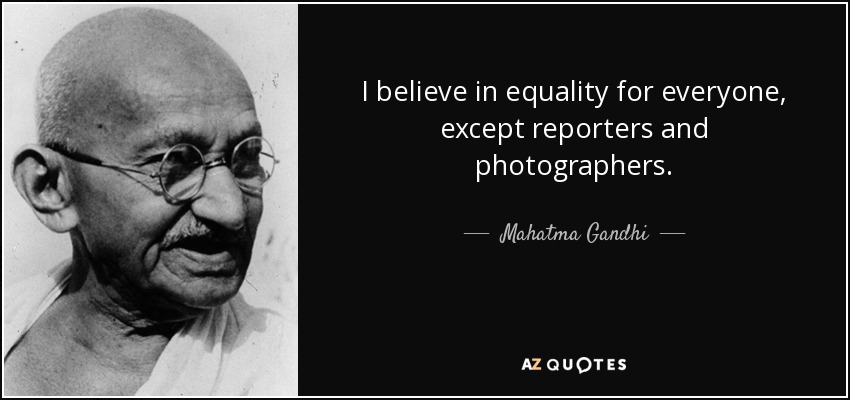
I believe in equality for everyone, except reporters and photographers.
The Bush administration works closely with a network of rapid response digital brownshirts who work to pressure reporters and their editors for 'undermining support for our troops.'
In 2014, impunity in journalism murder cases reached a staggering 96 percent and the remaining 4 percent obtained only partial justice, we have become targets. Insurgent groups no longer use reporters to transmit news, but instead kidnap them to make news. They treat us as enemy combatants and spies. This is our everyday reality.
It goes to show you how we in the press so often miss the big stories that are right under our noses. There is a famous journalistic legend about the time a young reporter covered the Johnstown flood of 1889. The kid wrote: God sat on a hillside overlooking Johnstown today and looked at the destruction He had wrought. His editor cabled back: Forget flood. Interview God.
I had - all my life, everybody who knew me thought that I would probably grow up to be a reporter, a newspaper reporter because we didn't have much television in those days.
People don't live their lives in a series of scenes that form a dramatic narrative, they don't speak in dialogue, they're not lit by a cinematographer or scored by a composer. The properties of real life and the properties of drama have almost nothing to do with each other. The difference between writing about reporters and being a reporter is the same as the difference between drawing a building and building a building.
By this point, it was clear she wasn't interested in continuing the relationship. What publication on earth would continue a relationship with a writer who would refuse to discuss her work with her editors? What publication would continue to publish a writer who attacked it on TV? What publication would continue to publish a writer who lied about it - on TV and to a Washington Post reporter? ... It's true: Ann is fearless, in person and in her writing. But fearlessness isn't an excuse for crappy writing or crappier behavior.
[Clinton] believes that the Washington press corps is so out of touch that it is absolutely inconceivable that reporters will understand the issues that people are really dealing with in their lives.
The strain on Roger (Maris) was unbelievable. After I dropped out the reporters only had one guy to go to. They surrounded him everywhere he went. He had big clumps of hair falling out. That he went ahead and did it was unbelievable.
Another question a biblically literate reporter might have asked is, "Why are you proclaiming the Ten Commandments when you believe no one can live up to all of them?"
I'm more often confronted by women who come from religious traditions and don't feel that they have a place in the feminist movement. I've felt pressure when reporters asked me, "Do you believe in God?" I do say, "No. I believe in people."
Chats are so new to newspapers, historically. But they're so incredibly valuable because editors/reporters/columnists get to find out what's on the minds of our readers, what you think we should be writing about, what ticks you off, what makes you happy. Sometimes it can confirm what you think readers are interested in; sometimes it can turn you around 180 degrees.
Maybe it has something to do with being a reporter for a long time that I don't look to newspapers and television and so forth for inspiration most of the time.
Michele Bachmann told reporters that she will lead the nation in prayer if she is elected president. You know if she is elected president, we all better be praying. She doesn't have to lead us.
I make big shots everywhere. I get accustomed to it. I'm not afraid to be the goat. I don't worry about what you (reporters) say about me in the papers. In fact, I like it. It tickles me.
I was asked by an NPR reporter once, why don't I talk about race that often. I said it's because I'm a neurosurgeon. And she thought that was a strange response. And you say - I said, you see, when I take someone to the operating room, I'm actually operating on the thing that makes them who they are. The skin doesn't make them who they are.
To this day it cracks me up to think that my debut on national British television as a reporter ends with me turning a trick.
If I have lived by any maxim as a reporter, it was that every person is an expert on the circumstances of his life.
When I was 15 or 16 and I started climbing up the ladder of success in amateur boxing, a reporter asked me, "What do you want to be?" I think he was expecting me to say, "A champion." I said, "I want to be special." I don't know why I said that, but I didn't just want to be a fighter. I wanted to have an impact with people, particularly kids.
The reporters are needed to validate the historical record.
Reporters immediately push their interviewees into the most extreme version by saying in a shocked tone, 'Well, are you saying that ..." They're trying to make people be as hostile and opposed to each other as possible because they think only conflict is news.
Foreign correspondence has a natural element of romanticism - and this could be seen as soon as that class of professional reporter emerged in the last half of the 19th century.
I sort of think in a way that many of us young reporters who had the opportunity to go overseas for our organizations were kind of, in a sense, war profiteers. We were enhancing our careers while covering that terrible conflict.
Reporters aren't stupid. We were standing around talking about which of the 900 health-care proposals that nobody's going to accept is that day's hot news. They know how silly that is. But that's what they do.
I don't do research for my novels. Obviously, in my other line of work as a reporter and a columnist, I've had the opportunity to get to know both social workers and TV talk-show hosts.
Follow AzQuotes on Facebook, Twitter and Google+. Every day we present the best quotes! Improve yourself, find your inspiration, share with friends
or simply: