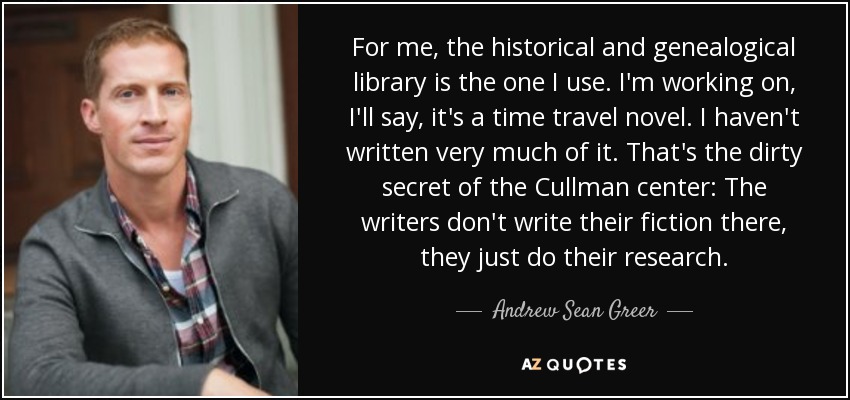
For me, the historical and genealogical library is the one I use. I'm working on, I'll say, it's a time travel novel. I haven't written very much of it. That's the dirty secret of the Cullman center: The writers don't write their fiction there, they just do their research.
Oh, I usually don't know a whole lot about a subject when I begin; the process itself teaches me a lot as I go along. Usually I know enough about one narrow area of the subject to start myself going, and then everything - including a lot more research - follows from that.
Does research get in the way of the story? It certainly can. Anything can, given that as writers we're all geniuses at procrastination. But mostly research teaches me about the world. Which often shows me the way, in terms of the story.
Because I work quite slowly, I have to keep myself interested over a long research and writing period. So I can't see myself writing about modern middle-class Londoners anytime soon.
I never really set out to research any of these stories. I try to lead an interesting life though. I guess the closest I came to research was when I applied to work at the state mental institution in Austin, TX. I wanted to work the night shift like Ken Kesey did when he wrote One Flew Over the Cuckoo's Nest. I thought that might inspire me to write a book that great.
The strong point of American research universities is the manner in which trustees, presidents and other senior executives retain a considerable amount of decision-making authority while at the same time maintaining a culture of open exchange and participatory debate.
The question of how much English should be used in international research universities is one with which I am extremely familiar. I would even say I am deeply puzzled by this trend. I am not certain what the correct answer should be.
What I see increasingly is that companies are playing political roles. We should actually have our research and our laws map that.
I try to do as little as possible without looking like an idiot. Research is fun and easy. Writing is hard. So I try not to let the research become an excuse to not do the writing part.
With the historical fictions, I was already doing so much research, and so much of the stories was anchored by historical truth that the move to nonfiction didn't feel all that dramatic - just another half-step to the right.
So it was doing all this research or going to the archives or doing all these interviews or traveling, and then trying as much as I can to delete all of that research in a later draft so that all the reader cares about is the characters.
I used to be concerned about style, worried about my work looking like a bad copy of someone who's better than me. So my embracing of the research and finding a way to replicate something consciously rather than replicate something unconsciously seemed like a way to go to distinguish what I do.
I've been told by people who write historical novels that you just sort of write the emotional truth first, the story at the core, and then you go back and research it at the end.
What happened in the interim is, billions of records have been digitized. Historians and scholars have always used genealogical records to tell the story of American history. It takes months and years of research. I can't even tell you how laborious that is. You have to be somebody who has a lot of free time, like a professor who can take tenure or someone with a great deal of leisure.
I'd done all my research and seen that Booker and Gadson had worked with giant folks and little peanuts, too. That just showed me that they're musicians. They're not just interested in doing the big ones, they're interested in doing stuff that - pardon the expression - gives them a boner. I'm like that, too. I don't want to just do easy stuff. I want to keep myself freaked out all the time. Hence the title of the record, I Like To Keep Myself in Pain.
When I began research, I read the writings of the Sonderkommandos. They are not well known, but these prisoners wrote from the middle of hell from Auschwitz, to let the world know what happened. The texts were buried beneath the ground and found after the liberation of the concentration camps.
A book is not only written - after it's finished it starts writing you, the writer. You become its notebook, its sheet of paper on which it forces you to think and rethink your original ideas, your topics, your research, actually everything.
Instead of giving it [war] a rest I continued pursuing more research, talking to more people on the subject as if I was to please this aftermath of the book by knowledge that was more historical and psychological than literary and aesthetical.
It is a bit more challenging for the simple fact that now the stories I am writing are relying more on my imagination than on facts, more on research than on memory; so it is basically a slower writing process, more reading, more exploring. On the other hand, this approach is a little bit relieving too, since many times while writing [How the Soldieer Repairs the Gramophone] I felt too close and equal to my character.
I've been to Loch Ness three times, I've done a fair amount of research on the Chupacabra and things like that, so I've actually done a bit of the sort of paranormal investigation that happens on this show [X-files].
I did this movie right after it about the life of Chet Baker. It's called Born to Be Blue. In that situation, there's a real clear character you're drawing on. It's a real person. It's really exciting and interesting to do the research to figure out how to make that a nuanced, three-dimensional human being.
We teach what we have to learn. It's been an extraordinary journey that I couldn't have done with not only the research participants but the community, the tribe that we've built of people who are also on this journey.
Maybe, through the stories I share about my life and others and the medical research that has been dedicated to the world of positive psychology, they'll relate to the power of a positive perspective and change the world one person at a time. Pipe dream, of course, but I love the thought of being given the chance to inspire!
I just need to make sure I don't get in my own way of a truthful and organic moment. Regardless of the research involved, at the end of the day, I have to show up, breathe, and listen.
I like to do my research, get in the right mental state for the person I'll be portraying. A lot of time, it's just incorporating a lot of what that person would be into, into my daily routine.
Follow AzQuotes on Facebook, Twitter and Google+. Every day we present the best quotes! Improve yourself, find your inspiration, share with friends
or simply: