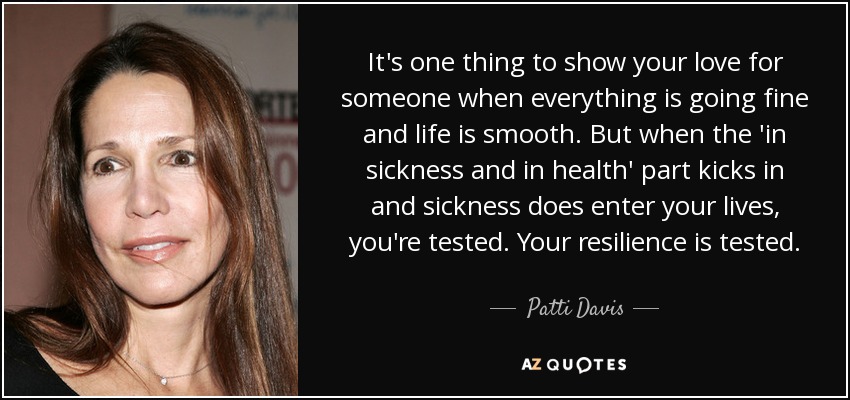
It's one thing to show your love for someone when everything is going fine and life is smooth. But when the 'in sickness and in health' part kicks in and sickness does enter your lives, you're tested. Your resilience is tested.
I want people to hear what I think about these foundational American values of personal responsibility, resilience, family and faith, there are things that people can learn from somebody who leads a state like Ohio which is, frankly, a microcosm of the country.
Our biggest challenges for the ocean and for the planet are problems of perception. People need to understand that species extinctions, habitat destruction, ocean acidification, and pollution are all chipping away at the resilience of the thin layer of life that sustains us on Spaceship Earth.
The resilience and the resourcefulness of people to make a better life, to survive, to give their children something better than they had, is so inspiring. I look at how hard it must be to get up every day and fight that battle and I think, Wow, anything I'm doing just has to be in service.
Throughout all of human history we've enjoyed certain benign circumstances: an envelope of atmosphere, an envelope of temperature. A kind of resilience that if you cut down trees, then they'll grow back. You take fish, they recover. You put stuff into the atmosphere that you know is not good for us, but we can still breathe. We haven't awakened, generally, to the sense of urgency that does exist.
It's also important that I, or [Producer] Karen Pritzker, also say that this film [ "Resilience: The Biology of Stress & the Science of Hope"] is not going to singlehandedly solve crime and poverty, or make big changes.
Resilience is not just a complimentary individual quality, but something that is built. And you build it through a number of things in your life, part of it being social fabric.
Our aim in the film ['Resilience'] is to make people understand that resilience is something you can create, build or develop, rather than just having as an inherent gift organically or thinking you are a special person. That's really important.
The Great Famine is a period of our history that we need to know in great detail in order to understand its continuing impact on us as a people. Its causes were complex. We can't apportion blame simplistically but rather [must] understand that blame has to be shared in different areas and levels of society. It was the very poorest of the poor, the small tenants and cottiers, who really suffered. Others were less affected. But most of all I welcomed the commemoration because it was a moment to look into our past and realize the courage and resilience of those who survived.
We must not forget either that some of the system's resilience is due to its ability to coopt people with money and prestige. It is easy to get sucked right in. Those who grasp the system are also likely to be talented and capable of doing well within the system. Who will turn down a lot of money? Who doesn't have an ego? A compromise here, another one there, and pretty soon, you are sucked right in.
Perseverance is what I tell my students. It's important that you keep your dream alive, because you're going to encounter a lot of obstacles, and no one is going to dream big for you. You have to have the fortitude and the resilience to stick with your own dreams. That can be hard.
Everyone faces defeats, setbacks, reversals of fortune. But just like water wearing away rock, persistence triumphs. Resilience is one of the most important qualities I would look at in trying to predict who is going to be ultimately successful.
Something called 'the Oklahoma Standard' became known throughout the world. It means resilience in the face of adversity. It means a strength and compassion that will not be defeated.
Resilience is woven deeply into the fabric of Oklahoma. Throw us an obstacle, and we grow stronger.
The use of a growing array of derivatives and the related application of more-sophisticated approaches to measuring and managing risk are key factors underpinning the greater resilience of our largest financial institutions... Derivatives have permitted the unbundling of financial risks.
Brian Walker and David Salt have written a thoughtful and powerful book to help resource users and managers put resilience thinking into practice and aim toward increasing the sustainability of our world. I urge public officials, scholars, and students in public policy programs to place this volume on their list of must-read books. It is a powerful antidote to the overly simplified proposals too often offered as solutions to contemporary problems at multiple scales.
Gratitude has a big job to do in us and our hearts. It is one of the chief ways that God infuses joy and resilience into the daily struggle of life.
Our reliance in this country is on the inquiring, individual human mind. Our strength is founded there; our resilience, our ability to face an ever-changing future and to master it. We are not frozen into the backward-facing impotence of those societies, fixed in the rigidness of an official dogma, to which the future is the mirror of the past. We are free to make the future for ourselves.
I always say African American history is the quintessential American story. It's about perseverance and resilience - something everyone can relate to.
The health of your family or your office or your city directly affects the health of it after. The better you are at handling high-stress situations with little information, those skills lead to resilience and the ability to recover afterward.
A good half of the art of living is resilience.
Follow AzQuotes on Facebook, Twitter and Google+. Every day we present the best quotes! Improve yourself, find your inspiration, share with friends
or simply: