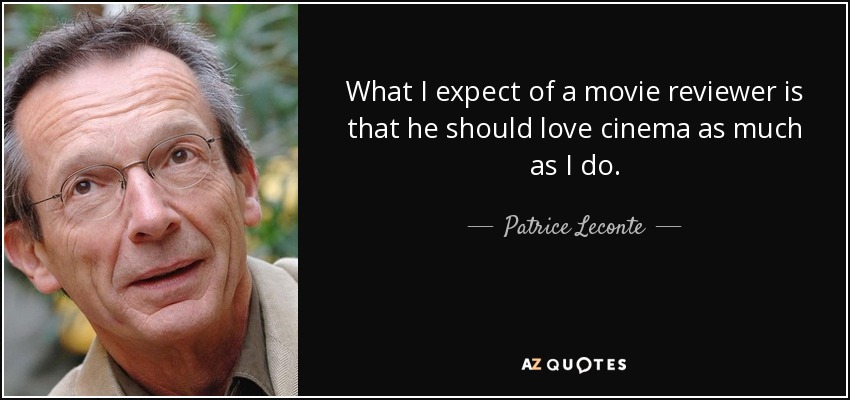
What I expect of a movie reviewer is that he should love cinema as much as I do.
Nothing would improve newspaper criticism so much as the knowledge that it was to be read by men too hardy to acquiesce in the authoritative statement of the reviewer.
Who shall dispute what the Reviewers say? Their word's sufficient; and to ask a reason, In such a state as theirs, is downright treason.
So, you see, it's a real chore for me to write a book review because it's like a contest. It's like I'm writing that book review for every bad book reviewer I've ever known and it's a way of saying [thrusts a middle finger into the air] this is how you ought to do it. I like to rub their noses in it.
Reviewer: 'One of your themes was very similar to one of Beethoven's!' Brahms replied, 'Of course it is. Everyone steals - the important thing is to do it brilliantly.
It is a fallacy to think that carping is the strongest form of criticism: the important work begins after the artist's mistakes have been pointed out, and the reviewer can't put it off indefinitely with sneers, although some neophytes might be tempted to try: "When in doubt, stick out your tongue" is a safe rule that never cost one any readers. But there's nothing strong about it, and it has nothing to do with the real business of criticism, which is to do justice to the best work of one's time, so that nothing gets lost.
With a poetry book I can send 100 copies out to reviewers and other people, and even do it in advance and get their response. It's difficult with iPad: how do you send it out for free, and how do you even disseminate it before it goes into their store?
The public examination of homosexuality in our contemporary life is still so coated with distasteful moral connotations that even a reviewer is bound to wonder uneasily why he was selected to evaluate a book on the subject, and to assert defensively at the outset that he is happily married, the father of four children and the one-time adornment of his college boxing, track and tennis teams.
Sometimes I am a collector of data, and only a collector, and am likely to be gross and miserly, piling up notes, pleased with merely numerically adding to my stores. Other times I have joys, when unexpectedly coming upon an outrageous story that may not be altogether a lie, or upon a macabre little thing that may make some reviewer of my more or less good works mad. But always there is present a feeling of unexplained relations of events that I note, and it is this far-away, haunting, or often taunting, awareness, or suspicion, that keeps me piling on.
You read reviews by top reviewers of films that not only had remarkably interesting scores, but films whose effectiveness was absolutely enhanced, and frequently created by the music, yet the reviewers seem unaware that their emotions and their nervous reactions to the films have been affected by the scoring. This is a serious flaw. Any film reviewer owes it to himself, and the public, to take every element of the film into account.
There is a secret and wholesome conviction in the heart of every man or woman who has written a book that it should be no easy matter for an intelligent reader to lay down that book unfinished. There is a pardonable impression among reviewers that half an hour in its company is sufficient.
I think my favorite fact about myself is that I have never been dismayed by a critic's bilge or bile, and have never once in my life asked or thanked a reviewer for a review.
An intelligent man or woman willing to make a career of reviewing fiction is hard to come by ... And the temporaries do the work cheaply. Moreover, continuity may be got at the expense of intellectual arthritis; a reviewer who has been at his grisly task for half a lifetime may stiffen into prejudices of every sort, and become too anchylosed to do better than turn his back to a new wave when it rushes down on him.
We've learned over the years that if we wanted we could write anything that just felt good or sounded good and it didn't necessarily have to have any particular meaning to us. As odd as it seemed to us, reviewers would take it upon themselves to interject their own meanings on our lyrics. Sometimes we sit and read other people's interpretations of our lyrics and think, 'Hey, that's pretty good.' If we liked it, we would keep our mouths shut and just accept the credit as if it was what we meant all along.
I think in many ways the problem that my writing would have with an American reviewer is that Americans find difficulty very hard to take. They are inevitably looking for a happy ending.
I can't write a scene unless I've visualized it. Unless I can actually see it, and that's why a lot of reviewers have said my books are very cinematic, because I actually do see them before I write them.
When I began to read as an adult, I read almost exclusively novelists of a generation back. I did the Russians, then I started getting more up to date. When you become published and become a reviewer, piles of books come along and you are pushed by fashion and what you are commissioned to do.
Religion embarrasses the commentators. It is offbounds. An editor of the old Life magazine once assigned me a book on religion with remark that I was the only 'religious nut' - his term for a believer - in his stable of regular reviewers.
I have no trouble publishing in Soviet astrophysical journals, but my work is unacceptable to the American astrophysical journals. [Referring to the trouble he had with the peer reviewers of Anglo-American astrophysical journals because his ideas often conflicted with the generally accepted or “standard"” theories.]
Because, as we know, almost anything can be read into any book if you are determined enough. This will be especially impressed on anyone who has written fantastic fiction. He will find reviewers, both favourable and hostile, reading into his stories all manner of allegorical meanings which he never intended. (Some of the allegories thus imposed on my own books have been so ingenious and interesting that I often wish I had thought of them myself.)
No man's thoughts are new, but the style of their expression is the never-failing novelty which cheers and refreshes men. If we were to answer the question, whether the mass of men, as we know them, talk as the standard authors and reviewers write, or rather as this man writes, we should say that he alone begins to write their language at all.
Now, practically all reviewers have academic aspirations. The people from the universities are used to a captive audience, but the literary journalist has to please his audience.
Unlike other people, our reviewers are powerful because they believe in nothing.
I think testing films are a great tool. And I think showing them to people that you value their opinion is important, but once you give over to what reviewers think, that's tricky. You don't know what their agenda is; it's so subjective. You have got to make sure you are asking someone's opinion who you know.
The critics and the reviewers are more frightening than anything else!
Follow AzQuotes on Facebook, Twitter and Google+. Every day we present the best quotes! Improve yourself, find your inspiration, share with friends
or simply: