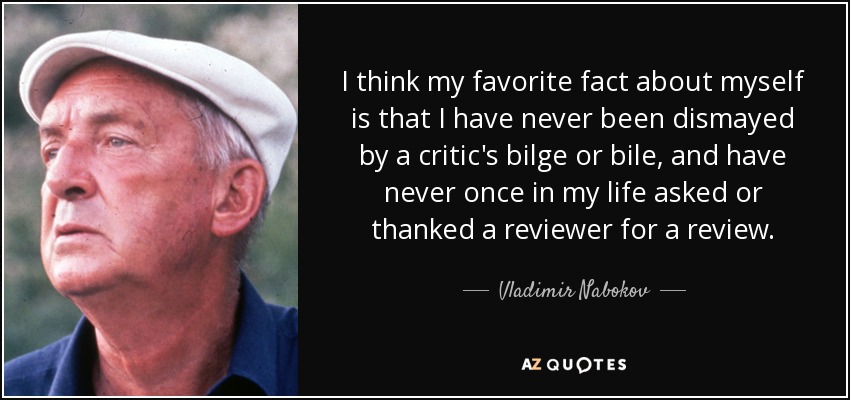
I think my favorite fact about myself is that I have never been dismayed by a critic's bilge or bile, and have never once in my life asked or thanked a reviewer for a review.
Sometimes I am a collector of data, and only a collector, and am likely to be gross and miserly, piling up notes, pleased with merely numerically adding to my stores. Other times I have joys, when unexpectedly coming upon an outrageous story that may not be altogether a lie, or upon a macabre little thing that may make some reviewer of my more or less good works mad. But always there is present a feeling of unexplained relations of events that I note, and it is this far-away, haunting, or often taunting, awareness, or suspicion, that keeps me piling on.
With a poetry book I can send 100 copies out to reviewers and other people, and even do it in advance and get their response. It's difficult with iPad: how do you send it out for free, and how do you even disseminate it before it goes into their store?
It is a fallacy to think that carping is the strongest form of criticism: the important work begins after the artist's mistakes have been pointed out, and the reviewer can't put it off indefinitely with sneers, although some neophytes might be tempted to try: "When in doubt, stick out your tongue" is a safe rule that never cost one any readers. But there's nothing strong about it, and it has nothing to do with the real business of criticism, which is to do justice to the best work of one's time, so that nothing gets lost.
When you are out of favor, so to speak, it's not just the reviewers. It's the editors, the publishers, they don't want you anymore, you're just gone and you've been written out of history as effectively as the old Stalinists would write someone else out, take their photograph out of a book.
There is a secret and wholesome conviction in the heart of every man or woman who has written a book that it should be no easy matter for an intelligent reader to lay down that book unfinished. There is a pardonable impression among reviewers that half an hour in its company is sufficient.
Reviewer: 'One of your themes was very similar to one of Beethoven's!' Brahms replied, 'Of course it is. Everyone steals - the important thing is to do it brilliantly.
So, you see, it's a real chore for me to write a book review because it's like a contest. It's like I'm writing that book review for every bad book reviewer I've ever known and it's a way of saying [thrusts a middle finger into the air] this is how you ought to do it. I like to rub their noses in it.
An intelligent man or woman willing to make a career of reviewing fiction is hard to come by ... And the temporaries do the work cheaply. Moreover, continuity may be got at the expense of intellectual arthritis; a reviewer who has been at his grisly task for half a lifetime may stiffen into prejudices of every sort, and become too anchylosed to do better than turn his back to a new wave when it rushes down on him.
We've learned over the years that if we wanted we could write anything that just felt good or sounded good and it didn't necessarily have to have any particular meaning to us. As odd as it seemed to us, reviewers would take it upon themselves to interject their own meanings on our lyrics. Sometimes we sit and read other people's interpretations of our lyrics and think, 'Hey, that's pretty good.' If we liked it, we would keep our mouths shut and just accept the credit as if it was what we meant all along.
I don’t believe that a reviewer or a critic can really criticize well unless he can praise well.
It is always dishonest for a reviewer to review the author instead of the author's book.
Some of the reviewers wanted less. Some wanted lots more. Some wanted lots more of something else. But these strips are exactly what they are.
Some movie I was in, I forget which one, some awful little movie, a reviewer said, What is Jessica Walter doing in this movie? And I said, Hello? Trying to make a living?
I think that curiosity happened on these reviews where I was just a guest of the reviewer, because it introduced me to new cuisines and to the idea of cooking as a mechanism for studying other cultures and understanding other parts of the world.
And it does no harm to repeat, as often as you can, 'Without me the literary industry would not exist: the publishers, the agents, the sub-agents, the sub-sub-agents, the accountants, the libel lawyers, the departments of literature, the professors, the theses, the books of criticism, the reviewers, the book pages- all this vast and proliferating edifice is because of this small, patronized, put-down and underpaid person.'
I've been reading reviews of my stories for twenty-five years, and can't remember a single useful point in any of them, or the slightest good advice. The only reviewer who ever made an impression on me was Skabichevsky, who prophesied that I would die drunk in the bottom of a ditch.
Book reviewers are little old ladies of both sexes.
The reviewer always has hold of the wrong horror.
Under true peer-review...a panel of reviewers must accept a study before it can be published in a scientific journal. If the reviewers have objections the author must answer them or change the article to take reviewers' objections into account. Under the IPCC review process, the authors are at liberty to ignore criticisms.
Writing prejudicial, off-putting reviews is a precise exercise in applied black magic. The reviewer can draw free-floating disagreeable associations to a book by implying that the book is completely unimportant without saying exactly why, and carefully avoiding any clear images that could capture the reader's full attention.
Reviewers, with some rare exceptions, are a most stupid and malignant race. As a bankrupt thief turns thief-taker in despair, so an unsuccessful author turns critic.
Peer reviewers go for orthodoxy ... Many of the great 19th-century discoveries were made by men who had independent wealth-Charles Darwin is the prototype. They trusted themselves.
I can't write a scene unless I've visualized it. Unless I can actually see it, and that's why a lot of reviewers have said my books are very cinematic, because I actually do see them before I write them.
I think in many ways the problem that my writing would have with an American reviewer is that Americans find difficulty very hard to take. They are inevitably looking for a happy ending.
Follow AzQuotes on Facebook, Twitter and Google+. Every day we present the best quotes! Improve yourself, find your inspiration, share with friends
or simply: