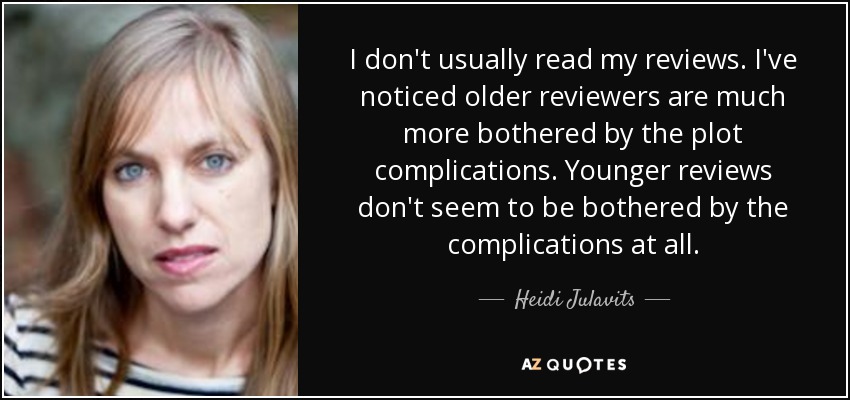
I don't usually read my reviews. I've noticed older reviewers are much more bothered by the plot complications. Younger reviews don't seem to be bothered by the complications at all.
My constant fear as a writer as that I will fail to convey the gravity of living. I know that to some degree that sets me up as boorish, but I'll have to live with that, and, honestly, I'd rather err on the side of being "unredeemingly dark," as one reviewer said about blood kin, than on keeping to the sunny side.
I couldn't give a sh*t what they have to say. As soon as I go home and see my husband James Thornton of Holby Blue fame and pick up my dog and cuddle him, that's all that matters. I couldn't care if some theatre reviewer thinks my American accent sounds a bit Welsh.
In lots of books I read, the writer seems to go haywire every time he reaches a high point. He’ll start leaving out punctuation and running his words together and babble about stars flashing and sinking into a deep dreamless sea. And you can’t figure out whether the hero’s laying his girl or a cornerstone. I guess that kind of crap is supposed to be pretty deep stuff—a lot of the book reviewers eat it up, I notice. But the way I see it is, the writer is just too goddam lazy to do his job. And I’m not lazy, whatever else I am. I’ll tell you everything.
I do not believe writers should read reviews of their own books, and I do not. If one is not careful one is soon writing to please reviewers and not their audience or themselves.
Reviewers do not read books with much care . . . their profession is more given to stupidity and malice and literary ignorance even than the profession of novelist.
If you read reviews that you think by their very nature are not respectful of the actresses involved or not appreciating the work as it should be, I think you should write to reviewers or comment and say, "Are you kidding me?"
The preface is the most important part of a book. Even reviewers read a preface.
I did think reviewers were supposed to be polite about story collections - collections are rather delicate creatures in the literary environment - but not everybody got this memo, I guess.
I want to look at myself the way I do on purpose, because if you aggrandize and try to look at yourself the way a fan does or the way a reviewer does or the way - God bless them, they all got a right to, everybody's got a right to an opinion about it.
I don't read the reviews because they're too horrible and the reviewers have not been big supporters of mine over the years, probably because I make these big populist movies and they hate it.
I am tired of reading reviews that call A Good Man brutal and sarcastic. The stories are hard but they are hard because there is nothing harder or less sentimental than Christian realism.... when I see these stories described as horror stories I am always amused because the reviewer always has hold of the wrong horror.
Is it not clear that a reviewer's psyche, like an iceberg, is seven-eighths beneath the surface?
I am never much interested in the effects of what I write....I seldom read with any attention the reviews of my...books. Two times out of three I know something about the reviewer, and in very few cases have I any respect for his judgments. Thus his praise, if he praises me, leaves me unmoved. I can't recall any review that has even influenced me in the slightest. I live in sort of a vacuum, and I suspect that most other writers do, too. It is hard to imagine one of the great ones paying any serious attention to contemporary opinion.
I am not alone in bearing grudges against reviewers who have doomed a book's chances because they've missed the point, the tone, everything.
I have a friend who says that reviewers are the tickbirds of the literary rhinoceros-but he is being kind. Tickbirds perform a valuable service to the rhino and the rhino hardly notices the birds.
Critics are giving marks for originality, acting, photography and scripting, while mass audiences are more drawn to familiarity of genre, stars they would like to have sex with or plots that are more likely to make their dates have sex with them. Reviewers are doing their day's work, cinema-goers are escaping from theirs: this leads to an inevitable difference of response. It is, though, wrong to conclude that reviewers are completely useless. Books, movies and shows may be critic-proof, but the egos and psyches of the people who make them very rarely are.
There's an enormous difference between being a critic and a reviewer. The reviewer reacts to the experience of that book.
Almost any show that has reviewers behind it, Rotten Tomatoes behind it, will find a way to survive.
I am a bad reporter because everything seems to me worth reporting; and a bad reviewer because every sentence in every book suggests a separate essay.
I believe passionately in preemptive pessimism, especially before a book comes out. I expect the worst both from reviewers and sales, and then, with any luck, I may be proved wrong.
Richard Price got a million dollar advance on one fake film book based on a paragraph outline and is able to seduce gullible White reviewers who know less about ghetto life than he. The New York Times has devoted more space to Price's tourist, ghetto writing than to any Black writer in history.
Lazy reviewers look up other people's reviews and they write the same thing, so you get people writing crap based on crap.
Memoirs have at their heart a content that "happened" to someone in real life. Is that what you are itching at in your question, so that if you are a reviewer or you are writing a critique you might feel as if you are stepping on someone's actual face?
Some reviewers have read this as cynicism but I don't see it that way. When I say "I am so sick / of pretending to be me," it's exhaustion at the everyday performance, in life, in art, even in our most intimate encounters.
Follow AzQuotes on Facebook, Twitter and Google+. Every day we present the best quotes! Improve yourself, find your inspiration, share with friends
or simply: