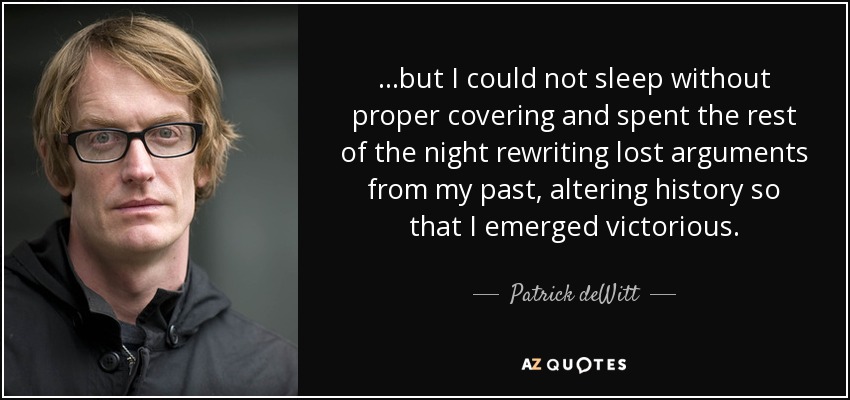
...but I could not sleep without proper covering and spent the rest of the night rewriting lost arguments from my past, altering history so that I emerged victorious.
I will write in words of fire. I will write them on your skin. I will write about desire. Write beginnings, write of sin. You’re the book I love the best, your skin only holds my truth, you will be a palimpsest lines of age rewriting youth. You will not burn upon the pyre. Or be buried on the shelf. You’re my letter to desire: And you’ll never read yourself. I will trace each word and comma As the final dusk descends, You’re my tale of dreams and drama, Let us find out how it ends.
History is the torch that is meant to illuminate the past, to guard us against the repetition of our mistakes of other days. We cannot join in the rewriting of history to make it conform to our comfort and convenience.
What is easy to read has been difficult to write. The labour of writing and rewriting, correcting and recorrecting, is the due exacted by every good book from its author, even if he knows from the beginning exactly what he wants to say. A limpid style is invariably the result of hard labour, and the easily flowing connection of sentence with sentence and paragraph with paragraph has always been won by the sweat of the brow.
It takes me six months to do a story. I think it out and then write it sentence by sentence - no first draft. I can't write five words but that I change seven.
By the time I am nearing the end of a story, the first part will have been reread and altered and corrected at least one hundred and fifty times. I am suspicious of both facility and speed. Good writing is essentially rewriting. I am positive of this.
And after you've done the acting, there's a lot of places you can put your input - in the editing, in the production of it, in the rewriting of it and so on
Hillary has already gotten a record $8 million advance from Simon & Schuster for the book -- reportedly the most anyone has ever received for rewriting history.
I try not to worry about rewriting books that worked well the first time. I'm too busy writing new books to worry about things that are already in print
Learn a lot about the world and finish things, even if it is just a short story. Finish it before you start something else. Finish it before you start rewriting it. That's really important. It's to find out if you're going to be a writer or not, because that's one of the most important lessons. Most, maybe 90% of people, will start writing and never finish what they started. If you want to be a writer that's the hardest and most important lesson: Finish it. Then go back to fix it.
Rewriting is a large part of the whole job. And get rid of stuff that's not working. Just pare it down until it's a beautiful thing you can hand in.
The writing process is not just putting down one page after another-it's a lot of writing and then rewriting, restructuring the story, changing the way things come together.
We are redefining terms and rewriting laws and removing fences everywhere you turn, and we seem to think we can do that with impunity.
Artistry is important. Skill, hard work, rewriting, editing, and careful, careful craft: All of these are necessary. These are what separate the beginners from experienced artists.
I studied philosophy, religious studies, and English. My training was writing four full-length novels and hiring an editor to tear them apart. I had enough money to do that, and then rewriting and rewriting and rewriting.
I know when a story is finished when there is not a single thing more I can think to do to it. And since I know at the start what the last line will be, I know when I've reached that point as logically as I can that it's finished. As for the rewriting-it's not foolproof, of course, but if you're honest about having thought of every possibility and you still come back to what you have, what more can you do?
When you perform in front of an audience after only two days of rehearsal, you're flying by the seat of your pants - particularly when they're rewriting the show right up to the moment the camera goes on.
The biggest challenge for me has been in coping with my perfectionism. I have a stiflingly hard time moving forward in a project if it's not 'just right' all along the way. The trap I so easily fall into is rewriting and rewriting the same scenes over and over to make them perfect, instead of continuing on into the wild unknown of the story.
Rewriting is the essence of writing well: it's where the game is won or lost. The idea is hard to accept. We all have emotional equity in our first draft; we can't believe that it wasn't born perfect. But the odds are close to 100 percent that it wasn't.
Once I get over maybe a hundred pages, I won't go back to page one, but I might go back to page fifty-five, or twenty, even. But then every once in a while I feel the need to go to page one again and start rewriting.
So much of the effort that goes into writing prose for me is about making sentences that capture the music that I'm hearing in my head. It takes a lot of work, writing, writing, and rewriting to get the music exactly the way you want it to be.
There is no good writing; there is only good rewriting.
I don't impose any word count or number-of-hours quota on myself, or have any rules, except one: persistence. Nothing glamorous. No epiphanies. Just revisiting and rewriting. For me, momentum is far more important than inspiration.
I'm interested in the moments where the audience is restless. I'm interested in the moments where they lean in and become incredibly engaged: the laughter, the silence. All of that is part of how I think about shaping and rewriting the play.
The book really comes to life in the rewriting.
Follow AzQuotes on Facebook, Twitter and Google+. Every day we present the best quotes! Improve yourself, find your inspiration, share with friends
or simply: