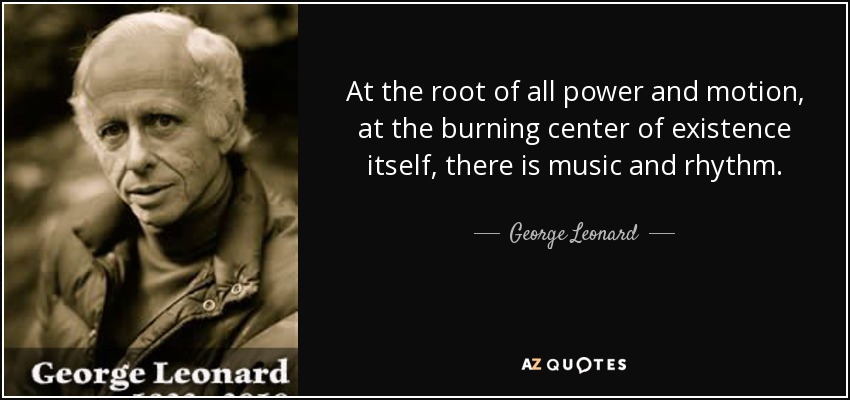
At the root of all power and motion, at the burning center of existence itself, there is music and rhythm.
Success and failure, triumph and disaster. That is the rhythm of life in the garden.
There is a set of balances and rhythms to a novel that we can't experience in real life. So I think there is a sense in which fiction can rescue history from confusion.
If you just concentrate on what you're doing and allow yourself to actually enjoy and let your feelings come out, whatever the tempos, whatever the rhythms, whatever the songs, 9 out of 10 times it will work.
The body of poetry is nothing but energy, waves, rhythm.
Merengue is a fast rhythm, you know, and danceable. Bachata is like a slow, romantic Caribbean bolero.
Sometimes I start with music on and then I get distracted because I'm working to a different rhythm; I'm not working to myself. So, I don't have music on when I'm working.
I usually start with a guitar riff or some little pattern of chords, and then I kind of go from there. Usually my lyrics are the last thing to go onto a song. For years and years I only ever did instrumental, so I'm still trying to get confidant with my lyrics and find the right balance. I'll generally get inspired from the music. I'll have a guitar line, and then I'll have a melody line, and I hook the lyrics up to fit that rhythm. So, my lyrics to tend be very rhythmic as well. They work with the music rather than the music works around them.
I was singing when I was five years old. My sister and I both had the talent from mom and dad, and she was in opera and I was into pop and uh, rhythm and blues, anything, I was about a four octave singer.
He [Phil Jackson] is such a basketball genius in terms of the details of the game, the little nuances of the game and the rhythm of the game.
When we travel for research our strategy is to simply move from kitchen to kitchen. It's truly a wonderful way to travel - food shopping, cooking and eating in one home for lunch and then another for dinner. The process of cooking takes us immediately into the rituals and rhythms of daily life and also places us firmly in the position of learners. We were meet with incredible generosity by all of the families we ate with.
Simply put, you can read a story in a single sitting and hold it all in your mind. You can experience all of its rhythms, beginning to end, during that span. Consequently it has, I think, greater emotional power than a novel because of this real-time effect. Stories can stun you.
I always think that the writer is doing the vast majority of the director's work, in a sense. If you're a writer who is also going to direct, you're doing all your preparation: You're already visualizing everything, you're imagining how the lines are going to be read, you see the blocking in your head, and you know the rhythm and the pacing.
You're not a rock 'n' roll person four hours a day or even when you're on stage. It's become the rhythm of your whole life.
Having to stand in front of an audience and have it be your job to make them laugh, you can't really look to anyone but yourself. It's what you wrote, what you said and how you said it, so it's kind of terrifying, but I liked it. When it goes well, it's the best feeling in the world. When it doesn't go well, it's the worst feeling, but once you get into the rhythm of it, I think it's really fun.
For me, rhythm is a type of divine mathematics in a way. No matter where you're from, we can all understand the mathematics of rhythm. I try to apply this mathematical thinking to my playing.
Of what is the body made? It is made of emptiness and rhythm. At the ultimate heart of the body, at the heart of the world, there is no solidity. Once again, there is only the dance.
I like working with sound; sound and rhythm. I like the abstract more than "What does that mean?" Nobody ever says to you, "Why did you use a harmonium?" Or "What is that ringing sound that occurs here?" The questions are always "What does that song mean?" or "What were you trying to say here?"
I'd try to write my poems in a certain rhythm. I had my rock 'n' roll stuff for performing and my denser stuff for writing.
I always listen to music when I write, I need a rhythm to write.
When you're doing those operation scenes, you not only have to be on top of the dialogue and the rhythm of the dialogue and what's happening dramatically, but you've got to technically get the rhythm right, so that everything is fitting with the dialogue at the right time. And you're performing the operation to the audience that's watching it. Thackery has to present it, as well. In some ways, that's the most challenging.
And the writers are good in that it's easy to memorize, and good writing has an innate rhythm to it. And I've always felt that it's easier to get in your head than writing that has very kind of mind busting moments.
There's a charm, there's a rhythm, there's a soul to Jewish humor. When I first saw Richard Pryor perform, I told him, 'You're doing a Jewish act.'
After watching a couple of live performances of bands like Nirvana, I was really excited and inspired by how raw and powerful it was. I wanted to at least aim in that direction with the guitar and do my own version of it. I know it doesn't really sound like that on the other end, but I wanted guitar, heavy rhythms, and singing to be the stamp of the whole thing.
The art of living is based on rhythm - on give & take, ebb & flow, light & dark, life & death. By acceptance of all aspects of life, good & bad, right & wrong, yours & mine, the static, defensive life, which is what most people are cursed with, is converted into a dance, 'the dance of life,' metamorphosis.
Follow AzQuotes on Facebook, Twitter and Google+. Every day we present the best quotes! Improve yourself, find your inspiration, share with friends
or simply: