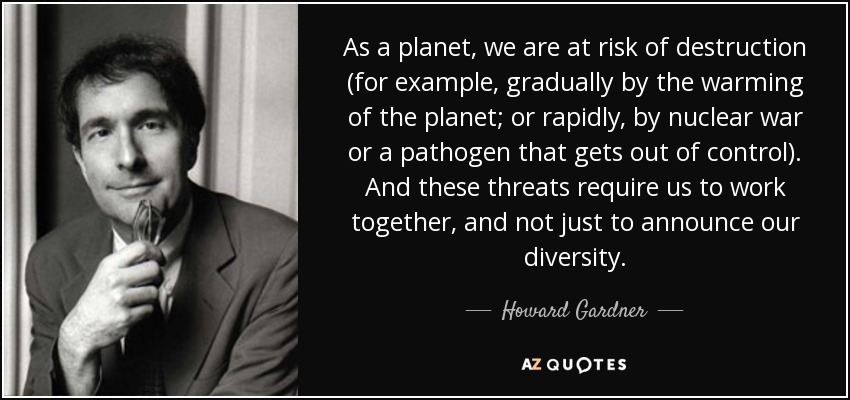
As a planet, we are at risk of destruction (for example, gradually by the warming of the planet; or rapidly, by nuclear war or a pathogen that gets out of control). And these threats require us to work together, and not just to announce our diversity.
It is now widely and rightly accepted that we live in a world which is more interdependent than ever before, and that problems are increasingly global in character. At the risk of stating the obvious, I would say that when governments realize that certain problems are beyond their powers, it is clear that the United Nations has an irreplaceable role to play.
I would say the biggest risk I always take is going in front of a live audience. There's nothing more risky to do. You have to really leave yourself open to your own authenticity, and you find that out pretty quick.
I'm very aware, but I'm very naïve. When you are really naïve and expecting safety and expecting the best, you don't feel you're taking risks. You can get smacked a little, but usually it works out pretty well. I would say that, as much as you can instill your open-minded naivety, if you're basically open minded, then you can do damn near anything.
I have privileges even in comparison to a Palestinian Israeli because Palestinian Israelis who live permanently in Ramallah risk their status, not as citizens but as residents. They might lose their social rights if they move to Ramallah. But I won't, so I live with privileges. That notion is very difficult for me as a child who was raised in a left-wing family, a family of people who suffered discrimination as Jews abroad. The notion that I am so privileged is disgusting. But this is what it means to live in a white society. You are white, so you are privileged.
Turbulence is a condition that we all experience during a flight when the plane is bouncing around by competing air currents. By analogy, the economy may bounce around a lot because of competing currents of public moods and investments. One week everyone might be optimistic and then suddenly something happens to turn everyone into pessimists. Investment dries up and investors become risk averse. A sudden piece of good news then turns around the public mood.
If you just want a comfortable life, the awards, and pats on the back then you play Christian Hip Hop safe. Because playing it safe will give you consistency, but if you're really in this to see peoples lives transform then you're gonna have to do some risk assessment - it is costly to rally try to impact people.
When I moved into one of the worst inner-cities in America to do missionary work I had to do risk assessment, and It was a risk. My family could have been in danger, house could get robbed at any minute but I count it all as nothing compared to knowing Jesus it was all worth it at the end of the day.
Early rejections are really tough, especially when all of your friends who you went to school with now have legitimate jobs, are getting married, having children, buying real estate, being adults. And you're still trying to figure out how to make a living doing the thing you think you love, but you're not even sure yet because you haven't even done it. It was a long road of risk and treachery.
If American society wants to invest in its young people, it has an obligation to provide them with an education in which they are challenged, can learn to take risks, think outside the boundaries of established ideologies, and expand the far reaches of their creativity and critical judgment. This demands a pedagogy that is complicated, taxing and disruptive.
On the foreign policy side, there's the risk of being too spontaneous and too disruptive where you end up doing more harm than damage. And figuring out that balance is where having strong people around you matters.
I would say Colin Jost is Kanye West because he takes like the creative risk a lot of times, whereas I'm like, "Uh, I don't know..."
The best stuff happens when you take a chance. When you risk something and do the thing that the other people are taking a chance on, on a network kind of level, they will be rewarded. You know, risk-reward.
We provide a secure, stable space for children to grow up in, so children will be able to take risks and have adventures and do things that are unexpected. If there isn't a risk that your children can fail, then you haven't succeeded as a parent.
Success will come. Or it won't. But I think you can only make a go at it in a big way by fully being yourself and taking risks. People can feel risks.
The people who live the life of their dreams take risks. And on top of that, they persist. And on top of that, they trust themselves. And on top of that, they don't let circumstances hold them back, because they know that they are more powerful than their circumstances.
If we were a culture of high-risk alcoholics, and suddenly we had Jack Daniels piped into our houses, we would be feeding that fire. Social networking, and the internet as a whole, seems to have simply landed in an extremely fertile place in an extremely fertile time in history, when we all have these narcissistic tendencies anyway - you can go further back into the self-esteem movement, and Dr. Spock, and the 'everybody gets a ribbon at the track meet' sort of thing, which preceded the internet - and then you drop the internet into the middle of this, and we've all gone haywire.
The thing I think I have learned from Wittgenstein is the importance of not making things up: philosophers should not invent problems, and they should also be conscious of the risk of inventing pointless 'technical' machinery which do not offer real explanations, but often just re-state the known facts in a more complex way.
If women have become innocent victims, if women running around today are unable to protect themselves, if the picture that we're painting, if the caricature we are creating is of women that are helpless waifs who are at risk of predator men throughout the busy day, then we have to somehow involve Hillary Clinton in that recipe in truthful and honest ways. That, when it came to defending and protecting women who alleged that they had been abused or even raped by her husband, those women were nothing but scum who had to be dispatched and just swept out of the way.
The culture of the State Department is very negative towards a conservative foreign policy. And the model that we all have, of civil servants as neutral careerists who carry out the policy of the elected president, doesn't work nearly the way it should in the State Department. So that there are many people who want to be good civil servants, who want to try and carry out these policies, but are afraid to do so. And I'm not even counting the very small number of conservatives in the State Department who are genuinely at risk.
It's important to understand that the president [Donald Trump] is now entering a world of public service. He's going to be asking his own appointees to make sacrifices. He's going to be asking our men and women in uniform to risk their lives in conflicts around the world.
In doing the research, I found myself consumed by a single, overwhelming question, as relevant today as it was seventy years ago: When would I, as a wife and mother, risk my life - and more importantly, my child's life - to save a stranger? That question is at the very heart of The Nightingale. I hope that everyone who reads the novel will ask themselves the question.
Having more success allows you more freedom to take more risks and do things.
The court was unable to rule on all circumstances in which nuclear weapons might be used, and it said in view of the problems, the risks posed by nuclear weapons, and in view of the lack of certainty of the law in all circumstances, the best course is fulfilling the obligation of good faith negotiations of nuclear disarmament contained in the nuclear non-proliferation treaty.
In no organized sport do the participants have to endure days of struggle just to get to the starting line of their event. The option to drop out of a race that is going badly does not exist for a climber halfway up a big route, and may entail more risk than pushing on. A team of volunteers will not be waiting with warm blankets and hot food at the next bivy ledge. When you reach the summit, having overcome the challenges that inspired you for months or years, you are not at the finish line. The race is not over. You can't relax and let your guard down like a normal athlete.
Follow AzQuotes on Facebook, Twitter and Google+. Every day we present the best quotes! Improve yourself, find your inspiration, share with friends
or simply: