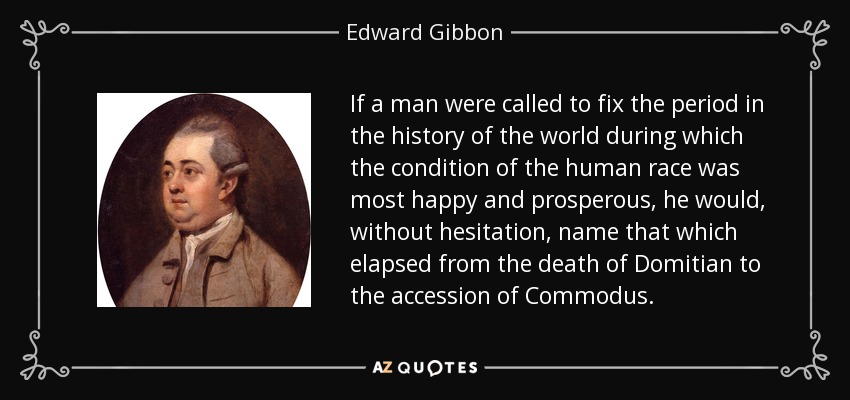
If a man were called to fix the period in the history of the world during which the condition of the human race was most happy and prosperous, he would, without hesitation, name that which elapsed from the death of Domitian to the accession of Commodus.
A citizen of the Roman Empire, for example, would have placed less value on individual liberty in the modern Western sense than on collective responsibility.
It is scarcely possible that the eyes of contemporaries should discover in the public felicity the latent causes of decay and corruption. This long peace, and the uniform government of the Romans, introduced a slow and secret poison into the vitals of the empire. The minds of men were gradually reduced to the same level, the fire of genius was extinguished, and even the military spirit evaporated.
Hope, the best comfort of our imperfect condition, was not denied to the Roman slave; and if he had any opportunity of rendering himself either useful or agreeable, he might very naturally expect that the diligence and fidelity of a few years would be rewarded with the inestimable gift of freedom.
A warlike nation like the Germans, without either cities, letters, arts, or money, found some compensation for this savage state in the enjoyment of liberty. Their poverty secured their freedom, since our desires and our possessions are the strongest fetters of despotism.
Europe is like the Roman Empire - indulged, decadent, flooded with immigrants and unprepared to fight for its culture.
Jesus himself, and most of the message of the Gospels, is a message of service to the poor, a critique of the rich and the powerful, and a pacifist doctrine. And it remained that way, that's what Christianity was up... until Constantine. :Constantine shifted it so the cross, which was the symbol of persecution of somebody working for the poor, was put on the shield of the Roman Empire. It became the symbol for violence and oppression, and that's pretty much what the church has been until the present.
How often has not the parallel been drawn and the golden age of the Roman Empire, when the external brilliancy of life likewise dazzled the eye, notwithstanding that the social diagnosis could yield no other verdict than 'rotten to the very core'?
Misgovernment is of four kinds, often in combination. They are: 1) tyranny or oppression, of which history provides so many well-known examples that they do not need citing; 2) excessive ambition, such as Athens' attempted conquest of Sicily in the Peloponnesian War, Philip II's of England via the Armada, Germany's twice-attempted rule of Europe by a self-conceived master race, Japan's bid for an empire of Asia; 3) incompetence or decadence, as in the case of the late Roman empire, the last Romanovs and the last imperial dynasty of China; and finally 4) folly or perversity.
The United States is now relearning an ancient lesson, dating back to the Roman Empire. Brutalizing an enemy only serves to brutalize the army ordered to do it. Torture corrodes the mind of the torturer.
Protestant churches everywhere are gravitating toward union with the Roman Catholic Church. These religious movements are speeding the fulfillment of the prophecies of the resurrected Roman Empire. For 30 years I have been proclaiming this tremendous event over the air and in print.
Obama, who is becoming more and more preacher-like, wants to be the Punisher-in-Chi ef of the Western World, the Avenger-in-Chie f. There is something oddly Roman about him. ... The lesser races must be civilized and they must be punished... Everyone outside the Roman Empire was called a barbarian. Everyone outside Obama’s empire is called a terrorist.
We must now face the difficult task of moving towards a single economy, a single political entity .. For the first time since the fall of the Roman Empire we have the opportunity to unite Europe.
The descendants of Holy Roman Empire monarchies became feeble-minded in the twentieth century, and after World War I had been done in by the democracies; some were kept on to entertain the tourists, like the one they have in England.
When Edward Gibbon was writing about the fall of the Roman Empire in the late 18th century, he could argue that transportation hadn't changed since ancient times. An imperial messenger on the Roman roads could get from Rome to London even faster in A.D. 100 than in 1750. But by 1850, and even more obviously today, all of that has changed.
The technologies which have had the most profound effects on human life are usually simple. A good example of a simple technology with profound historical consequences is hay. Nobody knows who invented hay, the idea of cutting grass in the autumn and storing it in large enough quantities to keep horses and cows alive through the winter. All we know is that the technology of hay was unknown to the Roman Empire but was known to every village of medieval Europe. Like many other crucially important technologies, hay emerged anonymously during the so-called Dark Ages.
Fashion is not just about trends. It's about political history. You can trace it from the ancient Romans to probably until the '80s, and you can see defining moments that were due either to revolutions or changes in politics. At the end of the Roman era, there was this whole move against togas, because that was the signifier of the Roman Empire. In the same way, the '60s were a reaction against the '50s and so on. But now we've been feeding on a sort of cadaver. At the moment, we're just endlessly recycling the past.
... All questions concerning the rise of Christianity are one: How was it done? How did a tiny and obscure messianic movement from the edge of the Roman Empire dislodge classical paganism and become the dominant faith of Western civilization? Although this is the only question, it requires many answers - no one thing led to the triumph of Christianity.
Philosophy, with the aid of experience, has at length banished the study of alchymy; and the present age, however desirous of riches, is content to seek them by the humbler means of commerce and industry.
His sumptuous tents, and those of his satraps, afforded an immense booty to the conqueror; and an incident is mentioned which proves the rustic but martial ignorance of the legions in the elegant superfluities of life. A bag of shining leather, filled with pearls, fell into the hands of a private soldier; he carefully preserved the bag, but he threw away its contents, judging that whatever was of no use could not possibly be of any value.
It is seldom that minds long exercised in business have formed any habits of conversing with themselves, and in the loss of power they principally regret the want of occupation.
It is incumbent on us diligently to remember that the kingdom of heaven was promised to the poor in spirit, and that minds afflicted by calamity and the contempt of mankind cheerfully listen to the divine promise of future happiness; while, on the contrary, the fortunate are satisfied with the possession of this world; and the wise abuse in doubt and dispute their vain superiority of reason and knowledge.
The distinctions of personal merit and influence, so conspicuous in a republic, so feeble and obscure under a monarchy, were abolished by the despotism of the emperors; who substituted in their room a severe subordination of rank and office, from the titled slaves who were seated on the steps of the throne, to the meanest instruments of arbitrary power.
The frequent repetition of miracles serves to provoke, where it does not subdue, the reason of mankind.
The philosopher, who with calm suspicion examines the dreams and omens, the miracles and prodigies, of profane or even of ecclesiastical history, will probably conclude that, if the eyes of the spectators have sometimes been deceived by fraud, the understanding of the readers has much more frequently been insulted by fiction.
Follow AzQuotes on Facebook, Twitter and Google+. Every day we present the best quotes! Improve yourself, find your inspiration, share with friends
or simply: