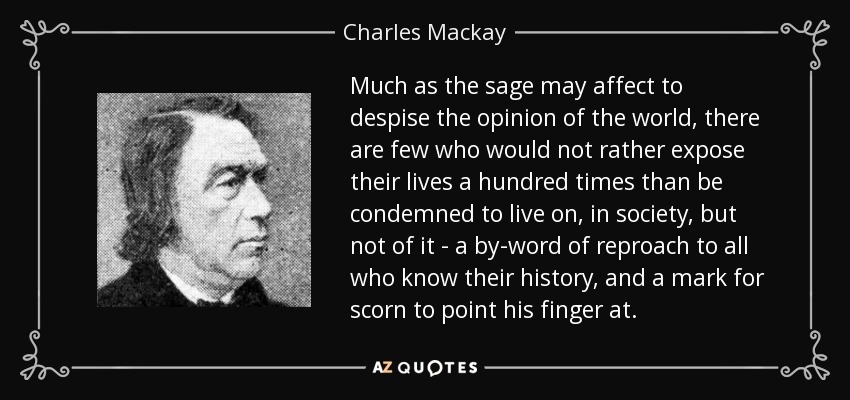
Much as the sage may affect to despise the opinion of the world, there are few who would not rather expose their lives a hundred times than be condemned to live on, in society, but not of it - a by-word of reproach to all who know their history, and a mark for scorn to point his finger at.
Give up this dry discussion, this hodge-podge of philosophy. Who has been able to know God by reasoning? Even sages like Suka and Vyasa are at best like big ants trying to carry away a few grains of sugar from a large hea.
It is not wise to be wiser than is necessary. [Fr., Ce n'est pas etre sage D'etre plus sage qu'il ne le faut.]
Sage advice? If you're drunk, stay away from the phone. You can't get the answering machine message back.
Our sages of blessed memory have said that we must not enjoy any pleasure in this world without reciting a blessing. If we eat any food, or drink any beverage, we must recite a blessing over them before and after. If we breathe the scent of goodly grass, the fragrance of spices, the aroma of good fruits, we pronounce a blessing over the pleasure. The same applies to pleasures of the sight. And the same applies to pleasures of the ear.
A poet is a poet, whether he rides in a Ford or on a donkey; a sage is a sage, whether he plays golf in New Jersey or bathes in the Ganges, or prays in the desert; and a fool is a fool, whether he be a maharaja or a president of a post-war republic.
The Portal of God is nonexistence. All things sprang from nonexistence. Existence could not make existence existence. It must have proceeded from nonexistence, and nonexistence and nothing are one. Herein is the abiding place of the sage.
The fear and anxiety that infect humanity today are the results of this degradation of values, this ignorance of what is of significance and what is not, this want of faith in what the elders and sages have handed down as the wisdom of ages. People prefer what is pleasing to what is beneficial.
The sage never strives for the great, and thereby the great is achieved.
The poet presents the imagination with images from life and human characters and situations, sets them all in motion and leaves itto the beholder to let these images take his thoughts as far as his mental powers will permit. This is why he is able to engage men of the most differing capabilities, indeed fools and sages together. The philosopher, on the other hand, presents not life itself but the finished thoughts which he has abstracted from it and then demands that the reader should think precisely as, and precisely as far as, he himself thinks. That is why his public is so small.
A public role endures for the literary high-command, as sages and seers, speaking out on social and political issues.
In its conception the literature prize belongs to days when a writer could still be thought of as, by virtue of his or her occupation, a sage, someone with no institutional affiliations who could offer an authoritative word on our times as well as on our moral life.
If God does not exist, and if religion is an illusion that the majority of men cannot live without ... let men believe in the lies of religion since they cannot do without them, and let then a handful of sages, who know the truth and can live with it, keep it among themselves. Men are then divided into the wise and the foolish, the philosophers and the common men, and atheism becomes a guarded, esoteric doctrine - for if the illusions of religion were to be discredited, there is no telling with what madness men would be seized, with what uncontrollable anguish.
In India the mother is the center of the family and our highest ideal. She is to us the representative of God, as God is the mother of the universe. It was a female sage who first found the unity of God, and laid down this doctrine in one of the first hy mns of the Vedas. Our God is both personal and absolute, the absolute is male, the personal, female. And thus it comes that we now say: 'The first manifestation of God is the hand that rocks the cradle'.
Pythagoras, Locke, Socrates - but pages might be filled up, as vainly as before, with the sad usage of all sorts of sages, who in his life-time, each was deemed a bore! The loftiest minds outrun their tardy ages.
The sage does not hoard. The more he helps others, the more he benefits himself, Having bestowed all he has on others, he has yet more; having given all he has to others, he is richer still.
The wisdom in the story of the most educated and powerful person is often not greater than the wisdom in the story of a child, and the life of a child can teach us as much as the life of a sage.
Children, do not listen to those who malign masters and sages. Never listen to or indulge in derogatory talk about anyone. When we harbor negative thoughts about others, our minds become impure.
When Newton saw an apple fall, he found In that slight startle from his contemplation- 'Tis said (for I'll not answer above ground For any sage's creed or calculation)- A mode of proving that the earth turn'd round In a most natural whirl, called 'gravitation'; And this is the sole mortal who could grapple, Since Adam, with a fall, or with an apple.
'Keep your head down at school.' Those are sage words from my dad. They kept me in check for years.
. . . the fools of this world prefer to look for sages far away. They don't believe that the wisdom of their own mind is the sage . . . the sutras say, "Mind is the teaching." But people of no understanding don't believe in their own mind or that by understanding this teaching they can become a sage. They prefer to look for distant knowledge and long for things in space, buddha-images, light, incense, and colors. They fall prey to falsehood and lose their minds to insanity.
Where all are selfish, the sage is no better than the fool, and only rather more dangerous.
One learned gentleman, "a sage grave man," Talk'd of the Ghost in Hamlet, "sheath'd in steel"— His well-read friend, who next to speak began, Said, "That was poetry, and nothing real;" A third, of more extensive learning, ran To Sir George Villiers' Ghost, and Mrs. Veal; Of sheeted Spectres spoke with shorten'd breath, And thrice he quoted Drelincourt on Death.
...And these vicissitudes come best in youth; For when they happen at a riper age, People are apt to blame the Fates, forsooth, And wonder Providence is not more sage. Adversity is the first path to truth: He who hath proved war, storm, or woman's rage, Whether his winters be eighteen or eighty, Has won experience which is deem'd so weighty.
Alas! I have nor hope nor health, Nor peace within nor calm around, Nor that content surpassing wealth The sage in meditation found.
Follow AzQuotes on Facebook, Twitter and Google+. Every day we present the best quotes! Improve yourself, find your inspiration, share with friends
or simply: