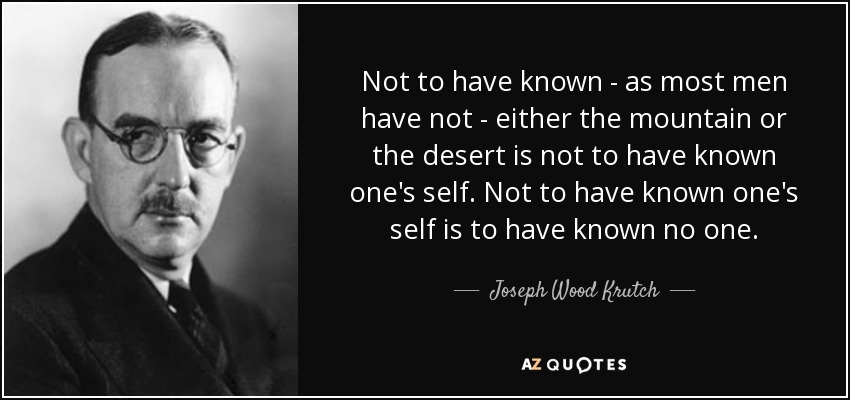
Not to have known - as most men have not - either the mountain or the desert is not to have known one's self. Not to have known one's self is to have known no one.
The lessons we learn from the wild become the etiquette of freedom.
Paradise is the here and now, the actual, tangible, dogmatically real Earth on which we stand. Yes, God bless America, the Earth upon which we stand.
Walking is the natural recreation for a man who desires not absolutely to suppress his intellect but to turn it out to play for a season.
Gardening is a long road, with many detours and way stations, and here we all are at one point or another. It's not a question of superior or inferior taste, merely a question of which detour we are on at the moment. Getting there (as they say) is not important; the wandering about in the wilderness or in the olive groves or in the bayous is the whole point.
A vagrant is everywhere at home.
A garden should feel like a walk in the woods.
Two roads diverged in a yellow wood, And sorry I could not travel both And be one traveler, long I stood And looked down one as far as I could To where it bent in the undergrowth.
Sweet pliability of man's spirit, that can at once surrender itself to illusions, which cheat expectation and sorrow of their weary moments! - long - long since had ye numbered out my days, had I not trod so great a part of them upon this enchanted ground. When my way is too rough for my feet, or too steep for my strength, I get off it, to some smooth velvet path which fancy has scattered over with rose-buds of delights; and have taken a few turns on it, come back strengthened and refreshed.
The rhythm of walking generates a kind of rhythm of thinking, and the passage through a landscape echoes or stimulates the passage through a series of thoughts. The creates an odd consonance between internal and external passage, one that suggests that the mind is also a landscape of sorts and that walking is one way to traverse it. A new thought often seems like a feature of the landscape that was there all along, as though thinking were traveling rather than making.
From thought to thought, from mountain peak to mountain. Love leads me on; for I can never still My trouble on the world's well beaten ways.
The English literary movement at the end of the 18th century was obviously due in great part, if not mainly, to the renewed practice of walking.
.... the brisk exercise imparts elasticity to the muscles, fresh and healthy blood circulates through the brain, the mind works well, the eye is clear, the step is firm, and a day's exertion always makes the evening's repose thoroughly enjoyable.
There is no orthodoxy in walking. It is a land of many paths and no-paths, where every one goes his own and is right.
We souls on foot, with foot-folk meet: For we that cannot hope to ride For ease or pride, have fellowship.
When one walks, one is brought into touch first of all with the essential relations between one's physical powers and the character of the country; one is compelled to see it as its natives do. Then every man one meets is an individual.
I can walk down the street all day and people look at me, but they don't talk to me or stop me.
Like after a nice walk when you have seen many lovely sights you decide to go home, after a while I decided it was time to go home, let us put the cubes back in order. And it was at that moment that I came face to face with the Big Challenge: What is the way home?
There is an intense but simple thrill in setting off in the morning on a mountain trail, knowing that everything you need is on your back. It is a confidence in having left the inessentials behind and of entering a world of natural beauty that has not been violated, where money has no value, and possessions are a dead weight. The person with the fewest possessions is the freest. Thoreau was right.
The walking of passers-by offers a series of turns and detours that can be compared to "turns of phrase" or "stylistic figures." There is a rhetoric of walking. The art of "turning" phrases finds an equivalent in an art of composing a path.
I will look at the footprints going in and out of the water and dream up a small blue good to talk to.
Walking shares with making and working that crucial element of engagement of the body and the mind with the world, of knowing the world through the body and the body through the world.
When the path ignites a soul, there's no remaining in place. The foot touches ground, but not for long.
Today is one of those excellent January partly cloudies in which light chooses an unexpected part of the landscape to trick out in gilt, and then the shadow sweeps it away. You know you're alive. You take huge steps, trying to feel the planet's roundness arc between your feet.
The subject of walking is, in some sense, about how we invest universal acts with particular meanings. Like eating or breathing, it can be invested with wildly different cultural meanings, from the erotic to the spiritual, from the revolutionary to the artistic.
Follow AzQuotes on Facebook, Twitter and Google+. Every day we present the best quotes! Improve yourself, find your inspiration, share with friends
or simply: