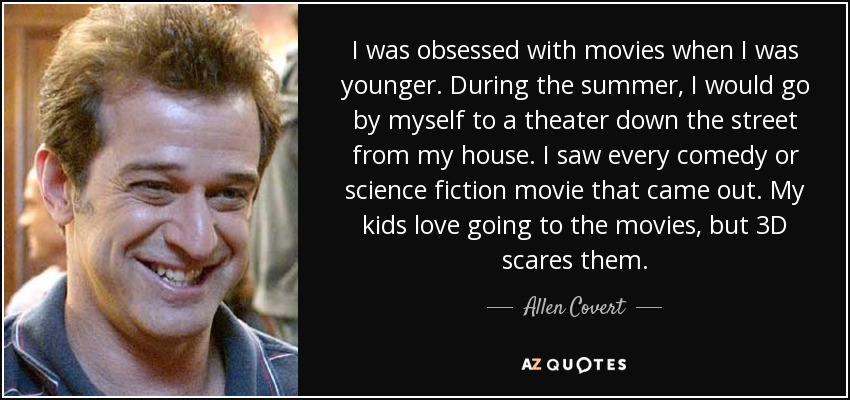
I was obsessed with movies when I was younger. During the summer, I would go by myself to a theater down the street from my house. I saw every comedy or science fiction movie that came out. My kids love going to the movies, but 3D scares them.
We never had books at home, but my dad, seeing how keen I was to read, took me to Islington Library when I was about eight and we pulled out two - a Biggles and a science fiction novel. I never got the ace fighter pilot but fell in love with all things to do with the future and space. Isaac Asimov soon became my guiding star.
Today, we know that time travel need not be confined to myths, science fiction, Hollywood movies, or even speculation by theoretical physicists. Time travel is possible. For example, an object traveling at high speeds ages more slowly than a stationary object. This means that if you were to travel into outer space and return, moving close to light speed, you could travel thousands of years into the Earth's future.
I seem to offend everybody. I just never got into the universe. I don't seem to have a tremendous amount of discipline or patience with having to follow a story that is really multi-leveled and science-fiction.
I'm not the sort of fellow who does the same thing all the time. I began using a lot of science fiction apparatus. I came out with the atom bomb two years before it was actually used because I read in the paper that a fellow named Nicola Tesla was working on the atom bomb.
Corollary 1: The existence of immense quantities of trash in science fiction is admitted and it is regrettable; but it is no more unnatural than the existence of trash anywhere.
[Social] science fiction is that branch of literature which is concerned with the impact of scientific advance on human beings.
I define science fiction as fiction in which things happen that are not possible today - that depend, for instance, on advanced space travel, time travel, the discovery of green monsters on other planets or galaxies, or that contain various technologies we have not yet developed.
I define science fiction as the art of the possible. Fantasy is the art of the impossible. Science fiction, again, is the history of ideas, and they're always ideas that work themselves out and become real and happen in the world. And fantasy comes along and says, 'We're going to break all the laws of physics.' ... Most people don't realize it, but the series of films which have made more money than any other series of films in the history of the universe is the James Bond series. They're all science fiction, too - romantic, adventurous, frivolous, fantastic science fiction!
Many people have tried to define science fiction. I like to call it the literature of exploration and change. While other genres obsess upon so-called eternal verities, SF deals with the possibility that our children may have different problems. They may, indeed, be different than we have been.
Attempting to define science fiction is an undertaking almost as difficult, though not so popular, as trying to define pornography... In both pornography and SF, the problem lies in knowing exactly where to draw the line.
[A] science fiction story is one which presupposes a technology, or an effect of technology, or a disturbance in the natural order, such as humanity, up to the time of writing, has not in actual fact, experienced.
[Science fiction is] the attempt to deal rationally with alternate possibilities in a manner which will be entertaining.
The brightest minds in our field have been trying to find a definition of science fiction for these past seventy years. The short answer is, science fiction stories are given as possible, not necessarily here and now, but somewhere, sometime.
Science fiction, as I mentioned before, writes about what is neither impossible nor possible; the fact is that, when the question of possibility comes up in science fiction, the author can only reply that nobody knows. We haven't been there yet. We haven't discovered that yet. Science fiction hasn't happened.
[Science fiction is] a specialized type of fantasy, in which the prime assumption usually is a new scientific discovery or invention.
Even people that were never interested in science fiction are interested in STAR TREK.
A handy short definition of almost all science fiction might read: realistic speculation about possible future events, based solidly on adequate knowledge of the real world, past and present, and on a thorough understanding of the nature and significance of the scientific method.
With 'Futurama,' I was just worried that somebody would beat us to it; it seemed so obvious that there should be an animated science fiction show set in the future. And one of the reasons why it's not, I learned, is that it's really, really difficult.
I have confused ideas of deity, heavily influenced by mind-altering years of reading science fiction, that do not often trouble me, but one thing I know for certain, and have known since the age of five or six, is that I really can't stand the God of Abraham. In fact, I consider him to constitute the pattern to which every true asshole I have ever known in my life has pretty well conformed.
I'm fond of science fiction. But not all science fiction. I like science fiction where there's a scientific lesson, for example - when the science fiction book changes one thing but leaves the rest of science intact and explores the consequences of that. That's actually very valuable.
I find that in the science fiction world, you have almost more women fans than male fans and I think it's because there's been such a shortage of strong female characters.
Blade Runner is one of my favorite films. But, so many thing influenced me that aren't science fiction because they were just good drama. I grew up watching a lot of French cinema. I was in love with The English Patient, and movies that are very romantic in nature and have a positive message. That's a large part of my fingerprint.
Since the show [Helix] is based in real science, there are real-life epidemic scares out there, throughout history, where there are these huge viruses that have wiped out huge populations. So, we're dealing with something that the CDC hasn't seen before, but it comes from a virus. That's something that's based in reality, and then you put the science fiction on that and it's a really interesting combination.
I grew up watching science fiction and action movies. I love it. I absolutely love it!
Follow AzQuotes on Facebook, Twitter and Google+. Every day we present the best quotes! Improve yourself, find your inspiration, share with friends
or simply: