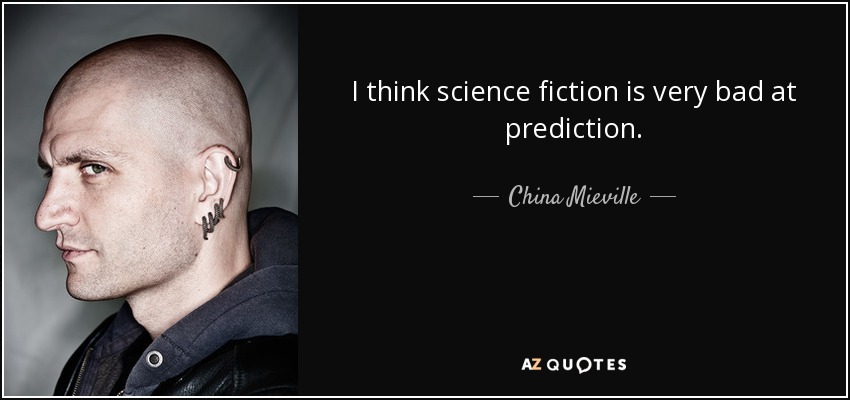
I think science fiction is very bad at prediction.
I'd never been to a science-fiction convention until I became a professional writer.
I'm a science fiction and fantasy geek.
It may be far in the future, but there's some kind of logical way to get from where we are to where the science fiction is.
What if most of the technologies readers and cinemagoers are presented with in bestselling books and blockbuster movies are not science fiction, but science fact? What if they currently exist on the planet, but are suppressed from the masses?
There's a thing with genre movies and science fiction movies that number two is the charmed; two seems to be the best. I loved 'Terminator 2.'
I do love science fiction, but it's not really a genre unto itself; it always seems to merge with another genre. With the few movies I've done, I've ended up playing with genre in some way or another, so any genre that's made to mix with others is like candy to me. It allows you to use big, mythic situations to talk about ordinary things.
In a lot of Western science fiction, you need some form of conflict, whether it's aliens or robots. I think in Western culture, being more suspicious of science, and hubris, you'll see a lot of fear of creating something that goes out of control.
For the last 30 years our cinemas have been ruled by science fiction and horror. We've had some very good Fantasy films in that time period, but for my tastes I still haven't seen fantasy done to absolute perfection. That is the hope I have in this project.
Science fiction shows are traditionally about the gimmick or the gadget and tend to be emotionally cool to the touch.
When I was a kid and I was being introduced to science fiction by watching movies with my Dad, Kubrick is one of those guys that we used to watch, you know, I watched Clockwork Orange at an age that was incredibly inappropriate, but he sat there with me and he explained what was going on and you know, I came to appreciate it even if I was terrified at the time.
[Science fiction is] a specialized type of fantasy, in which the prime assumption usually is a new scientific discovery or invention.
Science fiction, as I mentioned before, writes about what is neither impossible nor possible; the fact is that, when the question of possibility comes up in science fiction, the author can only reply that nobody knows. We haven't been there yet. We haven't discovered that yet. Science fiction hasn't happened.
The brightest minds in our field have been trying to find a definition of science fiction for these past seventy years. The short answer is, science fiction stories are given as possible, not necessarily here and now, but somewhere, sometime.
Corollary 1: The existence of immense quantities of trash in science fiction is admitted and it is regrettable; but it is no more unnatural than the existence of trash anywhere.
Even people that were never interested in science fiction are interested in STAR TREK.
A handy short definition of almost all science fiction might read: realistic speculation about possible future events, based solidly on adequate knowledge of the real world, past and present, and on a thorough understanding of the nature and significance of the scientific method.
I have confused ideas of deity, heavily influenced by mind-altering years of reading science fiction, that do not often trouble me, but one thing I know for certain, and have known since the age of five or six, is that I really can't stand the God of Abraham. In fact, I consider him to constitute the pattern to which every true asshole I have ever known in my life has pretty well conformed.
I'm fond of science fiction. But not all science fiction. I like science fiction where there's a scientific lesson, for example - when the science fiction book changes one thing but leaves the rest of science intact and explores the consequences of that. That's actually very valuable.
I find that in the science fiction world, you have almost more women fans than male fans and I think it's because there's been such a shortage of strong female characters.
Does it strike you, Mr. Keller, that we live every day in the science fiction of our youth?
I worked out a book which I thought was just straight science fiction -- with everything pretty much explained, and suddenly I got an idea which I thought was kind of neat for working in a mythological angle. I'm really struggling with myself. It would probably be a better book if I include it, but on the other hand I don't always like to keep reverting to it. I think what I'm going to do is vary my output, do some straight science fiction and some straight fantasy that doesn't involve mythology, and composites.
Most of what I do is science fiction. Some of the things I do are fantasy. I don't like the labels, they're marketing tools, and I certainly don't worry about them when I'm writing. They are also inhibiting factors; you wind up not getting read by certain people, or not getting sold to certain people because they think they know what you write. You say science fiction and everybody thinks Star Wars or Star Trek.
It's interesting how many science fiction writers get going when they are very young. I was on a program with Greg Bear and he mentioned that he had gotten started writing when he was eight. And I began writing when I was 10. I think we're influenced by the stuff, we find it and we love it and we're influenced by it....I know I collected my first rejection slip when I was 13, and I went on collecting them for a long time after that.
With 'Futurama,' I was just worried that somebody would beat us to it; it seemed so obvious that there should be an animated science fiction show set in the future. And one of the reasons why it's not, I learned, is that it's really, really difficult.
Follow AzQuotes on Facebook, Twitter and Google+. Every day we present the best quotes! Improve yourself, find your inspiration, share with friends
or simply: