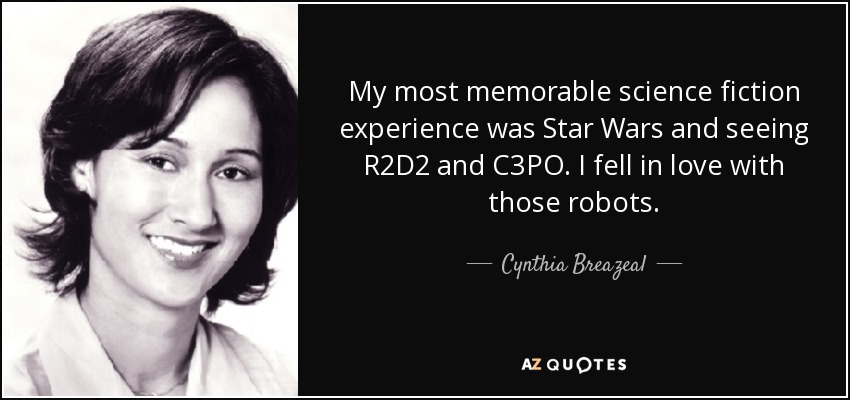
My most memorable science fiction experience was Star Wars and seeing R2D2 and C3PO. I fell in love with those robots.
What do my science fiction stories have in common with pornography? Fantasies of an impossibly hospitable world, I'm told.
Theres two tiers of science fiction: the McDonalds sci-fi like Star Trek, where they have an adventure and solve it before the last commercial, and there are books that once youve read, you never look at the world the same way again.
At some point, every science fiction and fantasy story must challenge the reader's experience and learning. That's much of the reason why the genre is so open to experimentation and innovation that other genres reject--strangeness is our bread and butter. Spread it thick or slice it thin, it's still our staff of life.
The computer has evolved into a partner, a tool, and an environment--not just in science fiction, but in the public consciousness as well. Computers are no longer malevolent iron brains that manufacture tyrannical and oppressive answers; they are not a way to think, they are a place from which to think. The computer is an environment in which answers can be sought, created, manipulated and developed.
It is not extraordinary that the extraterrestrial origin of women was a recurrent theme of science fiction.
With some exceptions in science fiction and other genres I have small difficulty in avoiding anything that could be called American literature. I feel it is unnatural, not I think entirely because it uses a language that is not mine, however closely akin to my own.
It's funny because when I was growing up, I was really into science fiction and fantasy as a kid. And, when I first became a screenwriter, I ended up really just doing historical drama and non-fiction based stuff, like Band of Brothers and stuff that didn't get made, but was also non-fiction.
Nearly all the writing of our time is likely to disappear in a hundred years. Certainly most readers - and nearly all critics - feel that [Kurt] Vonnegut started to repeat himself, to grow increasingly self-indulgent and meandering, and to sometimes just blather in his later work. But his books up to "Slaughterhouse-Five" do possess a distinctiveness that will insure some kind of permanence, if only in the history of the 1960s and of science fiction.
I would love to do more science fiction. I always envisioned the Riddick franchise as a continuing mythology, so I always imagined that there would be many other films to follow.
As you see, I bear some resentment and some scars from the years of anti-genre bigotry. My own fiction, which moves freely around among realism, magical realism, science fiction, fantasy of various kinds, historical fiction, young adult fiction, parable, and other subgenres, to the point where much of it is ungenrifiable, all got shoved into the Sci Fi wastebasket or labeled as kiddilit - subliterature.
There are very real differences between science fiction and realistic fiction, between horror and fantasy, between romance and mystery. Differences in writing them, in reading them, in criticizing them. Vive les différences! They're what gives each genre its singular flavor and savor, its particular interest for the reader - and the writer.
I came into science fiction at a very good time, when the doors were getting thrown open to all kinds of more experimental writing, more literary writing, riskier writing. It wasn't all imitation Heinlein or Asimov. And of course, women were creeping in, infiltrating. Infesting the premises.
I was hardly fit for human society. Thus destiny shaped me to be a science fiction writer.
Science fiction that's just about people wandering around in space ships shooting each other with ray guns is very dull. I like it when it enables you to do fairly radical reinterpretations of human experience, just to show all the different interpretations that can be put on apparently fairly simple and commonplace events. That I find fun.
When I was starting out, science fiction was a little genre over there, which only a few people read. But now -- where are you going to put, for example, Salman Rushdie? Or any of the South American writers? Most people get by calling them magical realists.
What they [critics of Lessing's switch to science fiction] didn't realize was that in science fiction is some of the best social fiction of our time.
We shall not read it for its sociological insights, which are non-existent, nor as science fiction, because it has a general air of implausibility; but there is one high poetic fancy in the New Atlantis that stays in the mind after all its fancies and inventions have been forgotten. In the New Atlantis, an island kingdom lying in very distant seas, the only commodity of external trade is light: Bacon's own special light, the light of understanding.
[on L. Ron Hubbard] I'm not in favor of his religion by any means. But he wrote a book called 'Battlefield Earth' that was a very fun science-fiction book.
Historically, I guess that's how science fiction works: you start by using aliens to think the unthinkable and then, eventually, another writer, having grown a little more comfortable with the earlier notion, brings it into the human.
Many of the early greats of sf Hugo Gernsback (publisher of Amazing Stories) in particular saw themselves as educators. The didactic thrust of science fiction got the genre initially pegged as children's fare. It was seen, at its best, as an extension of school and, at its worst, as teenage wish fulfillment.
To those who think that all this sounds like science fiction, we point out that yesterday's science fiction is today's fact. The Industrial Revolution has radically altered man's environment and way of life, and it is only to be expected that as technology is increasingly applied to the human body and mind, man himself will be altered as radically as his environment and way of life have been.
I see myself as a novelist, period. I mean, the material I work with is what is classified as science fiction and fantasy, and I really don't think about these things when I'm writing. I'm just thinking about telling a story and developing my characters.
I never think about genre when I work. I've written fantasy, science fiction, supernatural fiction, and am now working on a suspense novel. Genres are mostly useful as a marketing tool, and to help booksellers known where to shelve a book.
While I'm a big fan of science fiction, especially as rendered in expensive Hollywood blockbusters, it's the real universe that calls to me. To fall into a black hole, that is more amazing than anything I've ever read in a science-fiction story.
Follow AzQuotes on Facebook, Twitter and Google+. Every day we present the best quotes! Improve yourself, find your inspiration, share with friends
or simply: