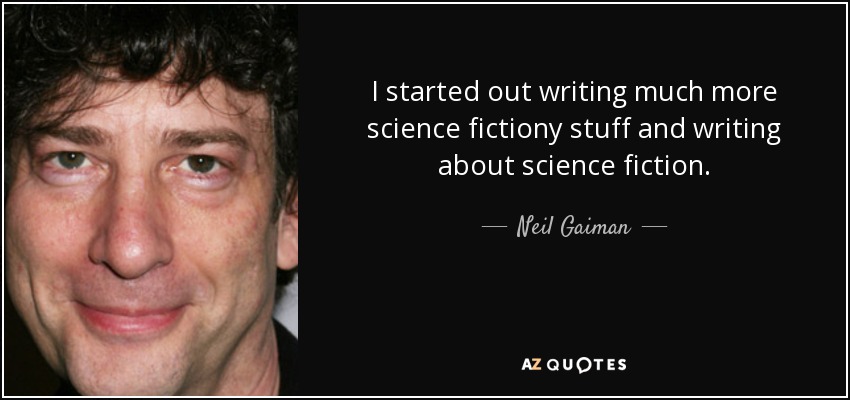
I started out writing much more science fictiony stuff and writing about science fiction.
A good writer should be able to write comedic work that made you laugh, and scary stuff that made you scared, and fantasy or science fiction that imbued you with a sense of wonder, and mainstream journalism that gave you clear and concise information in a way that you wanted it.
I'm frustrated with Hollywood and television and the movies because they see science fiction as an excuse for eye candy, for lots of great special effects.
My approach to 'Star Trek' was, 'I know science fiction, and I know screen writing.' That was very arrogant of me, but you really need to be a little bit arrogant to think that what you have to say is good enough to justify the expense of hundreds of thousands - now millions of dollars - to make an episode of the TV show.
I think the least important thing about science fiction for me is its predictive capacity.
A snappy label and a manifesto would have been two of the very last things on my own career want list. That label enabled mainstream science fiction to safely assimilate our dissident influence, such as it was. Cyberpunk could then be embraced and given prizes and patted on the head, and genre science fiction could continue unchanged.
I can't do fiction unless I visualize what's going on. When I began to write science fiction, one of the things I found lacking in it was visual specificity. It seemed there was a lot of lazy imagining, a lot of shorthand.
I think the least important thing about science fiction for me is its predictive capacity. Its record for being accurately predictive is really, really poor! If you look at the whole history of science fiction, what people have said is going to happen, what writers have said is going to happen, and what actually happened - it's terrible.
I loved literary science fiction. In fact, as a kid, when I was reading science fiction, I thought 'I can't wait for the future when the special effects are good' to represent what was in these books by Arthur C. Clarke, Alfred Bester, Philip K. Dick, J.G. Ballard, Jack Vance.
I've loved science fiction ever since I was a little kid, mainly from looking at the covers of science-fiction magazines and books, and I've read quite extensively as an adult.
The nice thing about 'Futurama' for me personally was that it was a way to honor some of the traditional ideas in literary science fiction, not so much movie or television science fiction - although we have that too, obviously. Our situation, a workplace comedy, led to all sorts of stuff.
We have 'Doctor Who' references on 'Futurama,' but we have a lot of science fiction references that I don't get; but in the staff we have experts on 'Star Trek,' 'Star Wars,' 'Doctor Who' and 'Dungeons and Dragons.'
I cannot say how strongly I object to people using other people's writing as research. Research is non-fiction, especially for horror, fantasy, science fiction. Do not take your research from other people's fiction. Just don't.
If I had unlimited funds, wall space and storage, I would collect a lot more things, like 'Planet of the Apes,' 'Star Wars,' science fiction stuff, autographs, and prop guns and weapons. I have to draw the line somewhere.
I did one sci-fi movie. I did 'Gattaca.' I liked 'Gattaca' because that was always the kind of science fiction I really dug, the non-action oriented sci-fi.
The once-science-fiction notion of hyper-connectivity - where we are all constantly connected to social networks and other bubbling streams of digital data - has rapidly become a widespread reality.
I really struggle to pinpoint whether I became a scientist because I like science fiction, or did I gravitate to science fiction because I identified strongly with scientists.
Science fiction is the only genre that enables African writers to envision a future from our African perspective.
Carver's best book yet! FROM A CHANGELING STAR combines deft characterization and fascinating extrapolation into a complex, compulsively readable thriller. I wish all science fiction novels could be this good.
The Place of No Shadows, in Isaac Asimovs Science Fiction Magazine (1990) In our Universe, matter is arranged in a hierarchy of structures by successive integrations.
I don't resent being identified with B science fiction movies at all -why should I? Even though they were not considered top of the line, for those people that like sci-fi, I guess they were fun. My whole feeling about working as an actor is, if I give anybody any enjoyment, I'm doing my job, and that's what counts.
I have to do more close research and fact checking for the science fiction. This is not however to say that writing good fantasy does not involve doing good research.
Does it strike you, Mr. Keller, that we live every day in the science fiction of our youth?
I worked out a book which I thought was just straight science fiction -- with everything pretty much explained, and suddenly I got an idea which I thought was kind of neat for working in a mythological angle. I'm really struggling with myself. It would probably be a better book if I include it, but on the other hand I don't always like to keep reverting to it. I think what I'm going to do is vary my output, do some straight science fiction and some straight fantasy that doesn't involve mythology, and composites.
Most of what I do is science fiction. Some of the things I do are fantasy. I don't like the labels, they're marketing tools, and I certainly don't worry about them when I'm writing. They are also inhibiting factors; you wind up not getting read by certain people, or not getting sold to certain people because they think they know what you write. You say science fiction and everybody thinks Star Wars or Star Trek.
Follow AzQuotes on Facebook, Twitter and Google+. Every day we present the best quotes! Improve yourself, find your inspiration, share with friends
or simply: