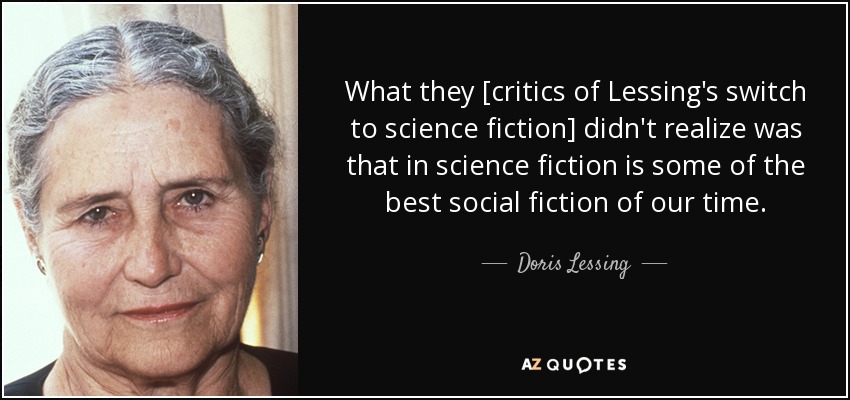
What they [critics of Lessing's switch to science fiction] didn't realize was that in science fiction is some of the best social fiction of our time.
We shall not read it for its sociological insights, which are non-existent, nor as science fiction, because it has a general air of implausibility; but there is one high poetic fancy in the New Atlantis that stays in the mind after all its fancies and inventions have been forgotten. In the New Atlantis, an island kingdom lying in very distant seas, the only commodity of external trade is light: Bacon's own special light, the light of understanding.
[on L. Ron Hubbard] I'm not in favor of his religion by any means. But he wrote a book called 'Battlefield Earth' that was a very fun science-fiction book.
Historically, I guess that's how science fiction works: you start by using aliens to think the unthinkable and then, eventually, another writer, having grown a little more comfortable with the earlier notion, brings it into the human.
Many of the early greats of sf Hugo Gernsback (publisher of Amazing Stories) in particular saw themselves as educators. The didactic thrust of science fiction got the genre initially pegged as children's fare. It was seen, at its best, as an extension of school and, at its worst, as teenage wish fulfillment.
To those who think that all this sounds like science fiction, we point out that yesterday's science fiction is today's fact. The Industrial Revolution has radically altered man's environment and way of life, and it is only to be expected that as technology is increasingly applied to the human body and mind, man himself will be altered as radically as his environment and way of life have been.
I see myself as a novelist, period. I mean, the material I work with is what is classified as science fiction and fantasy, and I really don't think about these things when I'm writing. I'm just thinking about telling a story and developing my characters.
I never think about genre when I work. I've written fantasy, science fiction, supernatural fiction, and am now working on a suspense novel. Genres are mostly useful as a marketing tool, and to help booksellers known where to shelve a book.
Literary science fiction is a very, very narrow band of the publishing business. I love science fiction in more of a pop-culture sense. And by the way, the line between science fiction and reality has blurred a lot in my life doing deep ocean expeditions and working on actual space projects and so on. So I tend to be more fascinated by the reality of the science-fiction world in which we live.
The rich survive and everyone else gets ready to work 2 1/2 to 3 1/2 jobs and what do you get? Blade Runner. Welcome to your science fiction. Your 21st century. I think that's where it goes. The rich get richer and everyone else... the middle class kind of starts dropping lower and lower.
My first obligation is to entertain but as far as science fiction goes, it's much easier to comment on today from another time because people then aren't focused on 'did you get the details right?' It's sort of a Trojan horse approach to ideas because it's wrapped in the future, it's wrapped in action, thriller.
My advice is to write about what you are interested in. If you read science fiction and fantasy, then write in that genre. If you read romance novels, then try writing one.
Neutrinos alone, among all the known particles, have ethereal properties that are striking and romantic enough both to have inspired a poem by John Updike and to have sent teams of scientists deep underground for 50 years to build huge science-fiction-like contraptions to unravel their mysteries.
We live in a science fiction universe. We have done for a long time.
As a youngster, I read of Buck Rogers and Flash Gordon. As a student, I wrote English reports on science fiction. And as a fighter pilot, I observed the selection of the Mercury astronauts. All this was fascinating, but I really didn't think I would ever be a part of it. It was only when my good friend Ed White was selected as a Gemini astronaut that I decided to join NASA as part of the Apollo program.
If my setting is new to a reader, or the concerns of the novel are new, I hope they will learn something about the world. I would like to say that they can trust that what they do learn in the novel will be accurate, because I pay a lot of attention to facts. I do a lot of research to make sure that I'm not giving them, you know, blue moons of Jupiter. It's not science fiction.
If we're talking about the science fiction or action genres, I've always tried when I could to do them in a way that's not just cookie-cutter - that they bring something fresh or original to it, have some kind of ideas to it. I've been fortunate, in some sense, to do those kinds of movies that are unique.
I don't write science fiction. I've only done one science fiction book and that's Fahrenheit 451, based on reality. Science fiction is a depiction of the real. Fantasy is a depiction of the unreal.
There's a lot of crap out there. Most of the science fiction films alone are abominations, you know. They're mindless. So you can't learn from those kinds of films.
Men read science fiction to build the future. Women don't need to read it. They are the future.
There are certain kinds of people who write science fiction. I think a lot of us married late. A lot of us are mama's boys. I lived at home until I was 27. But most of the writers I know in any field, especially science fiction, grew up late. They're so interested in doing what they do and in their science, they don't think about other things.
In my world of the people who study war and defense issues, we simply did not talk about robotics. We do not talk about it because it's seen as mere science fiction. It's cold, hard, metallic reality.
I don't think of myself as being particulary a subversive writer, but I like to think that my work could afford someone else, the extra degree of freedom that I found when I first found science fiction.
I read mostly science-fiction and fantasy when I was a teenager, and I was always drawn to stories where the characters had telepathic powers.
If you start looking at movies on a moral level - "I don't like that, that hurts, that's mean, that's bad" - then I don't even want to talk to you. Or like, someone that says "I don't like science-fiction movies," or "I don't want to sit through a Western," or "I don't like violence in movies," then I completely tune out.
Follow AzQuotes on Facebook, Twitter and Google+. Every day we present the best quotes! Improve yourself, find your inspiration, share with friends
or simply: