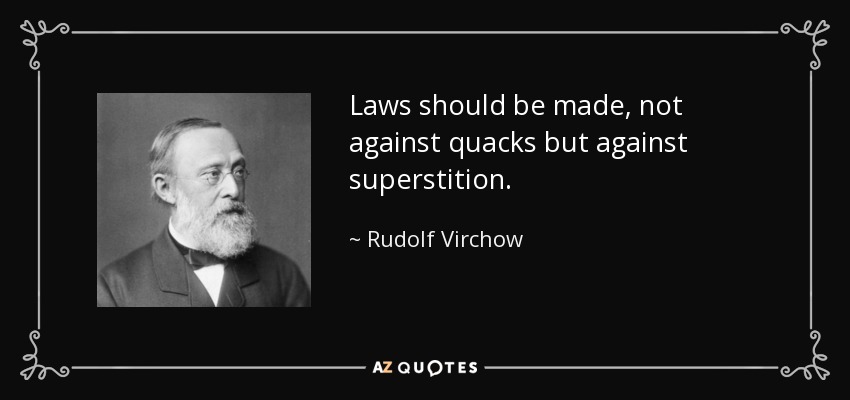
Laws should be made, not against quacks but against superstition.
Laws, written, if not on stone tables, yet on the azure of infinitude, in the inner heart of God's creation, certain as life, certain as death, are there, and thou shalt not disobey them.
My mind seems to have become a kind of machine for grinding general laws out of large collections of facts, but why this should have caused the atrophy of that part of the brain that alone on which the higher tastes depend, I cannot conceive. A man with a mind more highly organised or better constituted than mine would not, I suppose, have thus suffered, and if I had to live my life over again, I would have made a rule to read some poetry and listen to some music at least once every week; for perhaps the parts of my brain now atrophied would thus have been kept alive through use.
People are entirely too disbelieving of coincidence. They are far too ready to dismiss it and to build arcane structures of extremely rickety substance in order to avoid it. I, on the other hand, see coincidence everywhere as an inevitable consequence of the laws of probability, according to which having no unusual coincidence is far more unusual than any coincidence could possibly be.
The beauty of physics lies in the extent which seemingly complex and unrelated phenomena can be explained and correlated through a high level of abstraction by a set of laws which are amazing in their simplicity.
The floating vapour is just as true an illustration of the law of gravity as the falling avalanche.
The law of conservation of energy tells us we can't get something for nothing, but we refuse to believe it.
The natural scientist is concerned with a particular kind of phenomena ... he has to confine himself to that which is reproducible ... I do not claim that the reproducible by itself is more important than the unique. But I do claim that the unique exceeds the treatment by scientific method. Indeed it is the aim of this method to find and test natural laws.
The supreme task of the physicist is to arrive at those universal elementary laws from which the cosmos can be built up by pure deduction. There is no logical path to these laws; only intuition, resting on sympathetic understanding of experience, can reach them.
Under what law each thing was created, and how necessary it is for it to continue under this, and how it cannot annul the strong rules that govern its lifetime.
Yet is it possible in terms of the motion of atoms to explain how men can invent an electric motor, or design and build a great cathedral? If such achievements represent anything more than the requirements of physical law, it means that science must investigate the additional controlling factors, whatever they may be, in order that the world of nature may be adequately understood.
The purpose of religion is not so much to get us into heaven, or to keep us out of hell, but to put a little bit of heaven into us, and take the hell out of us. This has always been the greatest responsibility of religion.
[The aim of science is] to explain what so far has taken to be an explicans, such as a law of nature. The task of empirical science constantly renews itself. We may go on forever, proceeding to explanations of a higher and higher universality.
I have seen the sea lashed into fury and tossed into spray, and its grandeur moves the soul of the dullest man; but I remember that it is not the billows, but the calm level of the sea from which all heights and depths are measured.
There is no instrument for measuring the pressure of the Ether, which is probably millions of times greater: it is altogether too uniform for direct apprehension. A deep-sea fish has probably no means of apprehending the existence of water, it is too uniformly immersed in it: and that is our condition in regard to the Ether.
This king [Sesostris] divided the land among all Egyptians so as to give each one a quadrangle of equal size and to draw from each his revenues, by imposing a tax to be levied yearly. But everyone from whose part the river tore anything away, had to go to him to notify what had happened; he then sent overseers who had to measure out how much the land had become smaller, in order that the owner might pay on what was left, in proportion to the entire tax imposed. In this way, it appears to me, geometry originated, which passed thence to Hellas.
We never really see time. We see only clocks. If you say this object moves, what you really mean is that this object is here when the hand of your clock is here, and so on. We say we measure time with clocks, but we see only the hands of the clocks, not time itself. And the hands of a clock are a physical variable like any other. So in a sense we cheat because what we really observe are physical variables as a function of other physical variables, but we represent that as if everything is evolving in time.
[In plotting earthquake measurements] the range between the largest and smallest magnitudes seemed unmanageably large. Dr. Beno Gutenberg then made the natural suggestion to plot the amplitudes logarithmically.
In fact a favourite problem of Tyndall is-Given the molecular forces in a mutton chop, deduce Hamlet or Faust therefrom. He is confident that the Physics of the Future will solve this easily.
The literature Nobel laureate of this year has said that an author can do anything as long as his readers believe him.A scientist cannot do anything that is not checked and rechecked by scientists of this network before it is accepted.
It gives me a deep comforting sense that Things seen are temporal and things unseen are eternal.
Scientists are peeping toms at the keyhole of eternity.
Which is the best religion? [...] The religion that brings you closest to God.
The conquering of self is truly greater than were one to conquer many worlds.
There are innumerable definitions of God because his manifestations are innumerable.
Follow AzQuotes on Facebook, Twitter and Google+. Every day we present the best quotes! Improve yourself, find your inspiration, share with friends
or simply: