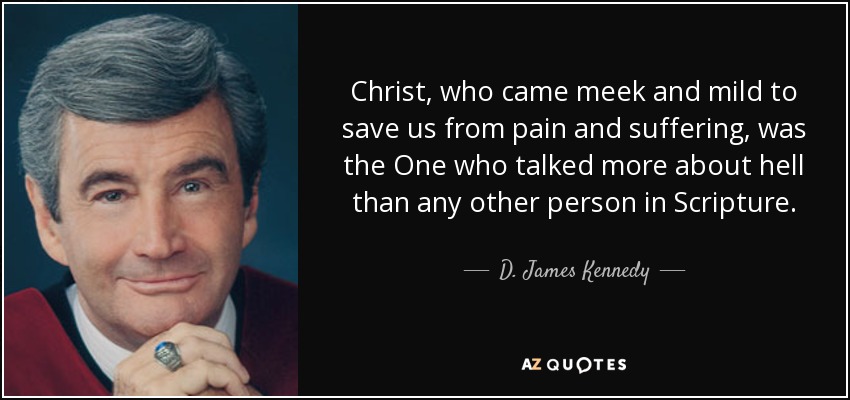
Christ, who came meek and mild to save us from pain and suffering, was the One who talked more about hell than any other person in Scripture.
Learning, pondering, searching, and memorizing scriptures is like filling a filing cabinet with friends, values, and truths that can be called upon anytime, anywhere in the world.
If we are perplexed by an apparent contradiction in Scripture, it is not allowable to say, 'The author of this book is mistaken'; but either the manuscript is faulty, or the translation is wrong, or you have not understood.
So, you want to be like Christ? Me too. But that kind of godliness won't just happen by hanging around a church or thinking lofty thoughts three or four times a day or learning a few verses of Scripture. It will take more - much more. Disciplining ourselves will require the same kind of focused thinking and living that our Master modeled during His brief life on earth.
It is scripture alone, not conservative Evangelical tradition or any other human authority, that must function as the normative authority for the definition of what we should believe. The authority of the scripture means that all the words in scripture are God's words in such a way that to disbelieve or disobey any word of scripture is to disbelieve or disobey God.
The fear of God does not come naturally to human beings; it must be learned through Scripture, worship, and the hard knocks of experience.
The Scriptures are shallow enough for a babe to come and drink without fear of drowning and deep enough for theologians to swim in without ever reaching the bottom.
The goal is not for us to get through the Scriptures. The goal is to get the Scriptures through us.
Truth is not obtained cheaply. It demands much time given to prayer and study of the Scriptures, followed by practical application in our daily lives. It must take priority over the many forms of cheap entertainment offered by our secular culture. It is a lifetime commitment.
Therefore 'Christ hath tasted death for every man:' not only for all kinds of men, as some vainly talk, but for every one, of all kinds; the benefit of whose offering is not only extended to such, who have the distinct outward knowledge of his death and sufferings, as the same is declared in the scriptures, but even unto those who are necessarily excluded from the benefit of this knowledge by some inevitable accident.
Scripture doesn't speak of people who found God. Scripture speaks of people who walked with God.
Intellectual methods-study and reason-are essential to our progress toward eternal life, but they are not sufficient. They can prepare the way. They can get the mind ready to receive the Spirit. But what the scriptures call conversion-the change of mind and heart that gives us the direction and strength to move resolutely toward eternal life-comes only by the witness and power of the Holy Spirit.
Men talk of "the mistakes of Scripture." I thank God that I have never met with any. Mistakes of translation there may be, for translators are men. But mistakes of the original word there never can be, for the God who spoke it is infallible, and so is every word he speaks, and in that confidence we find delightful rest.
Scripture will ultimately suffice for a saving knowledge of God only when its certainty is founded upon the inward persuasion of the Holy Spirit. Indeed, these human testimonies which exist to confirm it will not be vain if, as secondary aids to our feebleness, they follow that chief and highest testimony. But those who wish to prove to unbelievers that Scripture is the Word of God are acting foolishly, for only by faith can this be known.
Unfortunately, 19th-century scientists were just as ready to jump to the conclusion that any guess about nature was an obvious fact, as were 17th-century sectarians to jump to the conclusion that any guess about Scripture was the obvious explanation . . . . and this clumsy collision of two very impatient forms of ignorance was known as the quarrel of Science and Religion.
Sacred scripture is of course the basic authority for everything; yet I sometimes run across ancient sayings or pagan writings - even the poets - so purely and reverently and admirably expressed that I can't help believing the author's hearts were moved by some divine power. And perhaps the spirit of Christ is more widespread than we understand, and the company of the saints includes many not on our calendar.
There are no songs comparable to the songs of Zion, no orations equal to those of the prophets, and no politics like those which the Scriptures teach.
Be constantly committed to prayer or to reading [Scripture]; by praying, you speak to God, in reading, God speaks to you.
Some sleep too much....Nowhere do the scriptures say, 'Thou shalt sleep eight hours.' Nor do they say, 'Retire early unless you happen to be a night person.' There must be an excellent reason for the injunction to retire and arise early. ...You will profit by this counsel if you heed it.
Harmony of period and melody of style have greater weight than is generally imagined in the judgment we pass upon writing and writers. As a proof of this, let us reflect what texts of scripture, what lines in poetry, or what periods we most remember and quote, either in verse or prose, and we shall find them to be only musical ones.
Contention in our families drives the Spirit of the Lord away. It also drives many of our family members away. Contention ranges from a hostile spoken word to worldwide conflicts. The scriptures tell us that "Only by pride cometh contention".
It is never on account of its formal nature as a psychic act that faith is conceived in Scripture to be saving. It is not, strictly speaking, even faith in Christ that saves, but Christ that saves through faith. The saving power resides exclusively, not in the act of faith or the attitude of faith or nature of faith, but in the object of faith.
Before all else, Protestantism is, in its very essence, an appeal from all other authority to the divine authority of Holy Scripture
Let the scriptures refresh you.
Your vision of your future will help you press forward. Take a few minutes to envision where you want to be in one year or two or five. Then take action to prepare yourselves. People don’t just run a marathon when they decide to do it. They must train daily, slowly building stamina and endurance to run the 26.2-mile distance. So it is with life. It is daily diligence with prayer and scripture study that will help you reach your goals. Your daily decisions will influence generations.
Follow AzQuotes on Facebook, Twitter and Google+. Every day we present the best quotes! Improve yourself, find your inspiration, share with friends
or simply: